
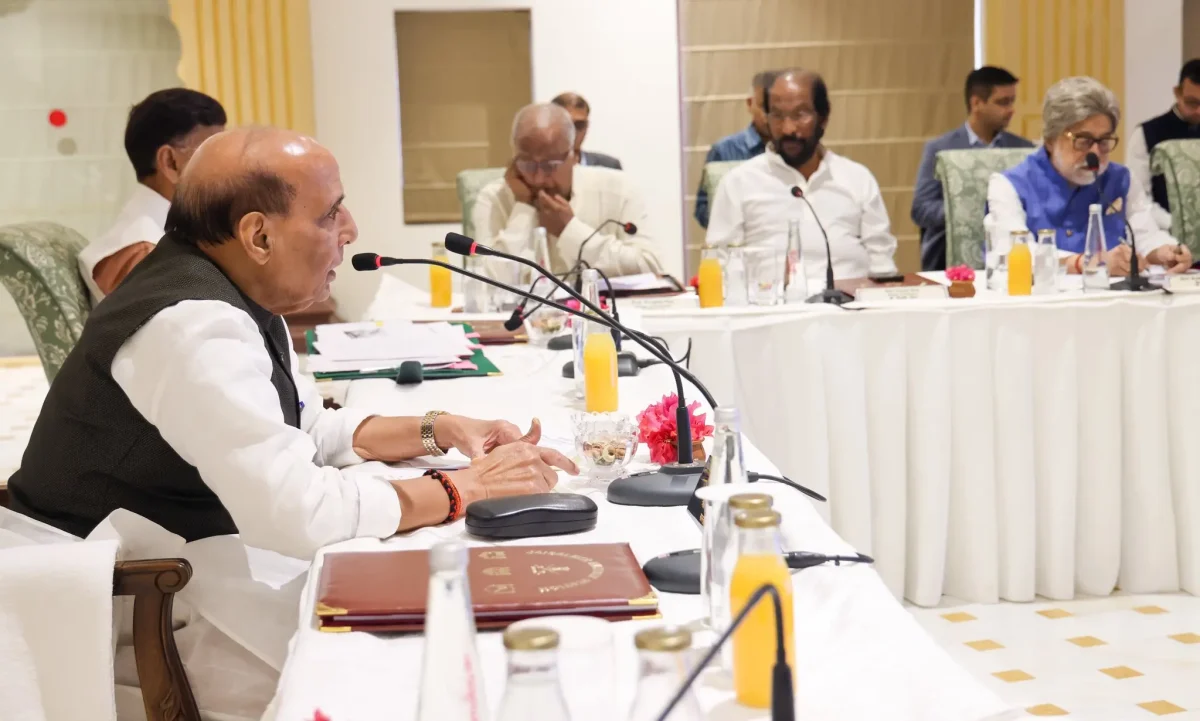
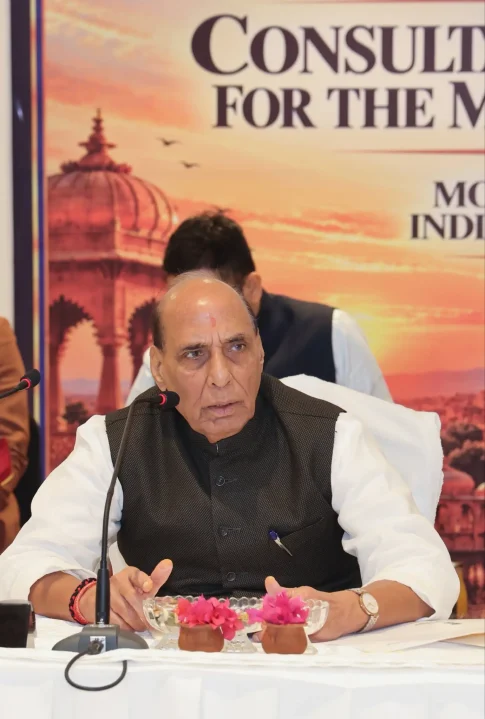
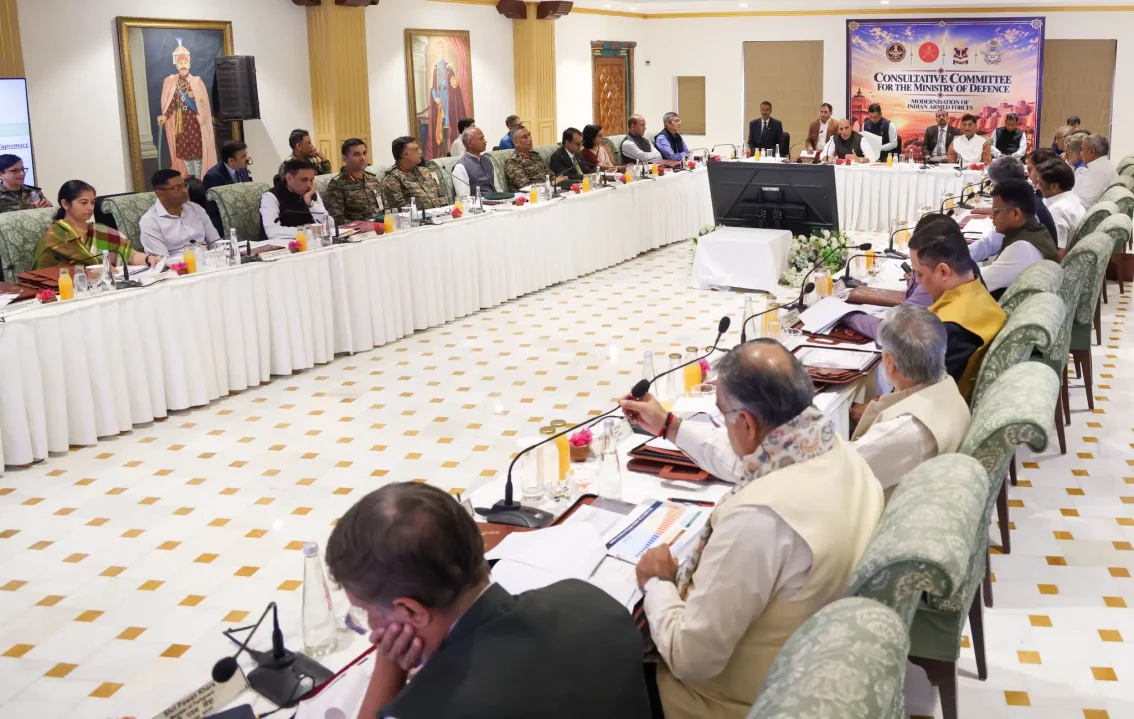
Defence Minister Rajnath Singh chaired a meeting of the Consultative Committee of the Ministry of Defence on ‘Modernisation of Indian Defence Forces’ in Jaisalmer, Rajasthan, on November 3, 2026. The meeting focused on emerging security challenges, changing warfare paradigms, technological advancements and the need to build a future-ready, technologically empowered and operationally agile military.





The deliberations covered six key areas: capability development and force modernisation, jointness and integration, indigenous defence manufacturing, emerging and disruptive technologies, defence research and innovation, and resource optimisation. The discussions emphasised accelerating the induction of next-generation platforms, weapon systems and technologies to enhance combat effectiveness and operational preparedness.
On capability development, the meeting highlighted the need to strengthen tri-service integration, joint operational planning and the coordinated application of military capabilities across multiple domains. It also underlined the importance of greater collaboration among the Defence Forces, Defence Research and Development Organisation (DRDO), Defence Public Sector Undertakings (DPSUs), private industry and academic institutions to accelerate the transition from research and innovation to operational capabilities.
Emerging technologies, including artificial intelligence, autonomous systems, unmanned platforms, cyber, space, electronic warfare and advanced communications, featured prominently in the discussions. The focus was on harnessing these technologies to prepare the Defence Forces for the changing character of future conflicts and increasingly complex operational environments.
Addressing the committee, Rajnath Singh stated that the government is committed to building a technologically empowered military capable of responding to present-day and emerging challenges. He outlined the government’s initiatives across three key dimensions: budget and capital acquisition with self-reliance, technology, and human capital.
Highlighting the financial support for military modernisation, the Defence Minister stated that the defence budget for the financial year 2026–27 had been increased to a record Rs 7.85 lakh crore. This includes a capital outlay of Rs 2.19 lakh crore earmarked for modernisation and capital procurement. He emphasised that adequate financial resources, effective utilisation of funds and prioritisation of critical requirements of the three Services were essential to strengthening military capabilities.
On the progress of indigenous defence manufacturing, Rajnath Singh noted that India’s defence production had increased from Rs 46,429 crore in FY 2014–15 to a record Rs 1.78 lakh crore in FY 2025–26. Defence exports, which stood at less than Rs 2,000 crore in 2014, had also grown to approximately Rs 40,000 crore.
Setting out the government’s future targets, he said, “We aim to achieve defence production worth Rs 3 lakh crore and defence exports worth Rs 50,000 crore by 2029.” He highlighted the importance of Make in India and Aatmanirbhar Bharat in strengthening the domestic defence industrial base and reducing dependence on foreign sources.
The Defence Minister also underlined the transformative role of technology in modern warfare. He highlighted DRDO’s initiatives in developing advanced weapons, missiles and systems, while noting that the government was providing a level playing field to private industry. The growing participation of enterprises ranging from MSMEs to large corporations, he said, reflected a whole-of-the-nation approach towards strengthening India’s defence capabilities.
Emphasising the importance of human capital, Rajnath Singh observed that military strength was determined not merely by technology and financial resources, but also by the capabilities, training and preparedness of personnel. He said that the rapidly changing nature of warfare required all three Services to continuously refine their structures and formations in accordance with evolving operational requirements.
In this context, he referred to the Indian Army’s new formations, including the Asani, Bhairav and Shaktiban platoons, stating that these were proving effective in addressing contemporary operational requirements and adapting to changing battlefield dynamics.
Rajnath Singh stressed that modernisation extended beyond the procurement of new weapons and equipment. It also involved improving operational preparedness, adopting advanced technologies and developing indigenous capabilities for the long term. He underlined that strategic autonomy and domestic technological capabilities were essential to safeguarding national security.
The meeting also discussed the need for sustained investment in research and development, greater participation of domestic industry, indigenous innovation and stronger coordination among stakeholders. Members of Parliament from both the Lok Sabha and Rajya Sabha offered suggestions and shared their perspectives, enriching the deliberations with legislative, strategic and national considerations.
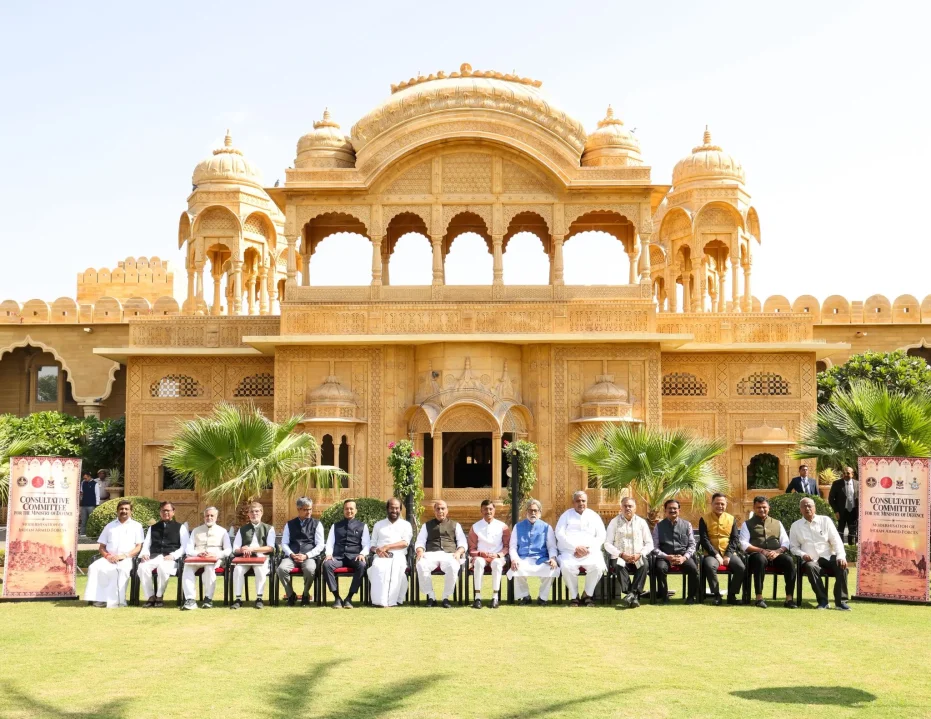
The discussions resulted in an emphasis on prioritising critical capabilities, streamlining acquisition and development processes, strengthening institutional coordination and periodically reviewing progress against defined objectives. The committee also stressed the importance of a structured and phased approach to ensure that modernisation initiatives translate into tangible operational outcomes.
The broader objective, as highlighted during the meeting, is to develop a military capable of responding effectively to conventional, sub-conventional and multi-domain security challenges while maintaining technological superiority, operational agility and self-reliance.
Raksha Rajya Mantri Sanjay Seth, Defence Secretary Rajesh Kumar Singh, Secretary (Defence Production) Sanjeev Kumar, Secretary (Ex-servicemen Welfare) Sukriti Likhi, Secretary (Defence Finance) Vishvajit Sahay and other senior civil and military officials attended the meeting.