

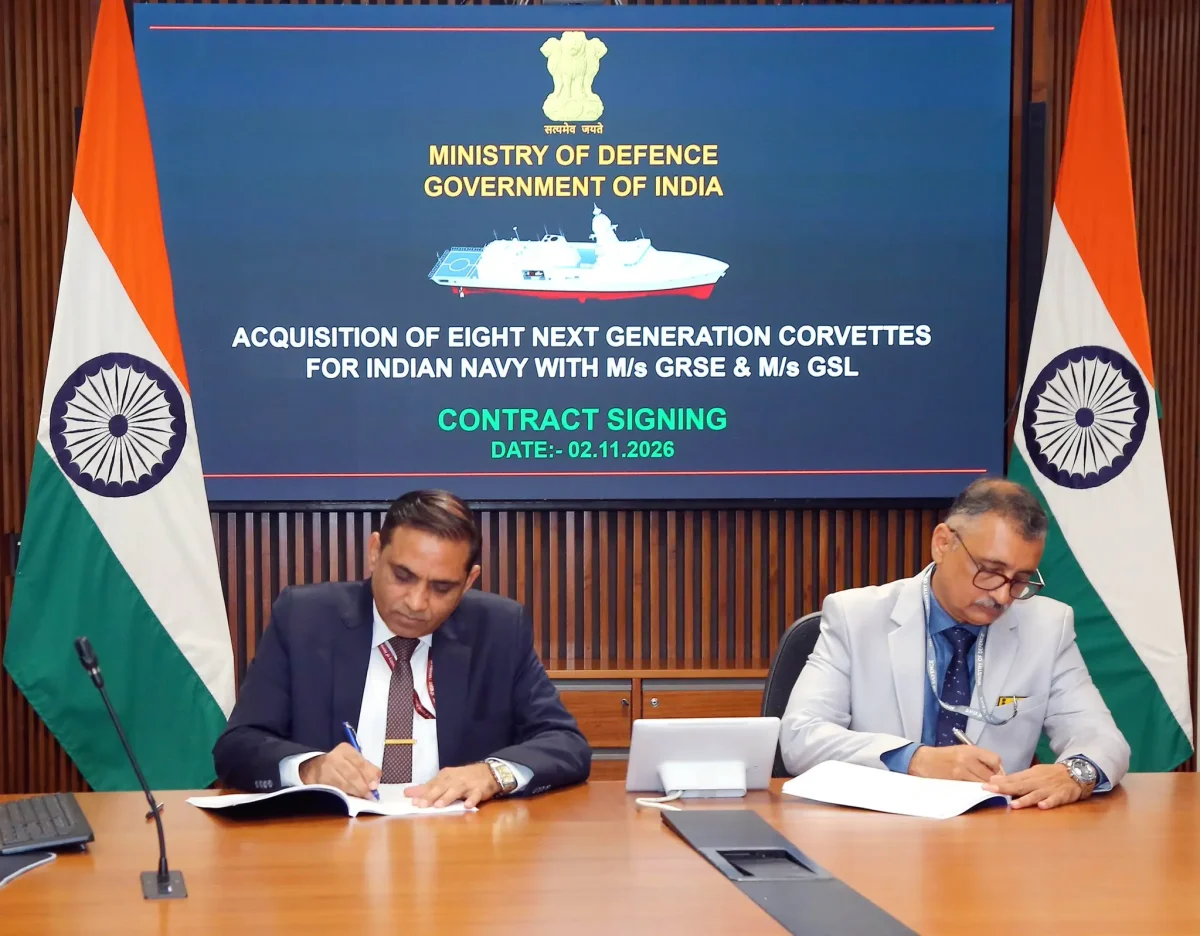
The Ministry of Defence on Monday, November 2, 2026, signed contracts worth Rs 53,866.50 crore with Garden Reach Shipbuilders & Engineers Limited (GRSE) and Goa Shipyard Limited (GSL) for the construction of eight Next Generation Corvettes (NGCs) for the Indian Navy. Under the agreement, GRSE will build five corvettes, while GSL will construct the remaining three.





The project marks a significant milestone in India’s indigenous warship design and construction capabilities. According to the Ministry of Defence, it is the first project in which the ships will be indigenously designed by the Indian Navy and constructed by Defence Public Sector Undertakings (DPSUs) selected through a competitive process.
The Next Generation Corvettes will be equipped with advanced missiles, weapons and sensor suites, providing them with capabilities to undertake missions across the air, surface and sub-surface domains. Their induction is expected to strengthen the Indian Navy’s ability to safeguard maritime trade routes, conduct anti-surface and anti-submarine warfare operations, reinforce coastal defence and undertake littoral combat missions.
The warships will also support maritime presence and surveillance operations, enhancing the Navy’s ability to monitor areas of strategic importance and respond to emerging maritime security requirements. Their multi-domain capabilities are intended to provide operational flexibility across different maritime environments.
The programme is also expected to provide a substantial boost to India’s domestic shipbuilding ecosystem by strengthening cooperation between defence public sector shipyards, private shipyards, Indian industrial partners and Micro, Small and Medium Enterprises (MSMEs).
Over the next ten years, construction of the eight corvettes is expected to generate approximately 72 lakh person-days of employment in the shipyards and another 460 lakh person-days in ancillary industries and MSMEs. The project is therefore expected to create a significant employment opportunity while supporting the growth of domestic manufacturing and industrial capabilities.
The Ministry of Defence stated that the programme would promote the use of Made-in-India materials and equipment, indigenous technologies and Indian skills and expertise. It described the project as an important step towards achieving Aatmanirbharta in defence manufacturing and advancing the government’s Make in India initiative.
With the Navy undertaking the indigenous design and DPSUs carrying out construction through a competitive selection process, the project represents an important development in India’s approach to warship acquisition. The programme is aimed at strengthening domestic design and manufacturing capabilities while enhancing the Indian Navy’s ability to undertake a broad range of maritime security operations.