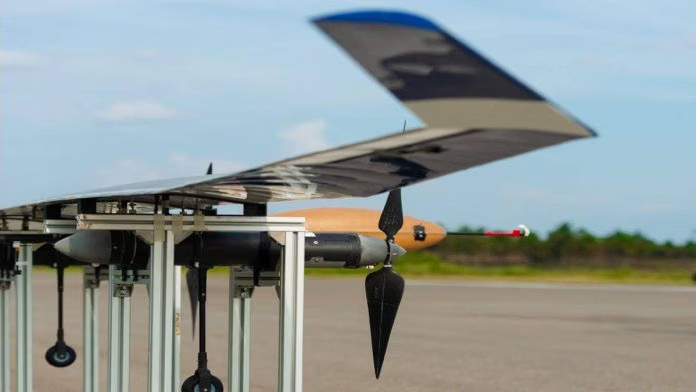
In a major boost to India’s unmanned and indigenous defence capabilities, the Indian Army has placed a ₹168 crore order for a fully electric, solar-powered unmanned aerial vehicle (UAV) designed for long-endurance border surveillance. The system, known as the Medium Altitude Persistent Surveillance System (MAPSS), has been developed by Bengaluru-based startup NewSpace Research & Technologies (NRT) under the Ministry of Defence’s Innovations for Defence Excellence (iDEX) programme.





This marks the first induction of solar-powered surveillance UAVs by the Indian armed forces, moving beyond conventional battery-powered and tethered drones currently in service.
Persistent Surveillance with Solar Power
MAPSS is engineered for medium-altitude, long-endurance missions, enabling continuous intelligence, surveillance and reconnaissance (ISR) across India’s vast and diverse borders—from the Himalayan high altitudes to the deserts of Rajasthan. Its solar-electric propulsion allows the UAV to remain airborne for extended durations without frequent landings or refuelling, significantly reducing logistical demands in remote areas.
According to defence sources, the platform will support:
- Persistent ISR and border monitoring
- Electronic intelligence (ELINT) missions
- Communication relay in connectivity-denied zones
- Artillery spotting and battlefield overwatch
Low acoustic and thermal signatures from electric propulsion also make the system harder to detect.
Built on Indigenous R&D under iDEX
The MAPSS programme evolved from NRT’s solar-powered High Altitude Pseudo Satellite (HAPS) research, which has already achieved national endurance records. Test flights conducted at the Aeronautical Test Range in Chitradurga demonstrated flights exceeding 24–27 hours at altitudes above 26,000 feet, even under low-sunlight conditions.
Adapted from these high-altitude trials, MAPSS has now been optimised for medium-altitude operational use after successful demonstrations in Army deployment areas.
Growing Drone Push After Operation Sindoor
The procurement reflects the Army’s accelerating shift toward unmanned warfare following Operation Sindoor. Since then, the Army has inducted loitering munitions, kamikaze drones and surveillance UAVs worth over ₹5,000 crore from Indian firms. Additional approvals of nearly ₹3,000 crore for drone acquisitions were granted by the Defence Acquisition Council in late 2025, with a much larger ₹20,000 crore fast-track drone procurement expected in 2026.
Strategic Significance
Defence officials say MAPSS will complement existing medium-altitude long-endurance (MALE) UAVs by providing networked ISR at forward formations, enhancing situational awareness without escalating to manned or high-signature platforms.
The induction also highlights the growing role of Indian startups in defence modernisation, with iDEX acting as a key bridge between innovation and operational deployment.
As the global UAV market expands rapidly, India’s adoption of solar-powered, persistent surveillance drones signals a decisive move toward technology-driven, sustainable and autonomous military operations, strengthening border security while reinforcing the push for Atmanirbhar Bharat in defence.