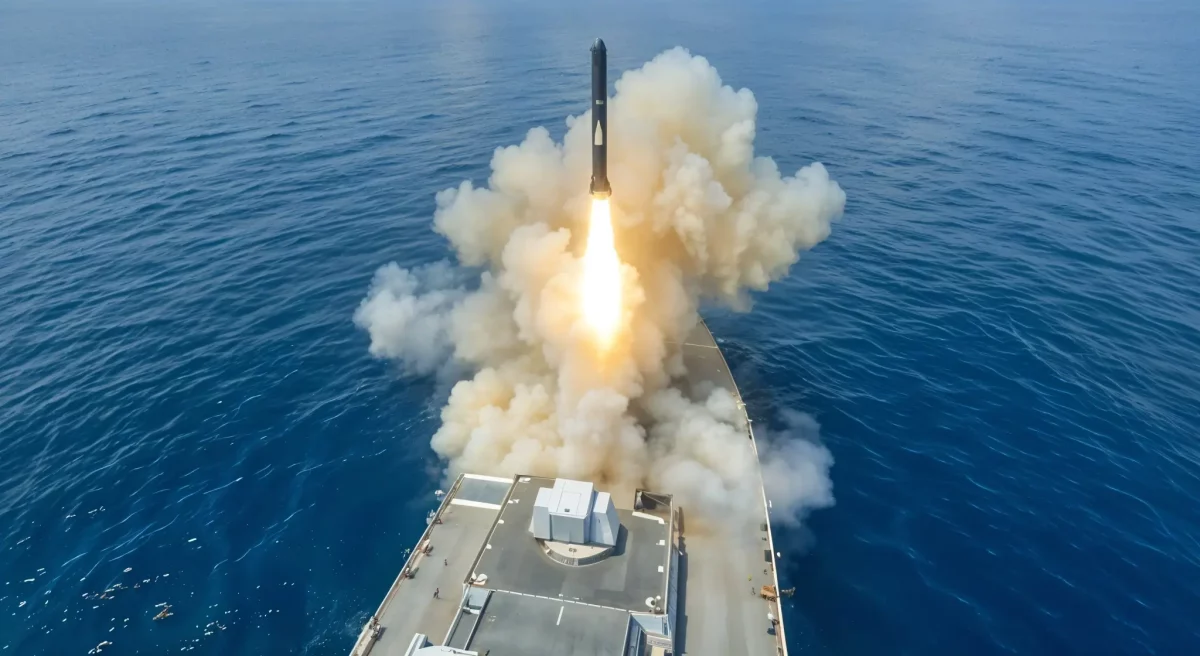
The recent U.S.-led Operation Epic Fury, commencing on February 28, 2026, has introduced a novel variant in precision-guided munitions: a dark-colored Tomahawk cruise missile observed for the first time in operational use. This development, captured in official U.S. Navy imagery, marks a significant evolution in the Tomahawk Land-Attack Missile (TLAM) family, potentially enhancing stealth capabilities amid escalating conflicts with Iran. As part of coordinated strikes alongside Israeli forces under Operation Roaring Lion, the missile’s appearance has prompted expert analysis on its design implications for modern warfare. This article examines the sighting, technical features, and strategic ramifications of this “Black Tomahawk” as a defense innovation deployed against Iranian targets.





Background on the Tomahawk Missile System
The Tomahawk cruise missile, designated RGM-109 for surface-launched variants, represents a cornerstone of U.S. naval strike capabilities since its introduction in the 1980s. Manufactured by RTX Corporation (formerly Raytheon), it operates at subsonic speeds of approximately 885 kilometers per hour, with ranges extending up to 2,500 kilometers in advanced Block V configurations. Traditionally painted in haze gray to match naval vessels, the missile employs terrain contour matching (TERCOM), digital scene matching area correlator (DSMAC), and GPS for precision navigation, enabling strikes on fixed and relocatable targets.
Evolutions in the Tomahawk lineup include the Block V series, subdivided into Block Va (Maritime Strike Tomahawk, or MST) for anti-ship roles and Block Vb for enhanced land-attack payloads. These upgrades incorporate multi-mode seekers, two-way data links for in-flight retargeting, and reduced radar cross-sections through design modifications such as chined nose cones. In Operation Epic Fury, Tomahawks were launched from Arleigh Burke-class destroyers and submarines in the Persian Gulf and Arabian Sea, targeting Iranian nuclear facilities, air defenses, and command structures.
The Sighting in Operation Epic Fury
During the initial phases of Operation Epic Fury, U.S. Central Command released photographs and videos depicting missile launches from naval platforms. Among these, one image prominently features a glossy black Tomahawk emerging from a destroyer’s vertical launch system, diverging markedly from the standard gray scheme observed on accompanying missiles. The dark coating covers the missile’s body, with a small v-shaped gray section at the air inlet, which retracts post-launch.
This variant was identified in strikes aimed at suppressing Iranian air defenses and maritime assets, potentially including naval bases near the Strait of Hormuz. Open-source intelligence and media reports confirm the missile’s deployment in the operation’s opening salvos, where hundreds of munitions were expended in the first 12 hours. The black coloration, previously unseen in public imagery, aligns with unclassified briefings on MST enhancements, suggesting this is the first combat appearance of a stealth-optimized Tomahawk.
Technical Analysis of the Dark-Colored Variant
Expert assessments indicate that the glossy black finish serves as a low-observable coating, incorporating radar-absorbent materials (RAM) and infrared-suppressive properties to minimize detection. This design mirrors the AGM-158C Long-Range Anti-Ship Missile (LRASM), which employs a similar dark exterior for reduced visibility over water and against advanced radar systems. For the MST, such enhancements improve survivability in contested maritime environments, where adversaries like Iran deploy integrated air and missile defenses.
Key technical features include:
- Guidance Upgrades: A multi-mode seeker with imaging infrared capabilities, enabling autonomous target acquisition and discrimination, particularly against moving ships.
- Stealth Modifications: Forward-swept wings in some observed examples may further reduce radar cross-section, though speculation exists that certain visuals depict Israeli Popeye Turbo missiles rather than Tomahawks.
- Operational Range and Speed: Maintaining the Block V’s extended range, the variant supports standoff strikes from beyond 1,000 kilometers, crucial for evading Iranian surface-to-air systems.
The coating’s glossy nature likely optimizes performance against sea-skimming profiles, where traditional gray paint could reflect radar or visual signatures more prominently. This represents a maturation of U.S. Navy efforts to adapt legacy systems for peer-level conflicts.
Strategic Implications
The introduction of the Black Tomahawk in Operation Epic Fury underscores a shift toward enhanced stealth in cruise missile operations, providing U.S. forces with greater penetration capabilities against fortified targets. In the Iranian theater, this variant likely contributed to the suppression of radar networks, enabling follow-on strikes by crewed aircraft and drones. Broader implications include deterrence against maritime threats, such as Iran’s naval forces in the Persian Gulf, and a demonstration of rapid technological adaptation in ongoing conflicts.
From a defense perspective, this development may prompt adversaries to invest in counter-stealth technologies, altering the balance of power in regional hotspots. It also highlights the U.S. Navy’s reliance on versatile, upgradable platforms like the Tomahawk to maintain operational superiority without necessitating entirely new systems.
Conclusion
The emergence of the dark-colored Tomahawk during strikes on Iran signifies a pivotal advancement in missile technology, blending legacy reliability with modern stealth attributes. As Operation Epic Fury progresses, further observations may reveal additional details on its performance and proliferation. This innovation reaffirms the strategic value of precision munitions in high-intensity environments, ensuring U.S. and allied forces can execute missions with minimized risk and maximized effectiveness.