

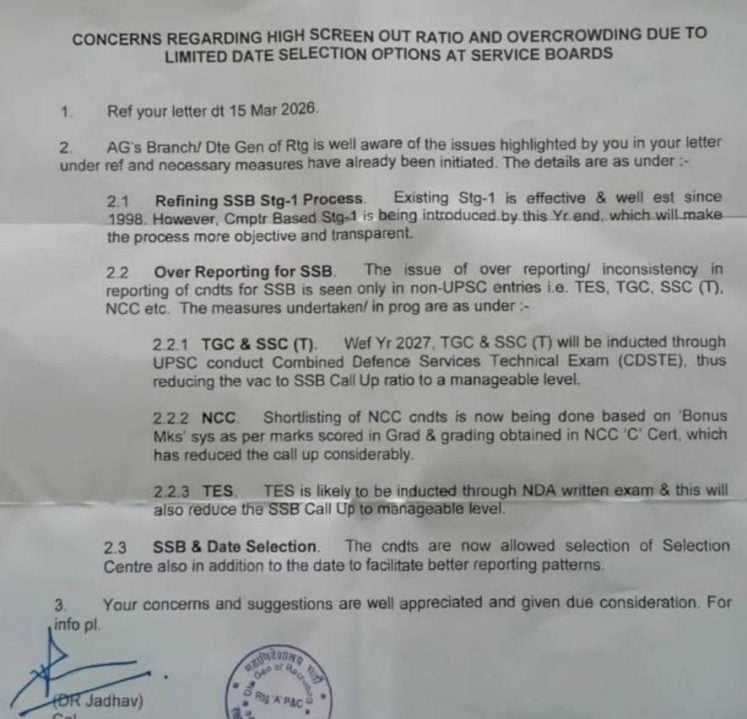
The Indian Army has announced key reforms in the Services Selection Board (SSB) process, including the introduction of a computer-based Stage-1 screening test by the end of 2026, aimed at reducing high screening-out rates and overcrowding.





Shift to Computer-Based Screening
The current Stage-1 screening system, in place since 1998, will be upgraded to a computer-based format, making the process more:
- Objective
- Transparent
- Efficient
Steps to Reduce Candidate Overload
The Army noted that excessive reporting at SSB centres is mainly seen in non-UPSC entries such as TES, TGC, SSC (Tech), and NCC. To address this:
- TGC & SSC (Tech):
From 2027, these entries will be routed through a proposed Combined Defence Services Technical Examination (CDSTE) conducted by UPSC, reducing the SSB call-up ratio. - NCC Entry:
Candidates are now shortlisted based on graduation marks and NCC ‘C’ certificate grading using a bonus marks system, significantly lowering the number of candidates called. - TES Entry:
Plans are underway to integrate TES through the NDA written examination, which will streamline the selection pipeline.
Improved Date and Centre Selection
Candidates will now have the flexibility to choose both:
- SSB reporting dates
- Selection centres
This is expected to distribute candidate load more evenly across centres.
Towards a More Transparent System
These reforms aim to:
- Reduce overcrowding at SSB centres
- Improve candidate experience
- Enhance fairness and efficiency in selection
Modernising Military Recruitment
The initiative reflects the Indian Army’s focus on modernising recruitment processes and ensuring a more streamlined and candidate-friendly system.