
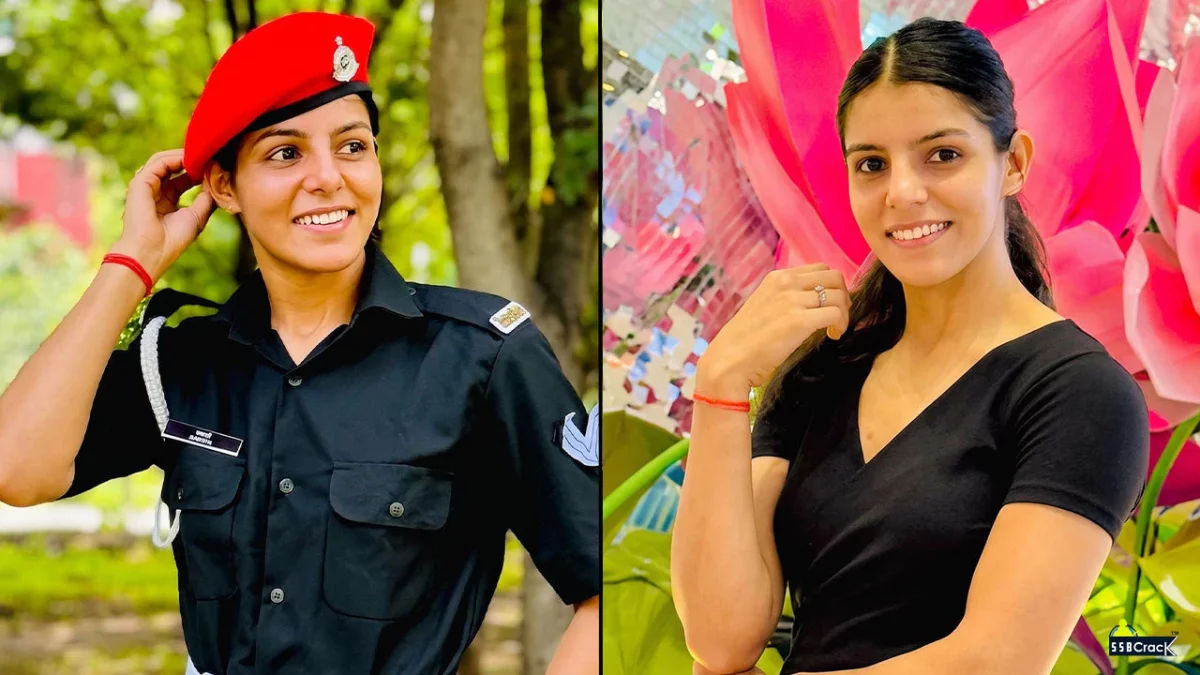
Havildar Sakshi Ghanghas Chaudhary has emerged as one of the most talked-about names in Indian boxing after producing a stunning performance at the national selection trials in Patiala in May 2026. Competing in the women’s 51 kg category, the Indian Army boxer defeated two of India’s biggest boxing names on her way to securing a place in the national squad for the upcoming Commonwealth Games in Glasgow and the Asian Games in Aichi-Nagoya, Japan.





In the semifinals, Sakshi defeated two-time world champion Nikhat Zareen by a 4-1 split decision. She followed it up with an even more dominant performance in the final, where she blanked reigning world and Asian champion Minakshi Hooda 5-0. The victories were not just important results in a selection trial; they marked a major statement from a boxer who has spent years building her career through discipline, setbacks, reinvention and quiet determination.
Sakshi Chaudhary, a soldier-athlete serving as a Havildar in the Indian Army, comes from Dhanana village in Haryana’s Bhiwani district, a region widely known as one of India’s strongest boxing belts. At 25, she has already seen the highs and lows of international boxing, from world-level youth success to injury setbacks and difficult transitions at the senior level. Her latest triumph in Patiala has now placed her firmly among India’s leading women boxers.
Born on 9 September 2000 in Bhiwani, Sakshi grew up in an environment where boxing was not just a sport but a way of life. Haryana’s Bhiwani district has produced several prominent boxers, and the success of Olympic medallist Vijender Singh inspired many youngsters from the region to take up the sport. Sakshi was one of them.
Her father introduced her to boxing in 2012 after noticing her energetic and combative nature as a child. Instead of suppressing that fighting spirit, her parents decided to channel it in a positive direction. She began training at the Bhiwani Boxing Club under the guidance of Jagdish Singh Tarar, the respected coach who had also shaped Vijender Singh’s boxing journey.
Sakshi’s first major competitive exposure came at the school nationals in November 2014. Even before that, she had started making her presence felt in state-level events. She won a silver medal at the 7th Sub-Junior Haryana State Championships in 2012 and later followed it with gold medals in sub-junior and junior state competitions. These early results showed that she had the talent, temperament and hunger needed to go far in the sport.
Her rise through the junior and youth categories was rapid. Sakshi won gold at the 2015 AIBA World Junior Women’s Championships, announcing herself as one of India’s finest young boxing prospects. She then continued her dominance at the youth level by winning gold at the 2017 World Youth Championships in Guwahati and the 2018 World Youth Championships in Budapest, Hungary.
These achievements gave Sakshi a strong identity in Indian boxing circles. She was seen as a technically sharp boxer with excellent movement, good reach and a precise left hand. Her ability to control distance and dictate the rhythm of a bout made her a dangerous opponent from a young age.
However, the journey from junior and youth success to senior-level dominance is rarely simple. Many athletes who shine in age-group competitions face major challenges when they enter the senior circuit. Sakshi too had to go through that difficult phase. She competed in several senior international events, including the Asian Championships, Strandja Memorial and World Championships, but major senior medals and consistent selection for big multi-sport events remained difficult to secure.
A shoulder injury in 2022 added another hurdle to her journey. Injuries can break momentum, especially in a physically demanding sport like boxing. For Sakshi, it became another test of patience and resilience. Instead of allowing the setback to define her career, she rebuilt herself and returned with greater focus.
A major turning point came in December 2022 when Sakshi was recruited by the Indian Army under its Mission Olympic Programme. She was enlisted as Recruit Havildar Sakshi in the Corps of Military Police through the sports quota. The move gave her career a new structure and a stronger institutional foundation.
The Indian Army has played an important role in supporting several athletes across disciplines, and for Sakshi, military life brought discipline, stability and access to specialised training support. As a soldier-athlete, she had to balance the demands of uniformed service with the requirements of elite boxing. That combination strengthened her mentally and physically.
Her identity as an Army boxer also became an important part of her story. The discipline of the forces blended naturally with the discipline of the ring. Every bout demanded not only skill, but also composure, courage and tactical intelligence. These qualities would later become decisive in her biggest trial victories.
Sakshi’s younger brother also joined the Indian Army as an officer, adding another proud military connection to the family. For her, service and sport became deeply intertwined. She was no longer just fighting for medals; she was representing the Indian Army and the country together.
In 2025, Sakshi delivered one of the most important performances of her senior career by winning gold at the World Boxing Cup in Astana, Kazakhstan, in the 54 kg category. The victory was significant because it was India’s first gold by a woman at the competition. She defeated all her opponents by unanimous 5-0 decisions, showing complete control and tactical maturity.
That gold medal proved that Sakshi had successfully crossed the difficult bridge from youth success to senior credibility. It also gave her confidence at a crucial stage of her career. But the biggest twist was still ahead.
For nearly five years, Sakshi had competed primarily in the 54 kg category. Ahead of the May 2026 national selection trials in Patiala, she made the bold decision to drop to the 51 kg category. Moving down in weight is never easy for a boxer. It requires strict diet control, physical discipline and careful management of strength and energy. Sakshi reportedly followed a demanding diet routine, at times keeping carbohydrate intake extremely low to make weight.
Her decision proved to be a masterstroke. Entering the trials as a serious contender, she faced two of India’s most accomplished boxers. In the semifinal, she came up against Nikhat Zareen, a two-time world champion and one of the most respected names in Indian boxing. Nikhat is known for her sharp attacking style, fast combinations and ability to dominate close-range exchanges.
Sakshi approached the bout with a clear tactical plan. She used her reach, maintained distance and avoided allowing Nikhat to settle into her preferred rhythm. Her disciplined movement and controlled punching helped her edge the contest 4-1 by split decision. The result immediately became one of the biggest talking points of the trials.
But Sakshi did not stop there. In the final, she faced Minakshi Hooda, the reigning world and Asian champion. Minakshi had moved up from 48 kg and brought an aggressive counter-punching style into the contest. Sakshi again showed tactical maturity, using her reach and defensive discipline to control the bout. She won 5-0, completing a remarkable run through the trials.
With these wins, Sakshi secured qualification for the Commonwealth Games in Glasgow and the Asian Games in Aichi-Nagoya. For a boxer who had spent years waiting for a breakthrough at the senior level, the moment was deeply significant. It confirmed her place in India’s squad for two major international events and marked the beginning of a new chapter in her career.
What made the Patiala performance special was not only the quality of opponents she defeated, but also the manner in which she defeated them. Sakshi displayed calmness, clarity and control under pressure. She did not rely merely on aggression. She boxed with intelligence, patience and purpose.
Her mental transformation has also been an important part of her recent success. Sakshi has credited work with a psychologist for helping her become calmer inside the ring. Earlier, emotional reactions could affect her performance in high-pressure situations. Over time, she learned to manage pressure better and execute her plans with greater focus.
That maturity was visible in Patiala. Against champions who had experience, reputation and proven records, Sakshi remained composed. She fought each round with discipline and did not allow the moment to overwhelm her. It was a performance built not only on physical preparation, but also on mental strength.
Sakshi Chaudhary’s journey also reflects the growing role of women in Indian sport and the armed forces. As a Havildar in the Indian Army, she represents a powerful model of soldier-athlete excellence. Her story shows how institutional support, family belief, village-level talent and personal discipline can combine to create world-class performers.
For young girls in Haryana and across India, Sakshi’s rise is especially inspiring. She came from a village, trained through the hard boxing culture of Bhiwani, overcame injury and setbacks, joined the Army, reinvented herself at a new weight category and defeated some of the country’s biggest boxing stars.
Her story also highlights the importance of not giving up during the difficult transition years. Many athletes shine early but struggle when results slow down at the senior level. Sakshi’s career proves that persistence can change the story. A delayed breakthrough is still a breakthrough, and sometimes it becomes more powerful because of the years of struggle behind it.
Today, Sakshi stands at a crucial point in her career. With selection secured for the Commonwealth Games and Asian Games, her focus will now shift to preparation, conditioning and tactical refinement. She has already shown that she can defeat the best in India. The next challenge will be to replicate that sharpness on the international stage.
Her ambitions go beyond participation. After years of waiting for her moment, Sakshi will be aiming to turn selection into medals. Given her recent form, tactical discipline and growing confidence, she will be watched closely by Indian boxing followers.
Havildar Sakshi Chaudhary’s journey is a story of courage, patience and reinvention. From Dhanana village to the boxing nurseries of Bhiwani, from junior world titles to Army discipline, from injury setbacks to a stunning senior comeback, she has built her career one fight at a time.
By defeating Nikhat Zareen and Minakshi Hooda in the same trials, she delivered a performance that will be remembered in Indian boxing circles for a long time. More importantly, she proved that reputations do not win bouts; preparation, strategy and belief do.
The Indian Army boxer has already sent a strong message from inside the ring. She is no longer just a promising name from the past or a youth champion waiting for a senior breakthrough. She is now a serious contender on the big stage, ready to carry India’s hopes at the Commonwealth Games and Asian Games.
For Havildar Sakshi Chaudhary, the gloves are on, the mission is clear, and the next chapter could be her biggest yet.