
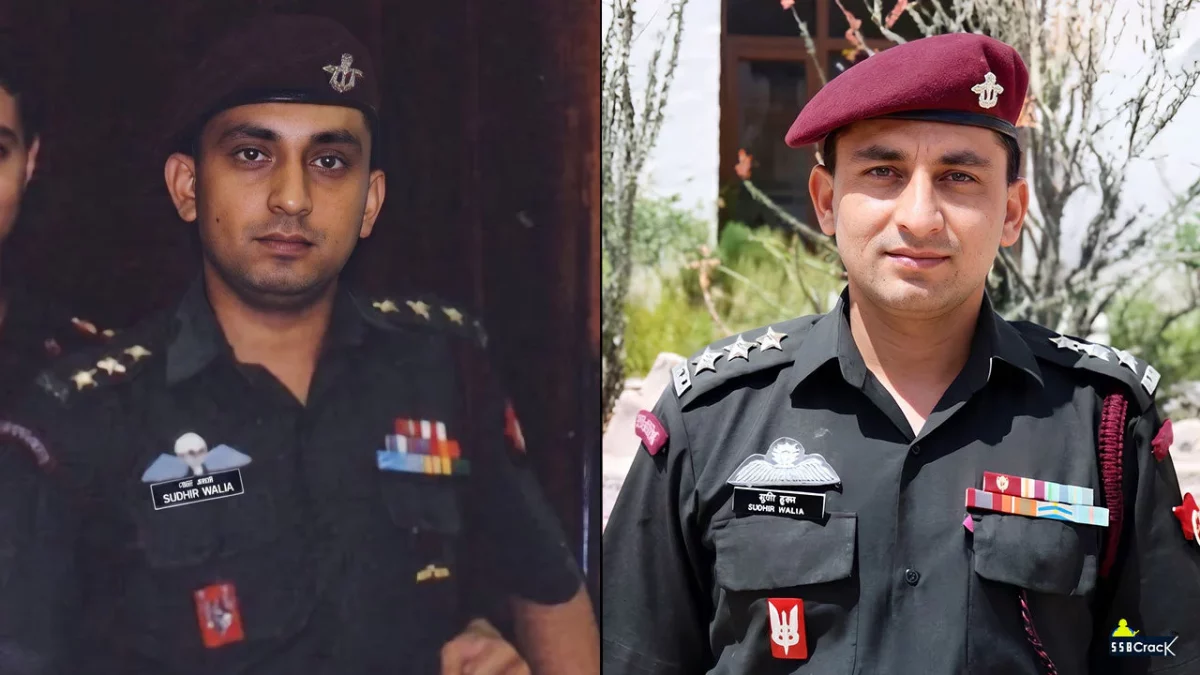
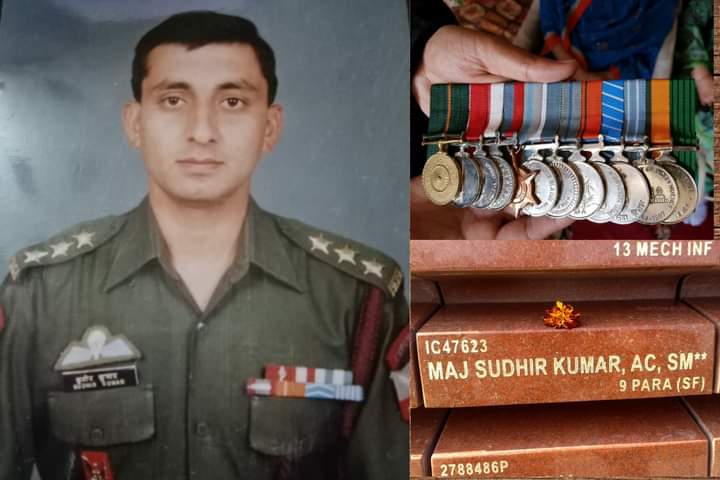
Major Sudhir Kumar Walia, AC, SM & Bar, ADC, is remembered as one of the bravest Special Forces officers of the Indian Army. A soldier of rare courage, exceptional physical strength, and remarkable battlefield presence, he earned the nickname “Rambo of the Indian Army” from his comrades for his fearless conduct in the most dangerous operations.
On 29 August 1999, Major Walia made the supreme sacrifice during a counter-insurgency operation in the Haphruda forest of Kupwara district in Jammu and Kashmir. Even after suffering multiple bullet injuries, he continued to command his troops over the radio and ensured that the terrorists were prevented from escaping. For this extraordinary act of gallantry, he was posthumously awarded the Ashoka Chakra, India’s highest peacetime gallantry award.
Early Life and Family Background
Sudhir Kumar Walia was born on 24 May 1968 at the Military Hospital in Jodhpur, Rajasthan. His father, Subedar Major Rulia Ram Walia, was serving in the Indian Army at the time. The family belonged to Banuri village in Palampur tehsil of Kangra district, Himachal Pradesh.
Born into a military family, Sudhir grew up in an atmosphere shaped by discipline, courage, and service to the nation. His father’s Army career had a deep influence on him, and from a young age, he developed a strong desire to follow the path of the uniform.
He began his schooling at the Government School in Banuri and later joined Sainik School, Sujanpur Tihra. The environment of Sainik School further strengthened his character and prepared him for a future in the armed forces. In 1984, at the age of 16, he joined the National Defence Academy at Khadakwasla as part of the 72nd Course.
After completing his training at NDA, he moved to the Indian Military Academy, Dehradun. On 11 June 1988, he was commissioned as a Second Lieutenant into the 4th Battalion of the Jat Regiment.
From Jat Regiment to Special Forces
Soon after commissioning, Lieutenant Walia served with the Indian Peace Keeping Force in Sri Lanka. This deployment exposed him to the realities of combat, jungle warfare, and counter-insurgency operations. During this period, he closely observed the professionalism and daring nature of 9 Para Special Forces.
Inspired by the elite soldiers of 9 Para SF, he volunteered for the Parachute Regiment Special Forces. His request was accepted, and he was posted to 9 Para SF, one of the Indian Army’s most respected and battle-hardened Special Forces units.
Major Walia went on to undergo some of the toughest military training courses. These included the Commando Course at Belgaum, Counter-Insurgency and Jungle Warfare training at Vairengte, parachute training, and mountain warfare training at Gulmarg. He also served two difficult tenures at the Siachen Glacier, the world’s highest battlefield.
His career was marked by constant exposure to extreme conditions, high-risk operations, and physically demanding assignments. These experiences helped shape him into one of the most capable Special Forces officers of his time.
Training Abroad and Recognition
In 1997, Major Walia was selected for an advanced specialised military course in the United States. He performed exceptionally well and secured the top position among international participants. His performance earned him admiration from foreign course-mates, who reportedly referred to him respectfully as “Colonel.”
He was also invited to speak at the Pentagon, a rare honour that reflected the respect he had earned through his professionalism, leadership, and military competence. This overseas exposure further sharpened his tactical understanding and added to his already impressive operational experience.
Service as ADC to the Army Chief
From 1997, Major Sudhir Kumar Walia served as Aide-de-Camp to General Ved Prakash Malik, the Chief of the Army Staff. It was a prestigious appointment that placed him close to the highest levels of the Indian Army’s leadership.
However, Major Walia was a field soldier at heart. When the Kargil War broke out in 1999, he requested permission to return to his unit and take part in the operations. General Malik accepted his request, and Major Walia rejoined 9 Para SF in the Mushkoh Valley sector.
Role in the Kargil War
During Operation Vijay, Major Walia led his team in the capture of Zulu Top, a strategically important feature located at an altitude of around 17,000 feet. Despite limited time for acclimatisation, he accepted the challenge with confidence and determination.
His actions during the Kargil War reflected his spirit as a leader who always preferred to be with his men in battle. The war officially ended on 26 July 1999, but Major Walia’s operational duties continued in Jammu and Kashmir’s counter-insurgency grid.
Gallantry Awards Before His Final Mission
Major Walia had already built a distinguished record of bravery before his final operation. In July 1993, during an operation in Kandi village in Rajouri district, he displayed exceptional courage by neutralising three hardcore terrorists. For this act of gallantry, he was awarded the Sena Medal on 26 January 1994.
He later received a Bar to the Sena Medal for his role in an armed fighting expedition to Peak Brammah II in the Kishtwar region of Jammu and Kashmir. The mission was conducted in extremely challenging terrain and harsh weather conditions, further proving his physical courage and operational skill.
These honours established him as one of the most decorated young officers in the Special Forces.
The Final Operation in Haphruda Forest
On 29 August 1999, Major Sudhir Kumar Walia led a five-man team of 9 Para SF into the dense Haphruda forest in Kupwara district. The team was tasked with locating and eliminating a group of heavily armed terrorists hiding in the area.
At around 8:30 in the morning, Major Walia and his buddy moved uphill towards a knoll. From there, they spotted two armed terrorists at very close range and also identified a hideout below, where a larger group of terrorists was present.
Without wasting a moment, Major Walia opened fire and killed one terrorist immediately. When another tried to run towards the hideout, he charged forward with complete disregard for his own safety. As the terrorists rushed out, he engaged them at close range.
During the fierce encounter, Major Walia eliminated four terrorists. However, he was hit by multiple bullets in the face, chest, and arm. Despite his critical injuries, he did not stop commanding the operation.
For nearly 35 minutes, he continued to guide his troops and nearby checkpoints over the radio. He instructed them to hold their positions and block the escape routes of the remaining terrorists. His calm leadership under extreme pain ensured that the mission continued effectively.
Only after the firing had stopped did he allow his men to evacuate him. He succumbed to his injuries while being airlifted to an Army hospital. Even in his final moments, he remained focused on the mission and the safety of his comrades.
Ashoka Chakra for Supreme Sacrifice
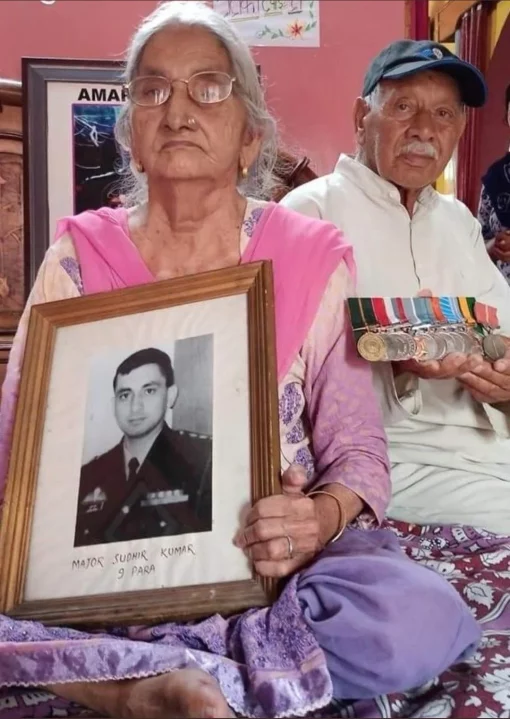
Major Sudhir Kumar Walia was posthumously awarded the Ashoka Chakra on 26 January 2000. The award recognised his outstanding bravery, inspiring leadership, and supreme sacrifice in the highest traditions of the Indian Army.
His father, Subedar Major Rulia Ram Walia, received the award from President K. R. Narayanan during the Republic Day ceremony in New Delhi. It was a proud yet deeply emotional moment for the family of a soldier who had given everything for the nation.
The Man Behind the Legend
Major Walia was remembered by his fellow soldiers as a tough, fearless, and deeply committed officer. His nickname “Rambo” was not merely a label; it reflected the way he operated in the field. He had the ability to remain calm in the most dangerous situations and inspire confidence among his men.
He was known for volunteering for difficult missions, leading from the front, and never asking his men to do anything he would not do himself. His leadership style was based on personal example, courage, and complete dedication to duty.
Those who served with him remembered his dry humour, quiet confidence, and remarkable ability to make even the hardest missions seem possible.
Legacy of Major Sudhir Kumar Walia
More than two decades after his martyrdom, Major Sudhir Kumar Walia continues to inspire soldiers, officers, defence aspirants, and citizens across India. A government senior secondary school in Kangra district has been named in his honour. His statue stands in Palampur, and a memorial square near his family home in Banuri keeps his memory alive.
His life and service have also been recorded in books such as Rambo by Colonel Ashutosh Kale and Coomar: The Story of Major Sudhir Walia, AC, SM by Jaishree Laxmikant. His story is also remembered in accounts of the Kargil War and Special Forces operations.
Major Walia’s life represents the finest traditions of the Indian Army. From Sainik School to NDA, from the Jat Regiment to 9 Para SF, from Sri Lanka to Siachen, from Kargil to Kupwara, his journey was one of courage, commitment, and sacrifice.
He did not merely fight bravely; he led with honour until his final breath. Major Sudhir Kumar Walia remains a true son of India, a legend of the Special Forces, and a warrior whose name will always be remembered with pride and reverence.