
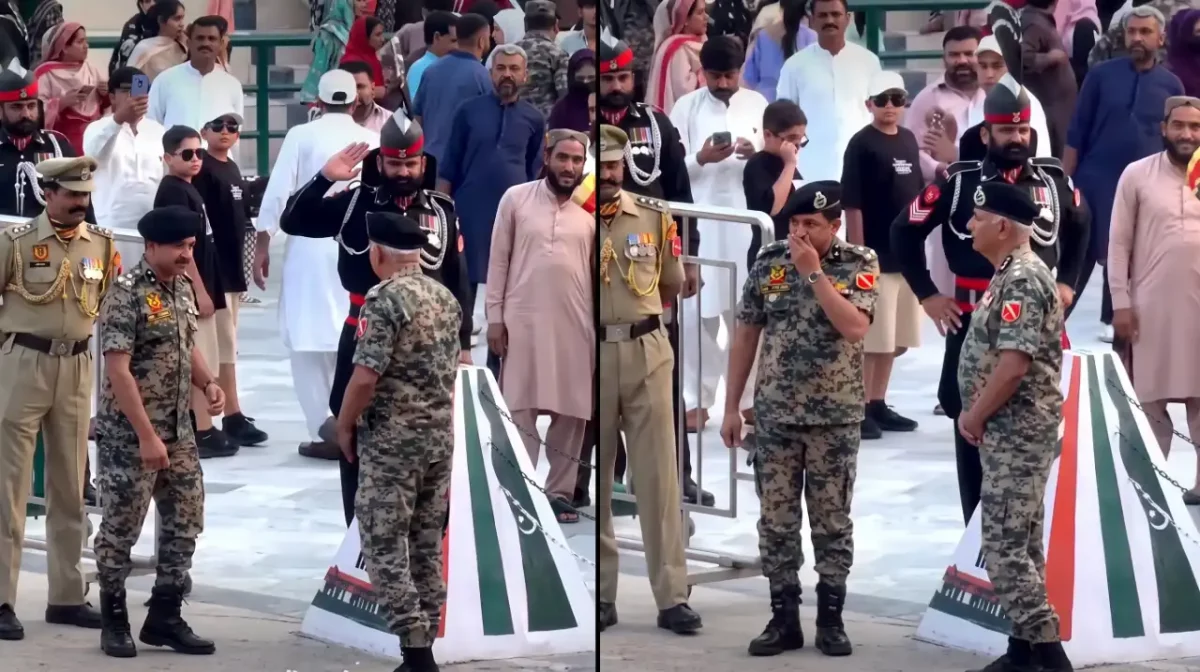
A short video from the Attari-Wagah border has gone viral on social media, showing a Pakistani Ranger offering a formal military salute to a senior Indian Army officer during the daily border ceremony. The Indian officer acknowledges the gesture with a courteous nod. The clip has triggered widespread discussion about military professionalism and mutual respect between the two forces, even amid ongoing tensions.
What the Video Shows
The footage, widely shared on platforms including Instagram (notably by the handle @comedycrest.in), captures a moment during the routine evening Beating Retreat ceremony at the Attari-Wagah international border crossing. Large crowds of spectators are visible on both the Indian and Pakistani sides, watching the well-known display of synchronised marching, high-stepping drills, and the coordinated lowering of the national flags.
In the clip, a Pakistani Ranger (from the Pakistan Rangers) is seen giving a crisp, formal military salute across the border to a senior Indian Army officer standing on the Indian side. The officer responds with a brief, respectful nod rather than returning a full salute. The exchange is brief and occurs amid the ceremonial proceedings.
Several outlets have described the officer as a senior Indian Army officer, while some reports have referred to him as a Border Security Force (BSF) officer. The Attari-Wagah ceremony itself is primarily conducted by India’s Border Security Force and Pakistan Rangers. Army officers can be present in an observational or supporting capacity. The exact date of the video has not been independently verified by all publications, though it began circulating widely in early August 2026.
Context of the Attari-Wagah Ceremony
The Attari-Wagah border ceremony (also known as the Beating Retreat) has been held every evening since 1959. It is a highly choreographed event featuring competitive drills, stomps, and coordinated flag-lowering. While the spectacle is energetic and sometimes theatrical, it traditionally concludes with a formal handshake between the lead personnel from both sides (though this practice has occasionally been suspended during periods of heightened tension).
Professional courtesies — including salutes based on rank, coming to attention, and formal acknowledgements — form part of long-standing military protocol at such joint border events, flag meetings, and official interactions. These gestures are rooted in the recognition of rank and the uniform rather than nationality. Junior ranks on either side commonly salute senior officers of the opposing force when rank is clearly identifiable. A senior officer may respond with a nod or verbal acknowledgement rather than a full return salute.
Defence observers note that such exchanges reinforce discipline and maintain a minimum level of professional decorum even when bilateral relations are strained.
Timing Amid Strained Relations
The video has gained traction at a time of continued strain in India-Pakistan relations, including recent military confrontations and heightened tensions along the Line of Control (LoC). Against this backdrop, the moment has been widely interpreted as a rare public display of military courtesy that transcends the political climate.
Social Media Reactions
Online reactions have largely focused on the theme of professionalism and respect for the uniform:
- Many users praised the Pakistani Ranger for upholding military norms: “This is professionalism. Not a political matter. Respect the solidarity.”
- Others highlighted the protocol aspect: “Salute is offered for the sake of rank and uniform, not the country. As the Indian officer was of higher rank, he didn’t salute in return but acknowledged the younger one with a nod.”
- Some expressed a wish that the Indian officer had returned a full salute, calling it a missed opportunity for a more “iconic” moment.
- A recurring sentiment was: “It’s not about India or Pakistan… it’s about men in uniform.”
Significance
Moments like this underscore that, despite the intense rivalry and geopolitical friction between the two countries, the armed forces on both sides continue to observe certain shared military traditions. These protocols help preserve a basic framework of communication and discipline during official interactions.
For defence aspirants and observers of military affairs, the incident serves as a reminder that professional conduct, respect for rank, and adherence to established customs remain core values across forces — even at one of the world’s most closely watched and symbolically charged borders.
The video continues to circulate, prompting both appreciation for the gesture and discussions on the deeper meaning of military etiquette in a tense neighbourhood.