

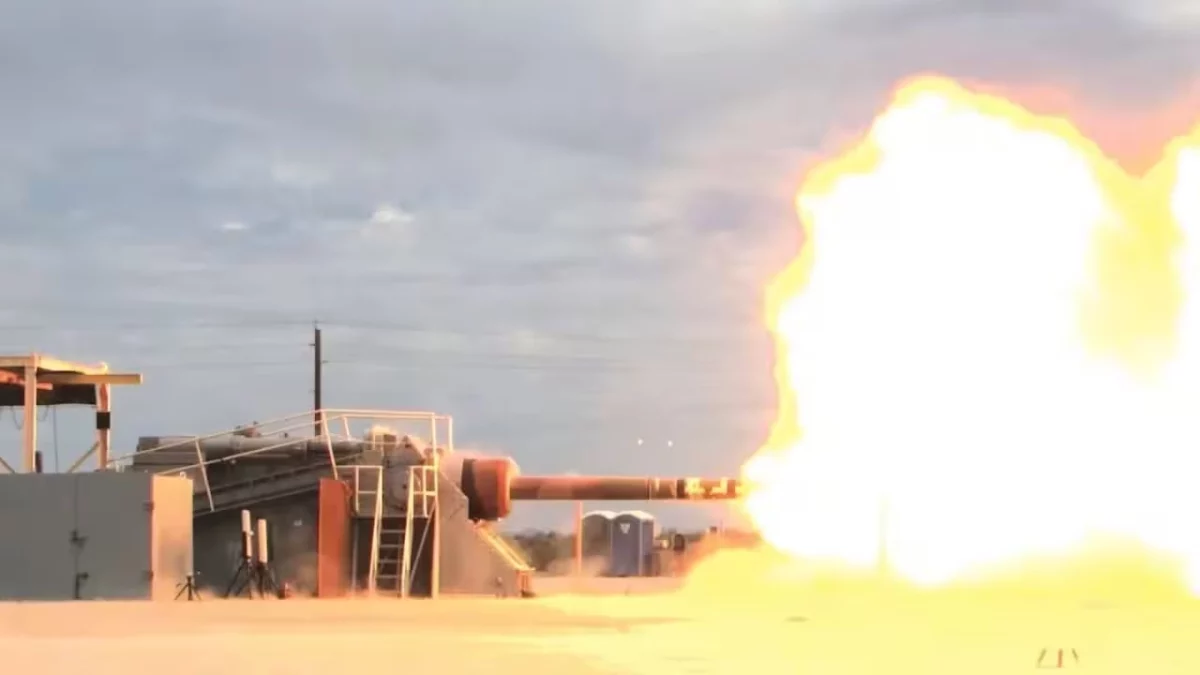
The United States Army has successfully conducted a hypersonic warhead test using a cannon-based launch system developed from its cancelled Strategic Long Range Cannon (SLRC) programme, marking a significant milestone in the development of next-generation hypersonic technologies. The innovative approach is expected to reduce the cost and complexity of hypersonic weapon testing while accelerating research and development.





The live-fire demonstration took place at the Yuma Proving Ground in Arizona using the Heavy Artillery Test System (HATS), a modified version of the giant artillery system originally designed for the Strategic Long Range Cannon project. The test was conducted by the US Army Combat Capabilities Development Command (DEVCOM) Armaments Center in collaboration with Lawrence Livermore National Laboratory.
Unlike conventional hypersonic weapon tests, which generally require expensive rocket launches, the HATS platform uses a high-powered cannon to accelerate test articles to extremely high velocities. This enables researchers to evaluate the critical terminal phase of hypersonic flight, including aerodynamic characteristics, structural integrity, thermal performance and warhead behaviour, without the expense of launching a complete missile.
According to the US Army, the demonstration successfully validated the Heavy Artillery Test System as an effective platform for hypersonic research. The trial generated valuable engineering and performance data that will support the development of future hypersonic weapons, materials and components.
Army officials stated that transforming the cancelled Strategic Long Range Cannon into the Heavy Artillery Test System required nearly two years of engineering modifications. The effort demonstrates how technology developed under discontinued defence programmes can be repurposed to support emerging military capabilities and ongoing research initiatives.
The Strategic Long Range Cannon was first unveiled in 2019 as part of the US Army’s long-range precision fires modernisation programme. It was envisioned as an advanced artillery system capable of engaging targets at ranges exceeding 1,000 miles (approximately 1,600 kilometres). Although the ambitious programme was later cancelled, many of its technological advancements have now found new applications in hypersonic research rather than operational battlefield deployment.
Military planners believe the cannon-based testing approach can substantially reduce development costs by eliminating the need for rocket boosters during many experimental trials. Since hypersonic missile tests involving full-scale launch vehicles are expensive and limited in number, HATS offers a more economical and flexible method for evaluating new concepts before progressing to complete missile testing.
The Army noted that while operational hypersonic weapon systems, including the Long-Range Hypersonic Weapon (Dark Eagle), will continue to require full-scale flight testing, the Heavy Artillery Test System will allow researchers to conduct more frequent and rapid experiments on materials, warhead configurations, guidance technologies and structural components. This approach is expected to shorten development timelines while improving overall system reliability.
Hypersonic weapons, capable of travelling at speeds exceeding Mach 5 while maintaining high manoeuvrability, are considered among the most significant emerging technologies in modern warfare. Their combination of extreme speed, unpredictable flight paths and precision strike capability presents major challenges for existing air and missile defence systems, making them a strategic priority for several major military powers.
The successful demonstration highlights the US Army’s continued focus on advancing hypersonic technologies through innovative and cost-effective methods. By repurposing technology from the cancelled Strategic Long Range Cannon programme, the Army has created a valuable research platform that could accelerate future hypersonic weapon development while reducing dependence on costly missile-based testing.
The development also reflects a broader trend in defence innovation, where existing technologies and legacy programmes are increasingly being adapted to meet evolving operational requirements. As global competition in hypersonic capabilities intensifies, platforms such as the Heavy Artillery Test System are expected to play an important role in advancing research, validating new technologies and supporting the next generation of long-range precision strike systems.