

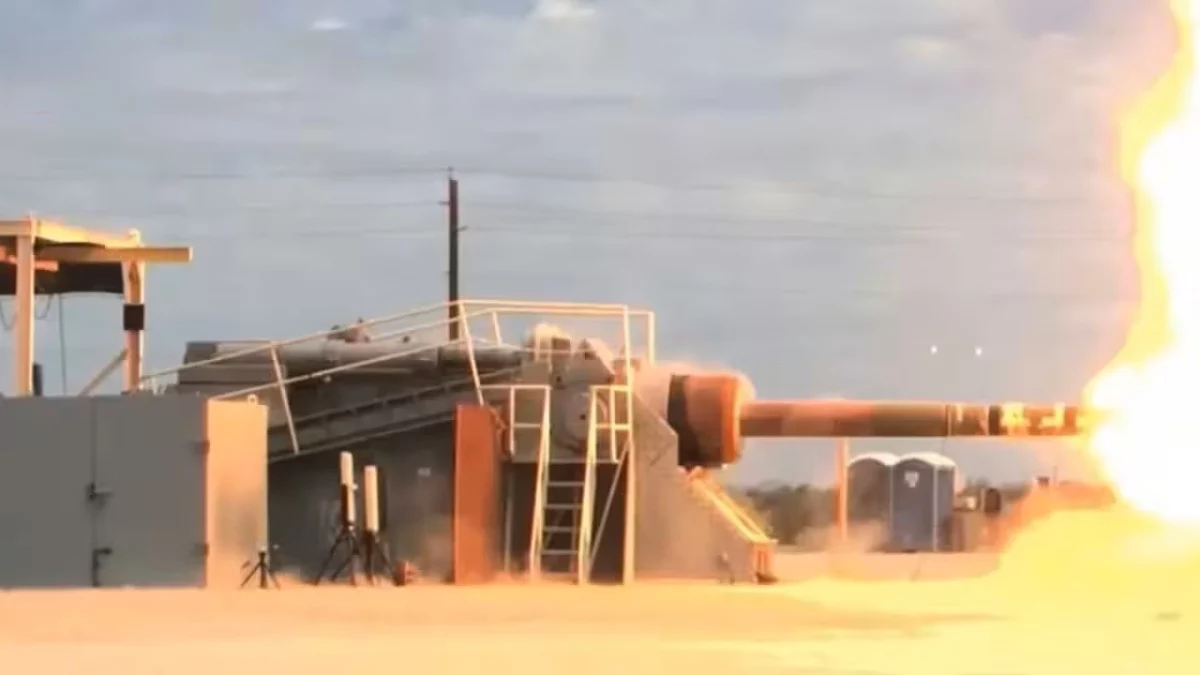
The US Army has reportedly conducted its first live-fire hypersonic test using the Heavy Artillery Test System (HATS), a repurposed cannon launcher originally developed under the now-cancelled Strategic Long Range Cannon (SLRC) programme. The test represents a new approach to hypersonic weapons development, allowing researchers to gather critical data without relying exclusively on expensive full-scale missile launches.





The trial was conducted on 30 July 2026 at the Yuma Proving Ground (YPG) in Arizona, one of the US Army’s major test and evaluation facilities. The exercise involved the Army’s DEVCOM Armaments Center, Lawrence Livermore National Laboratory (LLNL) and Yuma Proving Ground personnel.
Rather than launching a complete hypersonic missile, the test involved firing a specially developed Integrated Launch Package (ILP) from the HATS launcher. The hardened package contained the experimental payload and was designed to survive the extreme acceleration and stresses associated with a cannon launch before delivering the payload at very high velocity.
The test provided engineers with an opportunity to examine the performance of the experimental payload during the terminal phase of its trajectory. Telemetry systems, high-speed cameras and other range instrumentation were used to collect data from launch through impact, providing researchers with information that can support the development of future hypersonic weapon systems.
An important milestone in the trial was the first live-fire demonstration of the hardened Integrated Launch Package itself. The successful test demonstrated that the package could withstand the intense forces generated during a cannon launch, an important requirement for using the HATS system as a hypersonic research platform.
The HATS launcher has its origins in the Strategic Long Range Cannon programme, an ambitious US Army project that sought to develop an extremely long-range artillery system capable of firing rocket-assisted precision-guided projectiles at targets more than 1,000 miles, or approximately 1,609 kilometres, away.
The SLRC programme was ultimately cancelled after Congress ended dedicated funding in 2022. Instead of abandoning the technology completely, the US military subsequently repurposed the large-calibre launcher as an experimental platform for hypersonic research and testing.
The repurposing of the system illustrates how technology developed for cancelled weapons programmes can continue to contribute to US military research. In its current configuration, HATS is being used primarily as a test instrument rather than as an operational battlefield weapon.
One of the principal advantages of the cannon-based approach is its potential to reduce the cost and complexity of certain hypersonic experiments. Full-scale hypersonic missile tests can cost millions of dollars, with individual trials reportedly ranging from approximately $9.5 million to more than $15 million depending on the vehicle and programme.
By accelerating experimental payloads through a cannon system, researchers can obtain valuable information on materials, structural performance, terminal effects and other aspects of hypersonic technology without necessarily conducting a complete rocket-powered flight test for every development iteration.
The Army does not intend the HATS approach to replace conventional hypersonic flight testing. Instead, the cannon-based system can complement wind-tunnel testing, laboratory experiments, rocket sleds and full-scale missile launches by providing an additional method for evaluating components and payloads at high velocity.
The latest demonstration therefore marks an important step in the US Army’s broader effort to accelerate hypersonic weapons research while controlling development costs. By transforming technology originally intended for a cancelled long-range artillery programme into a specialised test platform, the Army is seeking to extract continued value from the SLRC programme while expanding its ability to evaluate next-generation hypersonic technologies.