
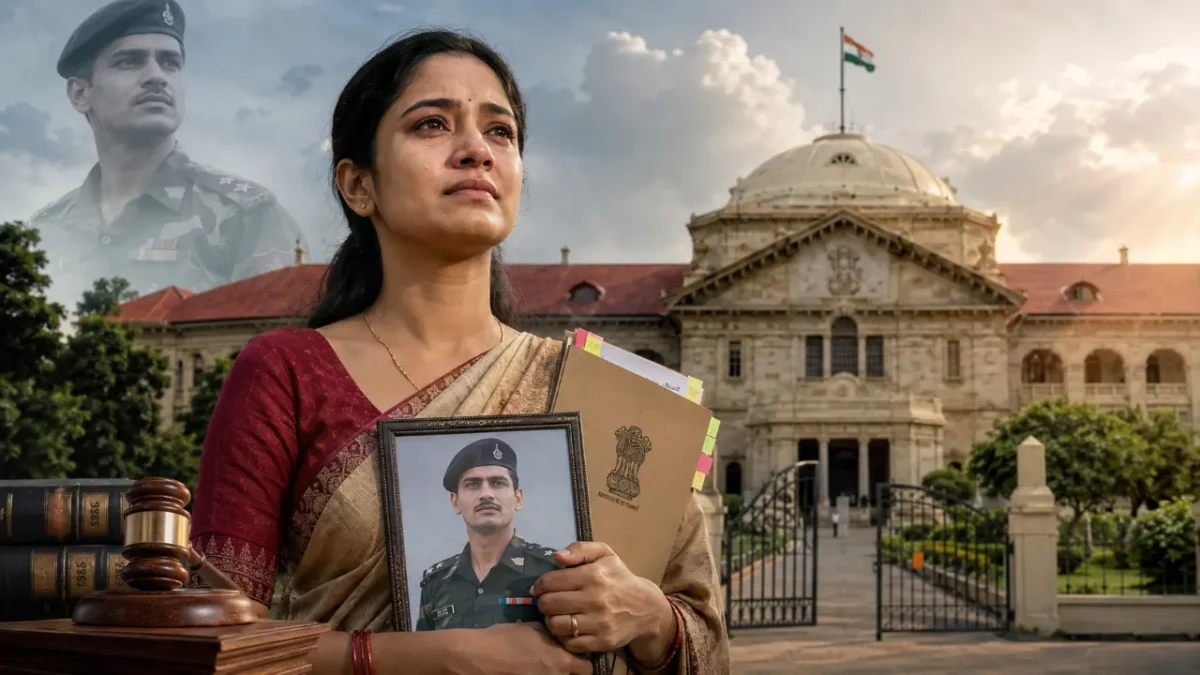
Prayagraj: The Allahabad High Court has upheld a Family Court ruling declaring Sadhna Devi the legally wedded wife and widow of an Indian Army soldier who died after sustaining a gunshot wound in an encounter with terrorists, rejecting claims by the soldier’s parents that the couple had never married and had only been engaged.




A Division Bench comprising Justice Arindam Sinha and Justice Satya Veer Singh dismissed First Appeal No. 493 of 2025, Rajdhari and Another v. Sadhna Devi, affirming the Family Court’s April 28, 2025 judgment. The High Court concluded that the evidence established that the marriage had taken place on May 12, 2007, and found that the parents’ subsequent denial was inconsistent with their own earlier position before another High Court.
The dispute had its origins in the death of the soldier, identified in earlier Gujarat High Court proceedings as Arve Shanker Yadav. He was serving in the Army when he died on January 14, 2008, from a gunshot wound sustained during an encounter with terrorists. Sadhna Devi maintained that she had married him on May 12, 2007, at her parental home in Azamgarh, Uttar Pradesh, around eight months before his death.
The soldier’s parents disputed her account. According to them, the ceremony conducted on May 12, 2007 was merely an engagement, while the actual wedding had been scheduled for April 24, 2008. Since their son died before that date, they argued that Sadhna Devi could not claim to be his widow or assert the rights and benefits associated with that status.
The question had significant consequences because recognition as the deceased soldier’s widow affected her status as next of kin as well as entitlement to service-related benefits and honours. The Family Court conducted a full trial, framed seven issues and examined oral and documentary evidence before deciding the principal questions in Sadhna Devi’s favour.
One of the most important factors considered by the Allahabad High Court was the position previously taken by the soldier’s mother before the Gujarat High Court.
Soon after her son’s death, she had filed Special Civil Application No. 2163 of 2009 before the Gujarat High Court. In that litigation, instead of claiming that no marriage had occurred, she stated in substance that it was not disputed that her son had married Sadhna Devi on May 12, 2007. Her contention at the time was that the marriage had not been consummated. She relied upon local custom under which consummation could take place one to three years later following another religious ceremony.
Her case then was therefore substantially different from the position subsequently taken before the Family Court and Allahabad High Court. Earlier, the argument had been that a marriage existed but had not been consummated; later, the family maintained that there had been no marriage at all and that the May 12 ceremony had only been an engagement.
The Gujarat High Court had rejected the mother’s 2009 petition on March 12, 2009, finding no substance in her claim. The Allahabad High Court considered the earlier admission regarding the marriage significant and held that it could not simply be ignored when the family subsequently presented an entirely different version of events.
The dispute also extended to the posthumous honours awarded to the soldier. On April 19, 2009, Sadhna Devi attended an investiture ceremony at Rashtrapati Bhavan and received a posthumous award from the President of India as the widow of the deceased soldier.
Further litigation followed. The soldier’s mother again approached the Gujarat High Court questioning Sadhna Devi’s entitlement to post-death benefits and honours. Departmental inquiries produced conflicting conclusions: one treated Sadhna Devi as the soldier’s married wife, while a later inquiry concluded that sufficient proof of the marriage had not been produced.
The Gujarat High Court proceedings eventually went against Sadhna Devi, and review applications were unsuccessful. Her special leave petitions were subsequently dismissed summarily by the Supreme Court on September 1, 2010.
However, the Allahabad High Court held that those proceedings did not finally determine her marital status in the manner of a full civil trial. They arose primarily from disputes over service benefits and departmental inquiries, and Sadhna Devi had not fully contested the factual questions during some of those proceedings.
The Bench distinguished those orders from the later Family Court adjudication, where both sides participated, issues were formally framed and evidence was tested during a complete trial. Consequently, the earlier Gujarat High Court and Supreme Court orders could not override the subsequent judicial determination of marital status.
Reviewing the evidence itself, the Allahabad High Court noted that Sadhna Devi had produced marriage invitation cards. One of those cards contained handwriting attributed to the deceased soldier’s father. Witnesses also testified that they had witnessed the marriage ceremony on May 12, 2007, and their account was not shaken during cross-examination.
There was additionally evidence concerning a motorcycle gifted in connection with the ceremony, which was subsequently found registered in the name of the husband of one of the appellants’ daughters.
The soldier’s parents relied heavily on the fact that vidai, the traditional ceremonial departure of a bride for her husband’s home, had not taken place.
The High Court rejected the argument that the absence of vidai meant there had been no marriage. It agreed with the Family Court that solemnisation of a marriage and the subsequent vidai ceremony were separate matters. Failure to perform a later customary ritual could not erase otherwise credible evidence establishing that the wedding itself had taken place.
The Bench found no positive evidence supporting the parents’ contention that only an engagement ceremony had been conducted on May 12, 2007.
The claim that the actual marriage had been fixed for April 24, 2008 also failed to persuade the Court. Evidence showed that leave had been taken so family members could attend the May 12, 2007 ceremony in Azamgarh. There was also material indicating that the soldier had applied for leave for his marriage and had been required to produce photographs.
After the May 2007 ceremony, the soldier returned to duty. Until his death in January 2008, there was nothing showing that he himself had ever disputed the marriage. The Family Court had characterised the later claimed wedding date as an “after thought”, and the High Court found no reason to interfere with that conclusion.
Another significant legal issue arose when the parents attempted to challenge the marriage on the basis of Sadhna Devi’s age.
An identity card produced during the trial recorded her date of birth as July 20, 1989. On that basis, she would have been approximately two months short of turning 18 when the marriage took place on May 12, 2007. The parents therefore argued during the appeal that the marriage should be considered void.
The High Court rejected this argument both procedurally and on the substance of the law.
The Bench noted that the parents had not raised the allegation in their written statement before the Family Court. No issue concerning minority had been framed, and they had not sought an additional issue during the trial even after the identity card was placed on record.
The Court referred to Order XIV Rule 1 of the Code of Civil Procedure, under which an issue arises when a material proposition is asserted by one party and denied by the other. Raising an entirely new argument regarding age for the first time at the appellate stage was therefore held to be without substance.
The Court also examined the Hindu Marriage Act, 1955. While Section 5(iii) prescribes 18 years as the minimum age for a bride, Section 11, dealing with void marriages, does not include violation of that age requirement among the grounds that automatically render a marriage void.
The Bench further observed that Section 12, concerning voidable marriages, also does not permit third parties to seek annulment of such a marriage merely on the basis of the age requirement under Section 5(iii).
More importantly, the High Court held that proceedings under Section 11 seeking a declaration that a marriage is void are available to the parties to the marriage. The appellants were the deceased husband’s parents, not parties to the marriage.
The ruling therefore makes clear that in-laws cannot, after the death of their son, seek to have his marriage declared void in such circumstances.
The parents also questioned whether the Family Court had jurisdiction over the dispute, arguing that the case was essentially concerned with the distribution of benefits following the soldier’s death and therefore belonged before an ordinary civil court.
They relied upon the Supreme Court judgment in R. Kasthuri v. M. Kasthuri, involving competing claims concerning the property of a deceased person.
The Allahabad High Court distinguished that precedent. In the present case, the central dispute was not simply over property or benefits; it was whether Sadhna Devi had legally married the deceased soldier in the first place. A proceeding seeking declaration of marital status falls within the scope of the Family Courts Act, 1984, the Bench held.
The judgment is significant beyond the individual family dispute because it addresses situations where service records, nominations, customary practices, departmental inquiries and competing family claims can produce conflicting accounts following the death of a serviceman.
The High Court placed considerable weight on earlier judicial admissions, particularly the soldier’s mother’s earlier acknowledgment that the marriage had taken place. It also made clear that the absence of rituals such as vidai cannot by itself undo evidence establishing solemnisation of a marriage.
Most importantly, the Court rejected an attempt by the deceased soldier’s parents to retrospectively invalidate the marriage after his death and after a full trial had established its existence.
Finding no perversity in the Family Court’s appreciation of evidence, the Allahabad High Court dismissed the appeal and upheld its judgment. Sadhna Devi consequently stands judicially recognised as the legally wedded wife and widow of the Army soldier who died on January 14, 2008.