

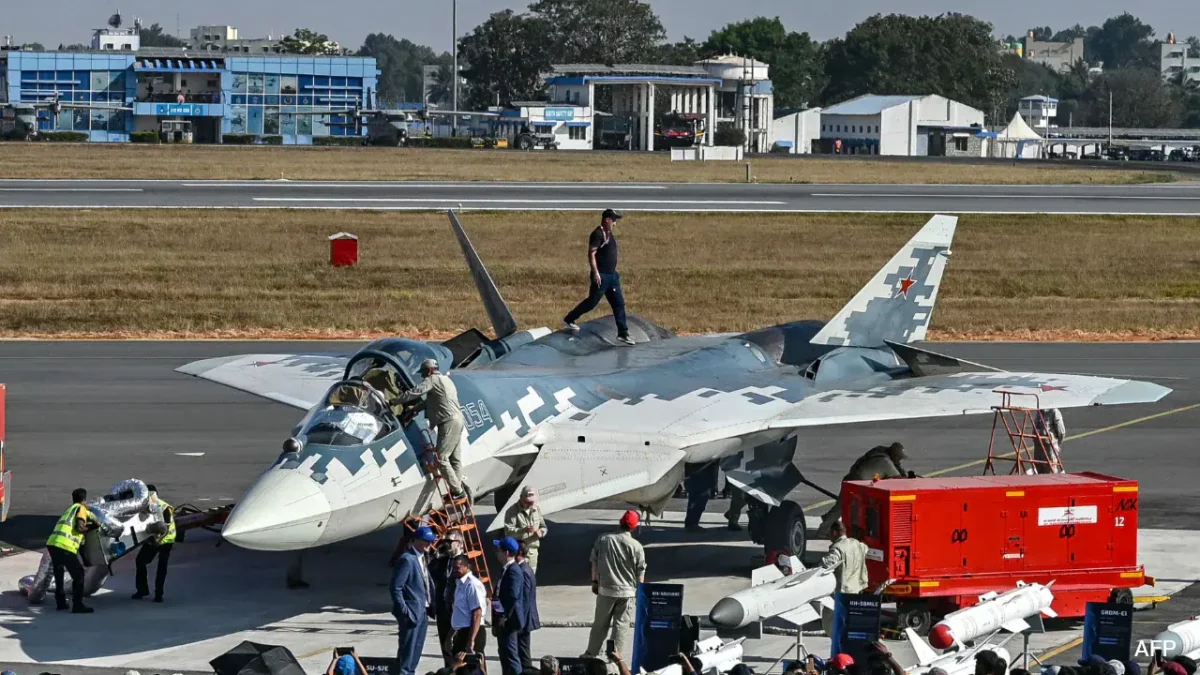
Russia has renewed its major defence pitch to India, placing two of its most advanced platforms—the S-500 Prometheus air and missile defence system and the Su-57 fifth-generation fighter—at the centre of its latest offering. The proposals come as India seeks to strengthen its air defence architecture and address gaps in its fighter aircraft strength while simultaneously pursuing greater self-reliance in defence production.
The renewed Russian push follows a meeting between Russian President Vladimir Putin and Prime Minister Narendra Modi in Bishkek and comes ahead of another expected engagement between the two leaders in New Delhi. Moscow is seeking to leverage decades of India-Russia defence cooperation and the extensive presence of Russian-origin military equipment in the Indian Armed Forces.
A key element of the Russian proposal is the S-500 Prometheus, Russia’s next-generation long-range air and missile defence system. Moscow is positioning the system as a potential successor or complement to the S-400 air defence systems already operated by India.
The proposal assumes significance following the reported operational employment of India’s S-400 systems during Operation Sindoor against Pakistani aerial threats. Russia is seeking to build on the reputation and operational experience of the S-400 by offering India access to a more advanced air and missile defence capability.
The S-500 proposal, however, comes at a time when India is developing indigenous alternatives. India’s ballistic missile defence programme has progressed significantly, while Project Kusha is being developed as an indigenous long-range air defence system. Any decision to acquire the S-500 would therefore have to be assessed against India’s existing capabilities and ongoing domestic programmes to determine whether it addresses a genuine operational requirement or creates overlap with systems under development.
The second major element of Moscow’s pitch is the Sukhoi Su-57, a fifth-generation stealth fighter being offered as a potential solution to the Indian Air Force’s requirement for advanced combat aircraft. The proposal comes amid concerns over the IAF’s fighter squadron strength and the time required for India’s indigenous Advanced Medium Combat Aircraft (AMCA) programme to deliver a fifth-generation platform.
Russia has indicated that localisation, technology transfer and production in India could form part of a future Su-57 arrangement. Such an approach could potentially align the acquisition with India’s broader emphasis on domestic manufacturing and technology absorption.
However, the possible acquisition of the Su-57 presents a complex decision for India. The IAF already operates a diverse fleet comprising Russian, French, British-French and indigenous aircraft. Introducing another fighter type would entail additional requirements for training, maintenance, logistics, weapons integration and spare parts.
The proposal also has a historical dimension. India and Russia had earlier pursued the Fifth Generation Fighter Aircraft (FGFA) programme, intended to develop an Indian variant based on the Russian fifth-generation fighter programme. The project eventually did not materialise, making the renewed Russian offer particularly significant in the context of India’s present requirement for a stealth fighter.
India faces a strategic dilemma as it balances immediate operational requirements against long-term indigenous ambitions. Waiting for AMCA could leave the IAF facing a fifth-generation capability gap, while acquiring an interim foreign platform could provide an immediate capability but potentially increase the complexity of the existing fighter fleet and affect resources available for indigenous programmes.
Beyond the S-500 and Su-57, Russia is also seeking to expand defence cooperation with India across several other areas. Moscow is reportedly pitching systems such as the Voronezh strategic early-warning radar, along with upgrade and modernisation programmes for India’s Su-30MKI fighter fleet and Russian-origin Kilo-class submarines.
The broader Russian strategy comes as India continues to diversify its defence procurement. New Delhi has increasingly sourced major platforms and systems from the United States, France, Israel and other partners while simultaneously expanding domestic defence production and indigenous research and development.
Recent moves such as India’s acquisition of American Javelin anti-tank guided missiles and its efforts to expand Rafale fighter procurement underline the increasingly diversified nature of India’s defence partnerships. At the same time, programmes such as AMCA, Project Kusha and other indigenous platforms are intended to progressively reduce dependence on foreign suppliers.
Russia nevertheless retains a significant advantage in the Indian defence ecosystem because of the depth of existing military cooperation. Russian-origin aircraft, tanks, submarines, helicopters, missiles and air defence systems constitute a substantial part of India’s military inventory. This established ecosystem creates long-term opportunities for upgrades, maintenance, modernisation and eventual replacement.
The latest Russian proposals therefore extend beyond individual weapons deals and form part of a wider contest over India’s future military capability. For New Delhi, the central challenge will be to balance immediate operational requirements with technology transfer, indigenous development, diversification of suppliers and long-term strategic autonomy.
The S-500 and Su-57 proposals consequently place two critical questions before Indian defence planners: how much additional foreign air defence capability is required as indigenous systems mature, and whether the IAF can afford to wait for an Indian fifth-generation fighter while regional air forces accelerate their transition towards stealth combat aircraft.