

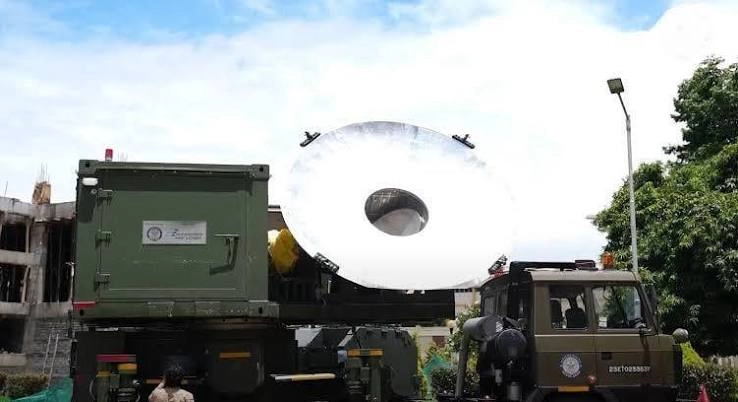
The Defence Research and Development Organisation (DRDO) has issued a Request for Proposal (RFP) for an advanced S-band High-Power Microwave Integrated Evaluation System for Lethality and Damage, codenamed SHIELD, marking another step in India’s efforts to develop indigenous capabilities in the emerging directed-energy technology domain.





The programme is being pursued under the Technology Development Fund (TDF) scheme, which is aimed at accelerating indigenous defence technology development by supporting industry-led innovation. Through the SHIELD initiative, DRDO is seeking to create an advanced evaluation platform capable of studying the effects of high-power microwave radiation on electronic systems.
According to the supplied details, the proposed SHIELD system will have a modular and scalable architecture, allowing it to be adapted for different testing and operational environments. The design is intended to provide researchers and defence technologists with a flexible platform for evaluating electromagnetic effects and establishing a structured understanding of the vulnerability of electronic systems.
A key component of the proposed system will be Gallium Nitride-based Solid State Power Amplifier (GaN SSPA) technology. Gallium Nitride is increasingly used in high-frequency and high-power electronics because of its efficiency and high power density. In the SHIELD architecture, the technology is intended to support the generation of high-power microwave signals while addressing the thermal and reliability challenges associated with such systems.
The proposed platform is expected to achieve a peak electric field strength of at least 3 kV/m in the far field. This capability is intended to enable controlled evaluation of the effects of S-band high-power microwave radiation on electronic equipment and help researchers quantify the potential damage associated with exposure to electromagnetic energy.
SHIELD is also designed to operate in pulsed mode with flexible duty cycles. This feature would allow different electromagnetic exposure conditions to be simulated during testing, providing researchers with greater flexibility in evaluating how electronic systems respond to high-power microwave radiation under varying conditions.
Thermal management is another important element of the proposed system. High-power microwave technologies generate considerable thermal loads, making effective heat management essential for maintaining reliability and sustained performance. The SHIELD programme therefore incorporates advanced thermal management solutions intended to support operation over extended periods.
The central objective of the platform is to evaluate and quantify the lethality and damage potential of S-band high-power microwave radiation against electronic systems. Such testing can help establish a clearer understanding of how communications equipment, sensors and control systems respond when subjected to electromagnetic energy.
The evaluation capability could also contribute to the development of survivability benchmarks and countermeasures. By systematically studying the effects of high-power microwave radiation, defence researchers can identify vulnerabilities in electronic systems and examine approaches for improving their resilience against electromagnetic threats.
One of the notable features outlined for SHIELD is its drone-mountable capability. The provision for mounting the system on an unmanned platform could provide additional flexibility for conducting airborne testing and demonstrations. It also reflects the wider interest in combining directed-energy technologies with unmanned systems.
High-power microwave technology forms part of the broader directed-energy weapons field, alongside technologies such as high-energy lasers. Unlike conventional kinetic weapons, directed-energy systems seek to affect targets through concentrated energy, creating potential applications in areas where electronic systems are the primary objective.
The technology is particularly relevant to the changing nature of modern warfare, where military effectiveness increasingly depends on interconnected communications, sensors, command-and-control systems and other electronic capabilities. The ability to assess and potentially disrupt such systems through electromagnetic effects has consequently become an area of interest in defence research.
The SHIELD initiative is also significant from an industrial perspective. By being pursued through the Technology Development Fund, the programme provides an avenue for Indian private-sector companies and start-ups to participate in the development of advanced defence technology. Industry participation can help translate research concepts into engineered systems while strengthening the domestic technology ecosystem.
The programme aligns with India’s wider emphasis on indigenous defence development under the Aatmanirbhar Bharat initiative. Developing domestic expertise in high-power microwave technologies, power amplifiers, thermal management and electromagnetic evaluation can contribute to reducing dependence on foreign technologies in an increasingly important area of military capability.
The proposed evaluation system could also have significance beyond the development of offensive directed-energy technologies. A robust testing infrastructure is equally important for developing defensive measures. Understanding how Indian communications, sensors and other electronic systems respond to high-power electromagnetic exposure can support efforts to improve their resilience and survivability.
The drone-mountable aspect of SHIELD further reflects the growing convergence between unmanned systems and advanced electronic warfare technologies. As unmanned platforms become increasingly important on the battlefield, the ability to develop compact and scalable payloads for specialised electromagnetic applications is likely to remain an important area of technological research.
At the same time, the issuance of an RFP represents a development and procurement stage rather than proof that a fully operational weapon system has entered service. The proposed SHIELD platform is primarily an evaluation system intended to support research, testing and assessment of high-power microwave effects.
The launch of the programme nevertheless represents an important development in India’s directed-energy research roadmap. Establishing an indigenous capability to evaluate high-power microwave lethality and damage can provide the scientific and engineering foundation required for future systems while simultaneously helping strengthen protection against emerging electromagnetic threats.
With its combination of GaN-based solid-state power amplification, pulsed operation, thermal management, high electric-field generation and potential drone-mountable configuration, SHIELD is positioned as a specialised technology demonstrator and evaluation architecture for India’s growing high-power microwave research effort.
The initiative ultimately reflects a broader shift in defence technology, where future battlespace effectiveness will depend not only on conventional firepower but also on the ability to protect, disrupt and evaluate sophisticated electronic systems. Through the TDF-backed SHIELD programme, DRDO is seeking to build indigenous expertise and infrastructure in this emerging field, supporting India’s longer-term ambitions in directed-energy and electronic warfare technologies.