
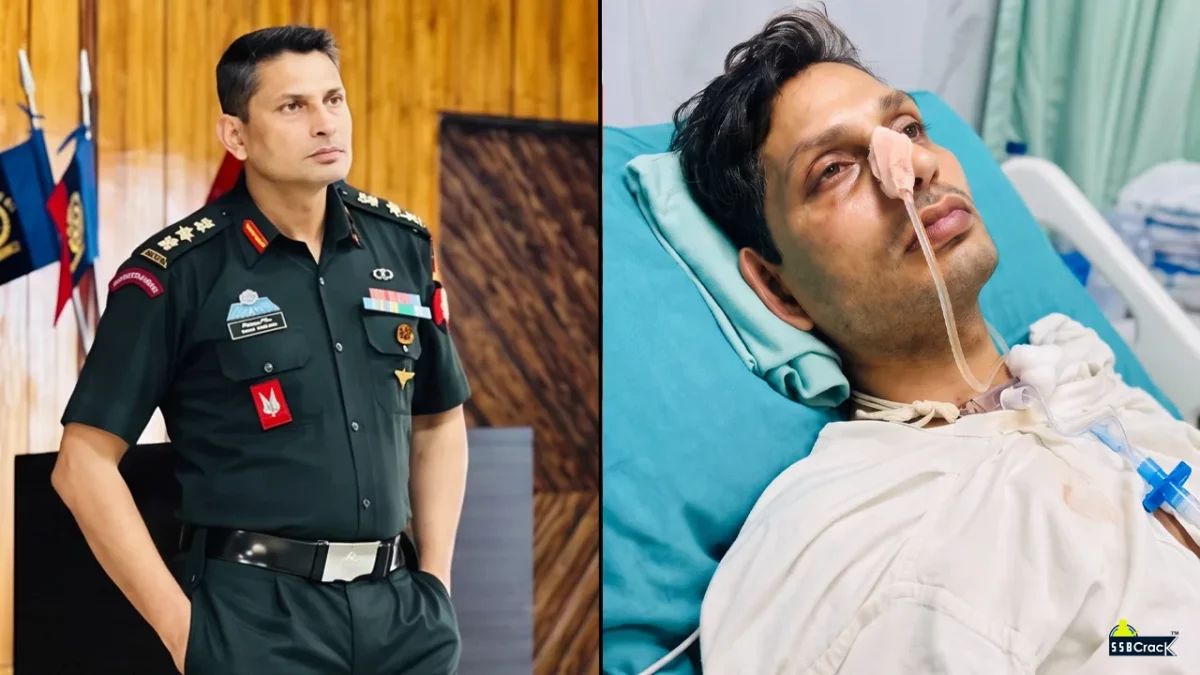
Colonel Anurag Upadhyay, an Indian Army veteran who gave up the prospect of a corporate career to serve in uniform and later volunteered for the elite Para Special Forces, is now facing one of the most difficult battles of his life.
A public appeal being circulated among veterans and on social media is seeking connections with neurologists, rehabilitation specialists, researchers and assistive-technology experts who may be able to explore further possibilities for the Para SF veteran, who is living with Locked-in Syndrome following a severe stroke.
According to the appeal, Col Upadhyay suffered a severe posterior circulation stroke in August 2025. The stroke left him with Locked-in Syndrome, a rare neurological condition in which a person can remain conscious and cognitively aware despite experiencing profound paralysis and severely limited ability to communicate.
The case has now drawn wider public attention, with the Times of India reporting on September 9 that his family is seeking medical, rehabilitation and technology experts who may be able to help improve his recovery, communication and independence.
Scored 99th Percentile in CAT, But Chose the Army
Long before his present medical battle, Col Anurag Upadhyay had already made an unconventional career choice.
According to accounts being shared about his life, he scored in the 99th percentile in the Common Admission Test (CAT), potentially opening the door to a promising management and corporate career.
Instead, he chose the Indian Army.
His military career eventually took him towards one of the toughest paths available to a soldier. He volunteered for the Special Forces and successfully completed probation with 3 PARA (Special Forces).
He subsequently became part of the raising team of 12 PARA (Special Forces), according to the public appeal.
His decision to pursue the Army despite his strong academic credentials has become one of the central aspects of the story now being shared across the country. The Times of India has also highlighted his decision to choose military service despite his 99th-percentile CAT performance.
Returned to Active Duty After Heart Attack
Col Upadhyay’s military journey was also marked by a major health challenge years before his stroke.
The appeal states that he suffered a heart attack in 2008. Despite the setback, he recovered sufficiently to return to active military duty.
Years later, however, the stroke in August 2025 dramatically changed his life.
The neurological damage severely affected his ability to move and communicate normally. Further medical complications eventually resulted in bilateral below-knee amputations, according to the appeal circulated on his behalf.
Yet one crucial part of Col Upadhyay remains intact: his awareness.
His Body Is Severely Affected, But His Mind Remains Aware
Those behind the appeal say Col Upadhyay remains conscious and aware of his surroundings. He remembers, understands and thinks, despite being unable to communicate through conventional speech or movement.
Communication is reportedly being achieved through eye movements and an alphabet-based scanning system, allowing him to convey his thoughts one selection at a time.
It is this preserved cognitive ability that has prompted his family and supporters to search beyond their existing medical network.
They are not seeking promises of a cure or making claims about what recovery may ultimately be possible. Instead, the appeal seeks access to specialists, researchers and technologies that could potentially improve his ability to communicate, interact with his environment or regain some degree of independence.
Family Seeks Neurologists, Researchers and BCI Experts
The appeal seeks connections with neurologists and neuro-rehabilitation specialists who have experience treating patients with Locked-in Syndrome.
It also seeks rehabilitation centres specialising in neurological recovery, researchers studying restoration of movement or speech, and experts working on emerging technologies such as brain-computer interfaces.
Brain-computer interface technology is of particular interest because such systems are being investigated as potential ways for people with severe paralysis to communicate or control external devices using neural signals.
The family is additionally seeking expertise in eye-tracking and other assistive communication technologies that could provide Col Upadhyay with a faster and more independent means of expressing himself.
Veteran organisations and individuals capable of connecting the family with relevant medical institutions, researchers or technology teams have also been urged to help.
An Appeal for Connections, Not Sympathy
The message circulating among the military community stresses that the effort is not intended as an appeal for sympathy.
Instead, those supporting Col Upadhyay want to ensure that potentially relevant expertise is not missed simply because a specialist, researcher or institution happens to lie outside the family’s existing network.
Someone encountering the appeal may know a neurologist who has treated a similar patient, a rehabilitation centre experienced with Locked-in Syndrome, a researcher working on assistive communication, or simply someone capable of making the right introduction.
Those who can provide a meaningful connection have been asked to contact “Tales Of A Gypsy” on Instagram, according to the appeal.
For a soldier who once chose the uncertainty of military service over the opportunities that could have followed a 99th-percentile CAT score, and who went on to serve in India’s Special Forces, the fight today is profoundly different.
The objective is no longer a military mission. It is to discover how much communication, independence and function modern medicine, rehabilitation and emerging technology might still make possible.
And that is the question at the heart of the appeal now being shared across the country:
What more is possible for Colonel Anurag Upadhyay?