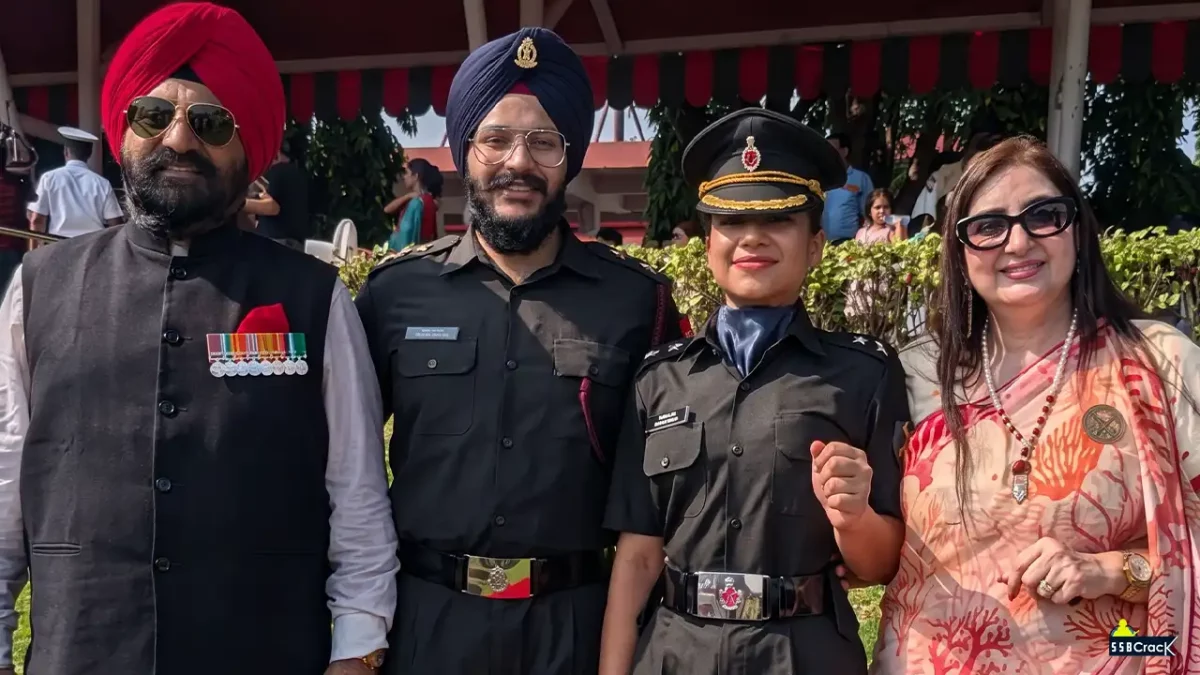
Meet Lieutenant Seerat Kaur, a young officer whose remarkable journey from the corridors of the Supreme Court of India to the Officers Training Academy in Chennai is a powerful story of perseverance, courage and determination.





A law graduate from Guru Gobind Singh Indraprastha University, Seerat Kaur graduated with a First Division and went on to build an impressive legal career. From October 2023 to May 2025, she worked as a Law Clerk-cum-Research Associate at the Supreme Court of India. But beyond the courtroom, she carried another ambition to wear the uniform of the Indian Army and serve as an officer in its Judge Advocate General (JAG) Branch.
Her opportunity came through the JAG-35 recruitment cycle. Seerat scored 432 marks and secured sixth position in the combined merit list of eight recommended candidates. She was fifth among the women candidates, and her score was equal to that of the third-ranked male candidate and the fourth-ranked female candidate. Despite her performance, she did not receive a joining letter because the recruitment structure at the time provided only four vacancies for women.
Instead of allowing the setback to end her dream, Seerat decided to fight for what she believed was a question of merit. She approached the Supreme Court, challenging the recruitment process and seeking an opportunity to join the Army. Her case came at a time when the system of recruitment for the JAG Branch itself was undergoing an important transition towards a common merit-based approach for male and female candidates.
On September 26, 2025, the Supreme Court gave Seerat an opportunity that would change the course of her life. Subject to completing the required formalities, she was provisionally permitted to join the Officers Training Academy in Chennai for the course beginning on October 1. But the order was only an opportunity to train; it was not a guarantee that she would eventually be commissioned.
Once she entered OTA Chennai, Seerat faced an entirely different challenge. The courtroom could give her an opportunity, but it could not earn the uniform for her. At the academy, she had to prove herself through discipline, physical endurance, professional competence and the demanding routine of military training all while living with uncertainty about whether she would ultimately be appointed.
Then came another major setback. On October 14, 2025, the Supreme Court dismissed her writ petition, ruling that the gender-neutral directions issued in the earlier Arshnoor Kaur case would apply prospectively and would not change the already ongoing JAG-35 recruitment cycle. However, considering the exceptional circumstances and the fact that Seerat had already begun training under an interim order, the court allowed her to complete the 11-month course at OTA Chennai as a special case.
Even then, there was no automatic commission waiting for her at the finish line. The court provided only a limited pathway under which she could be considered after successfully completing training if one of the selected candidates withdrew or was disqualified, or if another suitable vacancy became available. For Seerat, the battle was no longer about making arguments before judges. It was about proving herself every single day as an officer cadet.
For the next 11 months, she continued training at OTA Chennai despite the uncertainty surrounding her future. Every parade, every physical challenge, every lesson and every demanding day at the academy became another opportunity to demonstrate that she deserved the chance she had fought so hard to receive. The Supreme Court had opened a door for her, but walking through it was entirely up to Seerat.
Her perseverance finally delivered the moment she had been working towards. On September 5, 2026, after successfully completing her training, Seerat Kaur was commissioned as a Lieutenant into the Judge Advocate General Branch of the Indian Army. The young lawyer who had once worked inside the Supreme Court and later approached the same institution seeking an opportunity was now wearing the uniform of an Indian Army officer.
Lieutenant Seerat Kaur’s journey is inspirational precisely because nothing about the final outcome was guaranteed. She faced rejection, entered military training provisionally, saw her petition ultimately dismissed and still continued through one of the most demanding phases of her life without knowing exactly what awaited her at the end.
Her story carries a simple but powerful message for every young aspirant facing rejection or uncertainty: sometimes an opportunity is all you receive. What you make of that opportunity depends on your determination. Seerat was given the chance to continue her journey, and through perseverance and performance, she turned that chance into the stars of a Lieutenant.
From researching cases at the Supreme Court of India to serving the nation as an officer of the Indian Army, Lieutenant Seerat Kaur’s journey stands as an inspiring example of refusing to allow uncertainty to define one’s destination.