

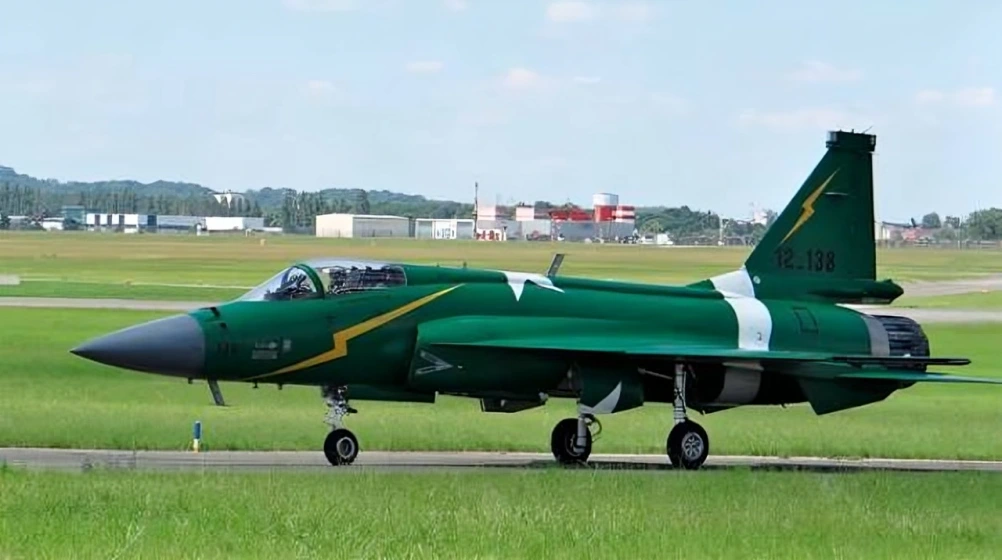
Pakistan’s air force is approaching a difficult phase in its long-running effort to maintain a large combat fleet, as ageing fighter aircraft approach the limits of their service lives while the cost of acquiring and sustaining modern combat aviation continues to rise.


The challenge is not unique to Pakistan. Air forces across the world have generally become smaller since the end of the Cold War, although advances in technology have enabled individual aircraft to perform far more sophisticated missions than their predecessors. The Pakistan Air Force (PAF), however, has historically placed considerable emphasis on maintaining numerical strength alongside technological capability, particularly in the context of its military competition with India.
That model is now facing increasing financial and technological pressure.
The Indian Air Force itself operates fewer aircraft than its sanctioned strength of 42.5 fighter squadrons, while the US tactical fighter fleet has also fallen substantially from its Cold War-era peak. European air forces experienced similar reductions after the collapse of the Soviet Union as governments benefited from what became known as the “peace dividend”.
China has been a major exception, expanding both the size and capability of its air force over the same period.
The underlying economics of combat aviation have also changed dramatically. Modern fighters are considerably more capable than aircraft of the early 1990s, offering longer-range detection, advanced sensors, networked operations, greater precision and improved pilot situational awareness. But these capabilities have also made modern fighters significantly more expensive to acquire, operate and maintain.
For Pakistan, the problem is particularly acute because a substantial portion of its combat fleet is ageing.
The PAF operates a diverse inventory comprising American F-16s, French-origin Mirage III and Mirage V aircraft, and a growing family of Chinese-origin platforms. These include the F-7, J-10 and JF-17, with the JF-17 being assembled in Pakistan in cooperation with China.
The Mirage fleet represents one of the clearest examples of the ageing-aircraft challenge. Pakistan began inducting Mirage aircraft in 1967, and while the fleet has undergone upgrades and has been supplemented by aircraft acquired from other countries, its basic airframes are now extremely old by modern fighter standards.
The PAF also operates three F-16 squadrons. Two were inducted during the 1980s, while another was inducted around 2010. Although the F-16 remains a capable multirole fighter, the age of some Pakistani aircraft means that service-life considerations and sustainment requirements are increasingly important.
At the same time, the PAF is transitioning its final F-7 squadron to the JF-17 Block III. Once that transition is complete, the number of JF-17-equipped squadrons is expected to rise from six to seven.
Pakistan has also expanded its Chinese-origin high-end fighter capability through the induction of the J-10CE. According to the material supplied, Pakistan has received the last of its 20 J-10 fighters.
Yet the newer aircraft do not entirely resolve the fleet-age problem.
According to the assessment cited in the source material, six frontline fighter squadrons—two F-16 squadrons and four Mirage squadrons—will require replacement over the coming years. In a frontline force of roughly 15 fighter squadrons, that would represent a substantial proportion of the fleet.
The PAF’s fighter-related strength is larger when training and conversion units are included. The service operates fighter units at the Combat Commanders’ School and operational conversion units flying F-16 and JF-17 aircraft. Including these formations, the number of PAF squadrons operating fighter aircraft is around 22.
Beyond fighter squadrons, the PAF also requires specialised combat-support capabilities, including airborne early warning and control, electronic warfare and other enabling systems. These assets are essential to the effective employment of modern fighter fleets and add another layer to the financial burden associated with air-power modernisation.
Pakistan has historically sought to maintain a degree of numerical parity with India, making the replacement of ageing aircraft more than a simple procurement question. Islamabad must balance the need to preserve fleet numbers with the requirement to introduce increasingly capable platforms.
One possible avenue is the acquisition of additional second-hand F-16s as some NATO countries reduce their legacy fleets while inducting the F-35. Air Commodore GM Tripathi (Retd), VSM, former member of the National Security Council Secretariat, has suggested that such aircraft could potentially allow Pakistan to maintain or increase its F-16 fleet.
However, such an approach could present its own complications. Pakistan’s air force has become increasingly dependent on Chinese systems, raising questions about network compatibility and integration between Western-origin F-16s and Chinese-origin combat platforms.
The more ambitious option would involve acquiring a new-generation fighter.
Pakistan has reportedly been seeking China’s J-35 fifth-generation fighter, although no formal deal had been announced in the source material. Speculation over a possible acquisition increased after Prime Minister Shehbaz Sharif posted, and subsequently deleted, a list of military equipment Pakistan was expected to procure from China.
Whether a J-35 acquisition materialises remains a significant question for the future of the PAF. A fifth-generation fighter would offer Pakistan a potentially major technological capability, but acquiring such a platform would also involve substantial costs associated with aircraft, weapons, training, infrastructure, maintenance and support.
If the J-35 option does not materialise, another possibility could be greater cooperation with Turkey on the KAAN fighter. Such a route, however, could introduce a longer timeline because the aircraft programme remains under development.
Air Cmde Tripathi has also suggested that Pakistan could potentially consider stealthy unmanned combat aerial vehicles as an additional capability, alongside the possibility of acquiring more J-10CE fighters to strengthen its beyond-visual-range combat capability.
Any future acquisition of the Turkish KAAN would also have to address integration with Pakistan’s increasingly China-centric combat network. Such interoperability could require substantial cooperation between Turkey, Pakistan and China.
The financial dimension may ultimately prove to be the most important constraint.
Pakistan has demonstrated a willingness to spend significantly on defence equipment. According to the source material, it was the world’s fifth-largest recipient of major arms during 2021–25, moving up from 10th place in 2016–20. Its arms imports increased by 66 per cent between the two periods.
China has become overwhelmingly important to Pakistan’s defence procurement. Around 80 per cent of Pakistan’s arms imports during 2021–25 came from China, compared with 73 per cent during 2016–20.
This increasing dependence on Beijing provides Pakistan with access to a growing range of aircraft and other military technologies, but it also means that Islamabad’s future air-power architecture is likely to become increasingly shaped by Chinese systems.
The central question is whether Pakistan’s economy can sustain the cost of maintaining and modernising one of the world’s larger air forces.
According to the source, Pakistan has the world’s 40th-largest economy according to the IMF while maintaining what is ranked as the world’s seventh-largest air force. This represents a substantial defence commitment relative to the country’s economic resources.
The comparison with Bangladesh is illustrative. Bangladesh has a stronger economic position but operates a much smaller air force, highlighting the unusually high priority Pakistan has historically placed on maintaining a large combat aviation capability.
For Pakistan, the choice is therefore increasingly difficult. Retaining ageing aircraft can preserve numerical strength but increases maintenance and service-life challenges. Replacing them with modern fighters improves capability but dramatically increases procurement and life-cycle costs.
There is also the question of technological depth. Modern air warfare is no longer determined solely by the number of fighter aircraft. Airborne early warning systems, electronic warfare, data links, sensors, precision weapons, tankers, unmanned systems and resilient command-and-control networks increasingly determine how effectively combat aircraft can be employed.
A smaller fleet equipped with sophisticated sensors and networked weapons can therefore potentially deliver greater combat capability than a larger fleet of ageing aircraft. But developing that ecosystem requires sustained investment.
Pakistan’s recent procurement pattern indicates that Islamabad is attempting to balance these competing pressures by combining indigenous JF-17 production with Chinese imports and continued operation of older American and French-origin aircraft.
The JF-17 is particularly important to this strategy because it provides Pakistan with a domestically assembled fighter option while maintaining close technological cooperation with China. The transition from the F-7 to the JF-17 Block III represents part of the effort to replace older aircraft without relying entirely on expensive foreign acquisitions.
The difficulty is that the ageing Mirage and F-16 fleets cannot remain in service indefinitely. As more aircraft approach their technical total life limits, Pakistan will eventually have to make major decisions about replacement, life extension or retirement.
That decision will have consequences for the PAF’s overall force structure. A large procurement of advanced fighters could preserve numerical strength but place considerable pressure on national finances. A more limited acquisition programme could be financially manageable but result in a reduction in fleet size.
Pakistan’s air force therefore faces a strategic trade-off between quantity and quality at a time when both are becoming more expensive.
The situation also has implications for the wider India-Pakistan military balance. India’s own fighter fleet faces significant modernisation challenges, but New Delhi has simultaneously been expanding indigenous aerospace production and pursuing diversification of defence suppliers. Pakistan, by contrast, is increasingly dependent on China for new combat aviation capabilities.
The coming years will reveal whether Islamabad can maintain its traditional emphasis on numerical air-power strength while transitioning to a newer generation of aircraft and supporting systems.
For now, the PAF remains a substantial military aviation force, with F-16s, JF-17s, J-10CEs and other aircraft providing a diverse combat fleet. But the approaching retirement challenge facing its Mirage aircraft and older F-16s could force a major restructuring.
The fundamental problem is straightforward: modern air power is expensive, and maintaining a large fleet of increasingly sophisticated aircraft requires sustained economic resources. Pakistan’s ability to preserve the size of its air force while upgrading its technological edge will ultimately depend not only on what Moscow, Beijing, Ankara or other partners are willing to supply, but also on what Islamabad can afford to sustain.
The next phase of Pakistan’s air-power modernisation will therefore be shaped by a difficult equation involving ageing aircraft, emerging technologies, strategic dependence and economic capacity. How that equation is resolved could determine whether the PAF maintains its current numerical position or enters a period of gradual contraction as older fighters reach the end of their operational lives.