

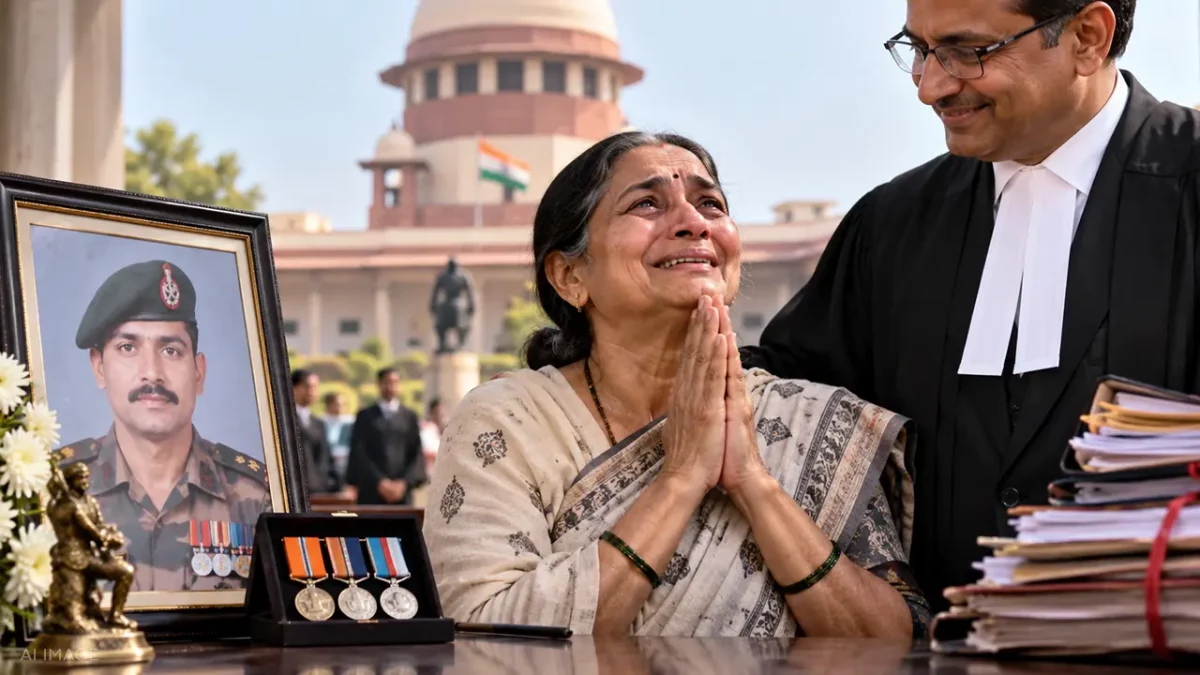
The Punjab and Haryana High Court has upheld an order granting invalid pension and ordinary family pension to the family of a former Army soldier who was medically boarded out after only seven years of service in 1978. The ruling, delivered on September 3, 2026, comes nearly 48 years after the soldier left the force and rejects the Union government’s attempt to deny the claim on the ground that he had not completed ten years of qualifying service.


Hakam Singh was enrolled in the Indian Army on August 18, 1971. He was invalided out of service in 1978 under the Army Rules, 1954, after being found permanently incapacitated. At the time of discharge he received invalid retirement gratuity. Service and medical records relating to his case were later destroyed in 2008 after the prescribed retention period expired, leaving no surviving papers that could establish the precise nature of the disability, its percentage, or whether it was attributable to or aggravated by military service.
Nearly 42 years after his invalidment, his widow approached the Armed Forces Tribunal seeking pensionary benefits available to personnel forced out of service because of permanent incapacity. On February 20, 2025, the Tribunal granted invalid pension to Singh for the period of his lifetime and ordinary family pension to his widow thereafter. The Union of India challenged that order before the High Court.
A Division Bench of Justices Harsimran Singh Sethi and Minderjeet Yadav dismissed the Centre’s petition. The government had argued that the soldier had not completed the minimum ten years of qualifying service required for invalid pension; that the absence of medical records made it impossible to determine entitlement; that the relevant benefit could be applied only prospectively from January 4, 2019, in terms of a government instruction dated July 16, 2020; and that the widow’s approach to the Tribunal after a delay of 42 years ought to defeat the claim.
The High Court held that these objections ran contrary to settled law. Relying on the Supreme Court’s decision in Union of India v. P.A. Thomas, the Bench observed that invalid pension is admissible even before completion of ten years of qualifying service. “Once, as per the settled principle of law settled in P.A. Thomas, it is well established that the invalid pension is admissible even prior to the completion of 10 years of qualifying service,” the Court said. It added that even if an officer is invalided out before completing ten years, he or she remains entitled to invalid pension where the other applicable conditions are satisfied. The ten-year requirement, by itself, could not defeat the claim.
The Bench also noted amendments made on January 4, 2019, to Rules 38 and 49 of the Central Civil Services (Pension) Rules, 1972, and a clarification issued by the Centre on February 12, 2019. That clarification stated that the ten-year qualifying-service condition would not apply to a government servant retiring on invalid pension on account of bodily or mental infirmity. The Court further recorded that a coordinate bench of the Armed Forces Tribunal had, in January 2025, held that the benefit could extend to soldiers invalided out before January 4, 2019. It declined to treat the 2019-20 instructions as a bar to retrospective relief in eligible cases.
On delay, the High Court held that pension is a continuing cause of action. The long interval between invalidment and the widow’s application was therefore not a sufficient ground to deny the benefit. Finding no perversity in the Tribunal’s February 20, 2025 order, the Bench dismissed the Union of India’s challenge and affirmed the grant of invalid pension during Singh’s lifetime and ordinary family pension to his widow after his death.
The judgment does not hold that every soldier invalided out before completing ten years automatically qualifies. Other conditions under the applicable rules must still be met. In this case, the Court concluded that those conditions had been satisfied and that the Centre had failed to displace the legal principles already settled by the Supreme Court and reflected in subsequent pension clarifications.
The decision adds to a line of High Court and Tribunal rulings that treat invalid pension as a protective entitlement for personnel permanently incapacitated in service, rather than as a benefit that can be withheld solely because the soldier fell short of a ten-year service threshold. For the widow, the order brings a measure of financial recognition almost five decades after her husband was forced out of the Army.