
The Indian Air Force has awarded a contract valued at about ₹135 crore (approximately $14 million) to New Delhi-based start-up Threye Interactive for indigenous part-task combat training simulators for the Mirage 2000 fleet. The award places an iDEX-developed system, already trialled on the upgraded Mirage 2000, on the path from prototype to operational training.
Threye Interactive is a subsidiary of NewSpace Research & Technologies. The parent company confirmed the ₹135-crore Indian Air Force contract for Mirage 2000 part-task simulators on 30 September 2026. Defence publication Livefist reported the signing on 29 September 2026. Earlier reports on 27 and 28 September had confirmed a procurement contract for a virtual-reality Part-Task Trainer without disclosing the value. No official Press Information Bureau release, quantity, or delivery schedule has been published.
From iDEX challenge to contract
The trainer was developed for the Mirage 2000 I/TI fleet under the Ministry of Defence’s Innovations for Defence Excellence (iDEX) programme, specifically the Defence India Start-up Challenge-5 (DISC-5) in the modelling and simulation category. The Department of Defence Production lists the Mirage 2000 Part-Task Trainer among the DISC-5 challenges assigned to the Indian Air Force.
The requirement was for a system that could support basic flying and simulation of the upgraded aircraft’s existing modes and functions. The system has completed Indian Air Force trials on the Mirage 2000 platform. The procurement indicates that the service intends to field it for structured training rather than rely only on live sorties for selected procedures and mission rehearsal.
What the simulator is designed to do
A part-task trainer does not replicate a full flight from take-off to landing. It concentrates on specific cockpit functions, systems operation, and mission elements so that aircrew can repeat difficult sequences, review errors, and practise again without consuming flying hours or airframe life.
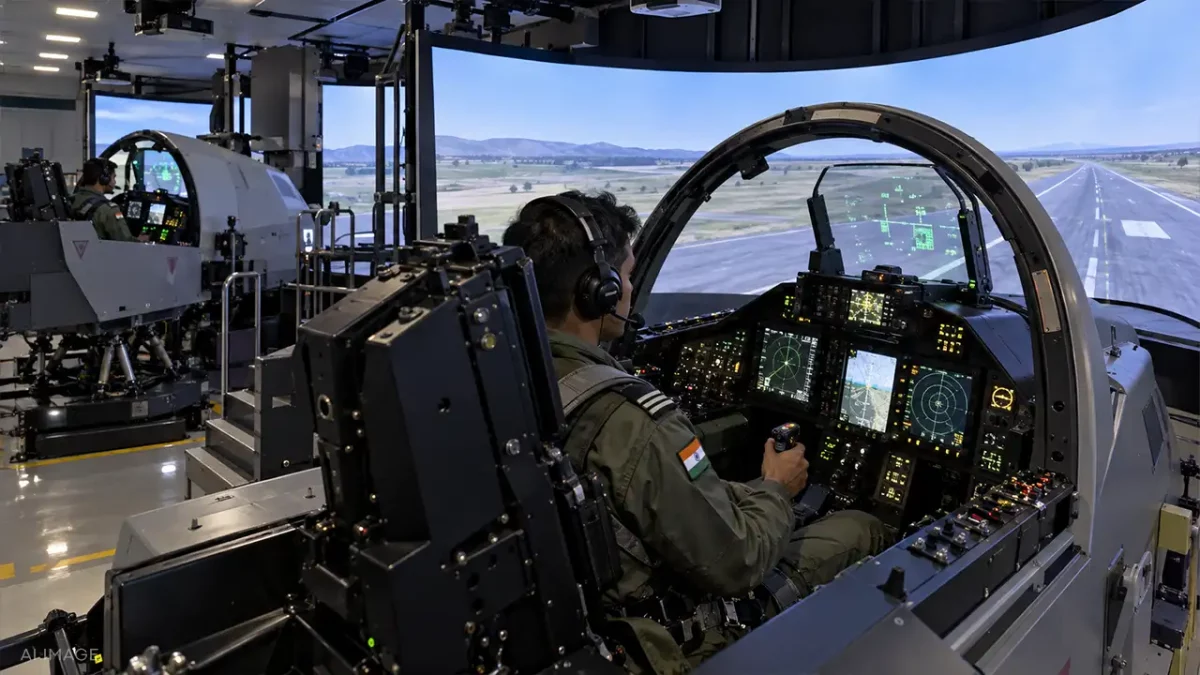
Threye’s system is a compact, PC-based Immersive Flight Training Device. It can be configured for individual or group training, and for virtual-reality or non-virtual-reality use. Reported cockpit representation includes the control stick and throttle, multifunction displays, the head-up display, the function selector and display unit, and associated switches and controls. Training tasks described in reporting include radar employment, target identification, weapon selection, threat response, combat manoeuvres, and coordinated large-force engagements in which pilots must track friendly aircraft, react to enemy fighters and ground defences, and adjust decisions as the mission changes.
Real-time networking is intended to allow multi-crew practice of situations that are difficult or expensive to stage in the air. The modular architecture is described as adaptable to other fixed-wing and rotary-wing platforms, subject to service requirements and integration. That wider application has not been contracted under this award.
Separate ground-crew system
Threye has also developed a distinct augmented-reality and virtual-reality technical training system for Mirage 2000 ground personnel. That system combines physical mechanical replicas, live electrical systems, and interactive digital modules for maintenance training, system checks, and fault diagnosis, including simulated fault insertion and networked multi-user instruction. The company states that this ground-crew system has been accepted and deployed by the Indian Air Force, and that it can reduce the cost of certain maintenance-training activities to less than 5 per cent of conventional training on operational platforms. Those figures are company claims and have not been independently confirmed in official releases.
Company background
Threye’s association with the Mirage 2000 predates the defence contract. In 2013 it released the PC game Operation Morning Glory, which placed players in a Mirage 2000 on a fictional mission. Former Indian Air Force fighter pilot Sameer Joshi, who had flown the Mirage and later founded NewSpace Research & Technologies, was involved in that development. In 2019 the company produced Indian Air Force: A Cut Above, the service’s official mobile combat game, later updated with a multiplayer version. Those products were for public engagement and recruitment. The present contract is for training of serving aircrew.
In 2025, Threye demonstrated a paired mission between a fighter and an uncrewed combat aircraft, drawing on Air Combat Intelligence Development work associated with NewSpace. The parent group is also engaged in military drone programmes, including collaborative combat aircraft concepts and systems such as the Sheshnaag attack drone.
Why the Mirage 2000 fleet matters
India inducted the French Dassault Mirage 2000 in the 1980s. The delta-wing fighter became a principal precision-strike platform, with a prominent role in the 1999 Kargil conflict and again in the 2019 Balakot strike. The fleet has since been upgraded by Dassault Aviation, Thales, and Hindustan Aeronautics Limited, with modernised avionics, radar, mission computers, glass cockpit, and weapon-delivery systems. Preserving flying hours and airframe life on this upgraded fleet, while still rehearsing complex procedures, is the operational rationale for the simulator buy.
At ₹135 crore, the contract is modest beside major fighter and missile programmes. Its significance lies in the Indian Air Force assigning frontline-fleet training content to an indigenous start-up that has moved an iDEX solution through trials into procurement. Delivery numbers, installation locations, and the induction timeline have not been disclosed.