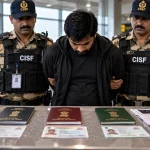

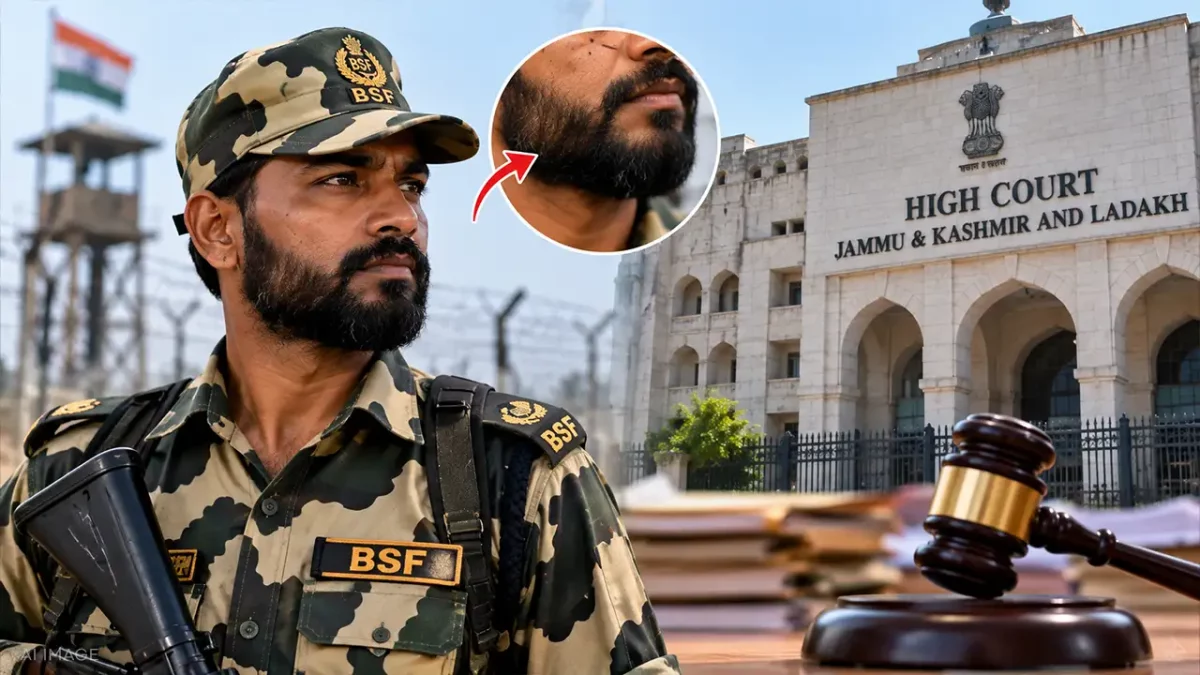
Srinagar, 1 October 2026: Justice Rajnesh Oswal dismissed the petition of Khursheed Ahmad Khan, who had challenged the order of 16 June 2023 by which the Commandant, 50 Battalion BSF, Praharinagar, Tura (Meghalaya), accepted his request for voluntary retirement and struck him off the strength of the unit with immediate effect.

The petitioner’s case
Khan was enrolled in the BSF in March 1998. On 6 January 2018 he was permitted to keep a neatly trimmed beard, subject to the condition that it remain neat and properly trimmed.
He told the court that this permission was withdrawn abruptly on 16 June 2023. He said the withdrawal left him in distress and led him, the same day, to apply for voluntary retirement. The request was accepted that day. He later sought to withdraw the application; that request was rejected. An order of 5 July 2023 directed him to draw pension and not to resume duty. A representation to the Director General, BSF, dated 19 July 2024, was not considered. He alleged that cancellation of the beard permission was vindictive and that the retirement was not truly voluntary.
The BSF’s version
The force said the 2018 permission was conditional. On 16 June 2023, it said, Khan was found shabbily dressed with a long, free-flowing and untrimmed beard, contrary to force regulations and to directions of the Supreme Court, and refused to trim it. Permission was then withdrawn.
According to the respondents, Khan himself asked to proceed on voluntary retirement after a parade. He was heard by the Commandant in the presence of other officers and, when asked, denied that the decision was under duress or compulsion. The proceedings were recorded. He is said to have cited his mother’s illness and his own inability, on account of his medical category, to bear the conditions of service. The competent authority considered his circumstances, service record and recent conduct, relaxed the three-month notice period, and accepted the request with immediate effect at Tura.
The force also stated that Khan had 13 adverse entries, including for absence without leave and intoxication, and was in a permanent low medical category.
Why the High Court declined to hear the plea
The BSF raised a preliminary objection on jurisdiction. The court agreed.
Justice Oswal held that the retirement application was submitted, and the impugned order passed, at Tura in Meghalaya, outside the territorial limits of the High Court of Jammu and Kashmir and Ladakh. Under Article 226 of the Constitution, writ jurisdiction depends on the cause of action arising, wholly or in part, within those limits. Even a fraction of the cause of action can confer jurisdiction only if it is an integral, essential or material part of the dispute. The court found no such part in this case within Jammu and Kashmir.
The petitioner’s reliance on the array of parties was rejected. The court recorded that the Inspector General, BSF, Kashmir, had no nexus with the controversy, and that the material formation was the Inspector General, BSF, Shillong. It also held that the seat of the Director General in New Delhi does not allow any High Court in the country to entertain the petition.
The court observed that the application was submitted, and the order passed, at a place beyond its territorial jurisdiction, and that no cause of action had accrued within its limits. The petition was dismissed at the threshold. Liberty was reserved to approach the jurisdictional court.
The High Court did not decide whether withdrawal of the beard permission was lawful, whether Khan was in fact compelled to retire, or whether the acceptance of voluntary retirement was otherwise valid.