

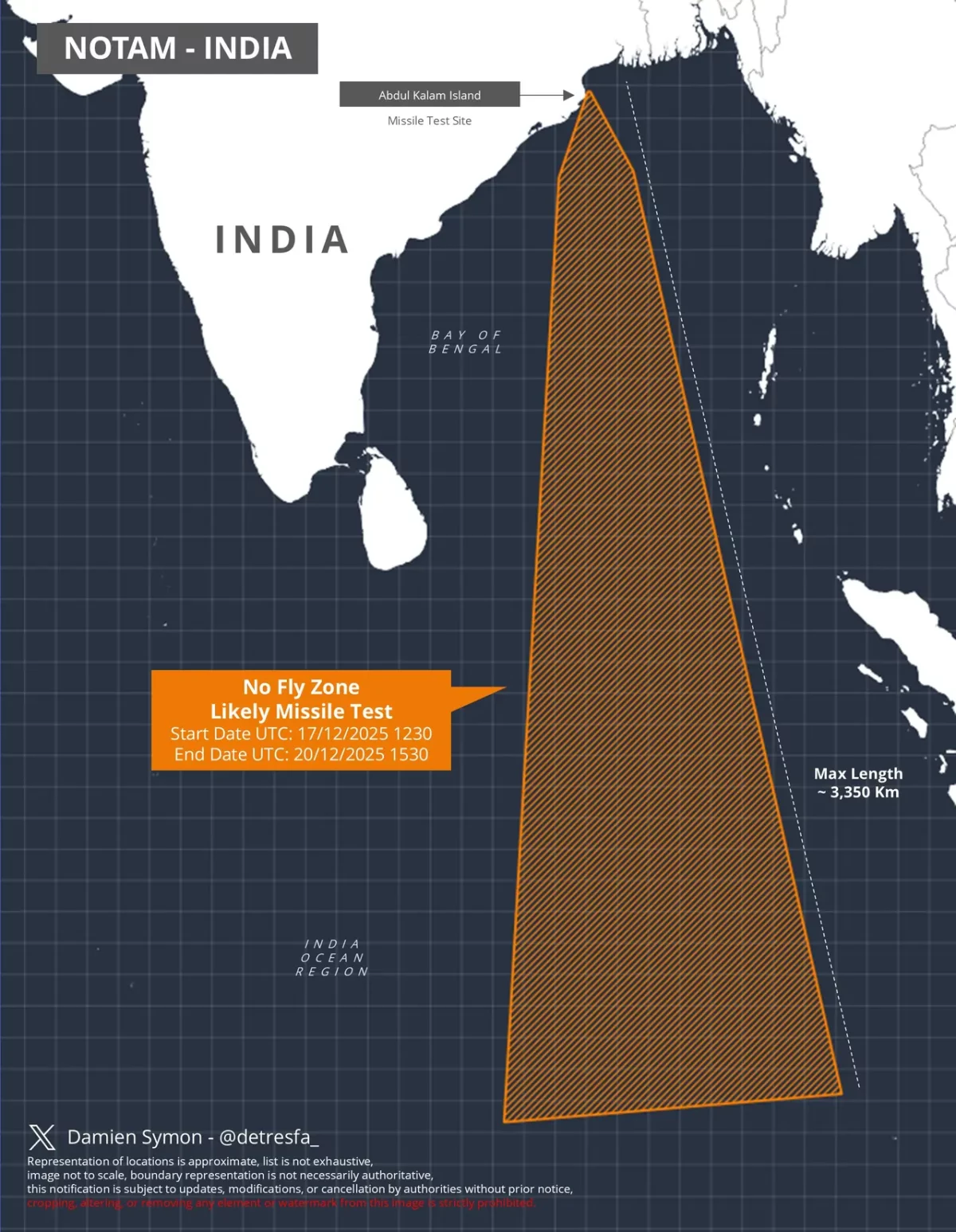
India has issued a Notice to Airmen (NOTAM) for a major missile test scheduled to be conducted in the Bay of Bengal between December 17 and 20, 2025, indicating a significant leap in the country’s strategic missile capabilities. The NOTAM establishes a massive no-fly and no-ship exclusion zone extending up to 3,550 km, one of the largest safety corridors ever declared for an Indian missile trial.





According to defence sources, the NOTAM will be active daily from 6:00 am to 6:00 pm IST during the test window. Civilian aviation and maritime traffic have been advised to reroute, while the Indian Air Force and Indian Navy will jointly enforce the restricted zone to ensure safety during the trial, particularly due to the risk of debris from missile stages.
The scale of the exclusion zone is significantly larger than the 1,480 km safety area notified during a missile test in October 2025, strongly suggesting the evaluation of a longer-range strategic system.
Likely Test of K-4 Submarine-Launched Ballistic Missile
Defence analysts assess that the test profile closely matches that of the K-4 submarine-launched ballistic missile (SLBM), a key component of India’s sea-based nuclear deterrent. Developed by the Defence Research and Development Organisation (DRDO), the solid-fuel K-4 is derived from Agni-series missile technology and is designed to address the limitations of the shorter-range K-15 Sagarika.
The K-4 programme was initiated after the launch of INS Arihant in 2009 to ensure India possesses a credible and survivable second-strike capability under its doctrine of credible minimum deterrence.
Submarine Integration and Operational Status
INS Arihant, commissioned in 2016, and INS Arighat, commissioned in 2024, are capable of carrying four K-4 missiles each, while the upcoming S4 and S4* ballistic missile submarines are expected to carry up to eight missiles per platform. By mid-2025, the K-4 reportedly achieved full operational status on Arihant-class SSBNs, with deterrent patrols undertaken following user trials aboard INS Arighat.
The December 17–20 test is believed to be aimed at further validating the missile’s range, accuracy and system integration, possibly as part of advanced user or operational trials.
Strategic Significance
With an operational range of 3,000–3,500 km, the K-4 enables India to hold strategic targets at risk while remaining in secure ocean bastions, significantly strengthening the sea leg of the nuclear triad. It provides a marked improvement over the 750 km-range K-15 and lays the groundwork for future systems such as the K-5 (5,000+ km) and the MIRV-capable K-6 (8,000 km), planned for deployment aboard next-generation S5-class SSBNs in the 2030s.
The missile’s development aligns with India’s broader maritime and strategic expansion in the eastern seaboard, centred around Visakhapatnam, which hosts critical nuclear submarine and missile infrastructure.
Why the 2,520 km Exclusion Zone Matters
The expanded safety corridor reflects the complexity of full-range ballistic missile testing, covering boost-phase ascent, mid-course flight and terminal re-entry phases. Solid-fuel stage separation, potential MIRV testing elements and splashdown zones necessitate wider safety buffers.
Defence sources note that previous K-4 trials in late 2024 involved exclusion zones of around 2,000 km, with the current expansion signalling increasing confidence and maturity of the system as it moves closer to sustained deployment.
If successful, the test will further cement India’s position among a small group of nations with credible sea-based nuclear deterrence, enhancing strategic stability in the Indo-Pacific amid evolving regional security dynamics.