

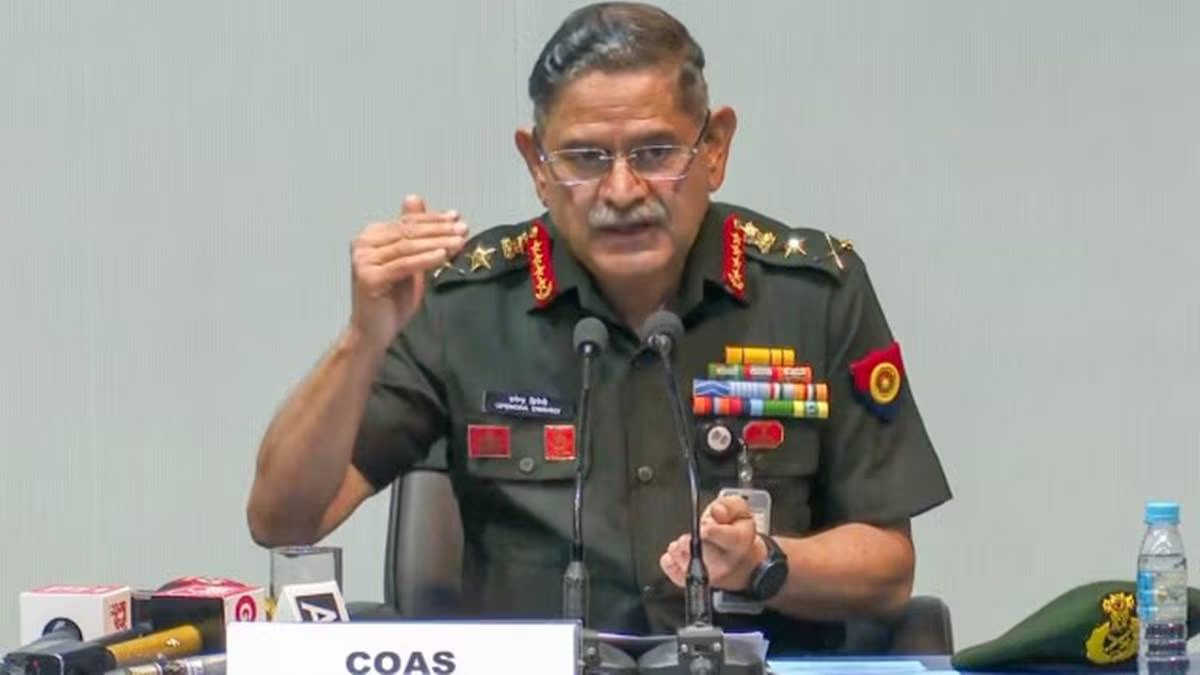
Chief of the Army Staff (COAS), General Upendra Dwivedi, is set to embark on an official visit to Australia from 16 to 19 February 2026, aimed at further strengthening India–Australia defence cooperation and reinforcing the growing strategic convergence between the two nations.



During the visit, the COAS will hold extensive interactions with senior leadership of the Australian Defence Forces (ADF), with a focus on enhancing army-to-army engagements, including joint training, bilateral exercises, professional exchanges and capacity-building initiatives. In Sydney, he will engage with senior leaders from Forces Command (FORCOMD), Special Operations Command (SOCOMD) and the 2nd Division, whose troops regularly participate in the bilateral Exercise AUSTRAHIND, scheduled to be held in India later in 2026.
In Canberra, General Dwivedi will be accorded a ceremonial welcome and Guard of Honour, followed by talks with Lieutenant General Simon Stuart, Chief of the Australian Army. Notably, both Army Chiefs are alumni of the US Army War College (Class of 2015), sharing a strong professional bond. Their interaction will be followed by a comprehensive round-table discussion at Australian Defence Forces Headquarters on defence cooperation, modernisation and future-oriented military operations. The COAS will also interact with the Commander of the Australian Defence College and address officers at the Australian Command and Staff College.
As part of high-level engagements, the COAS will call on the Chief of Defence Forces (CDF) and the Secretary of the Department of Defence, and visit Headquarters Joint Operations Command (HQJOC) to gain insights into ADF operational dynamics, including integrated and multi-domain operations. He will also lay a wreath at the Australian War Memorial to honour fallen soldiers and meet Indian defence veterans residing in Australia, reaffirming the enduring bond between the Indian Armed Forces and its veteran community.
The visit underscores the shared commitment of India and Australia to deepen defence cooperation and jointly contribute to peace, stability and security in the Indo-Pacific region, reflecting the growing strategic partnership between the two democracies.