

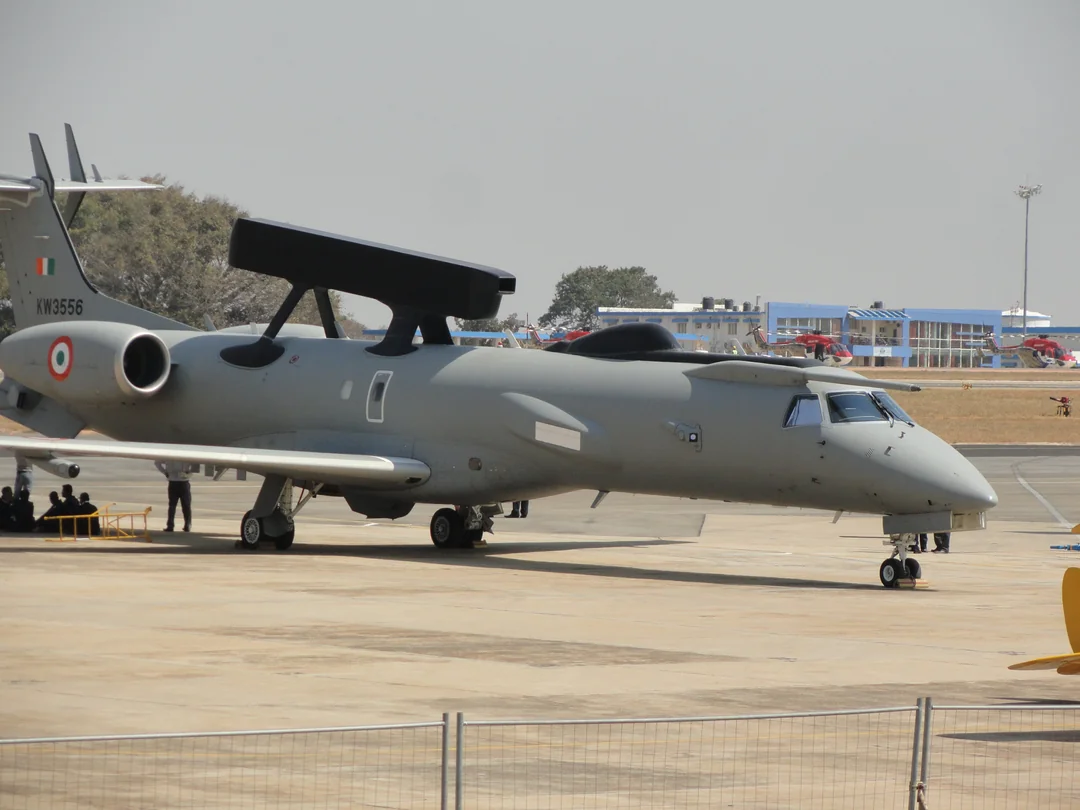
Bengaluru/New Delhi, June 25, 2026 — In a landmark achievement for India’s defence indigenisation efforts, the Defence Research and Development Organisation (DRDO) has granted Final Operational Clearance (FOC) to the indigenous Netra Airborne Early Warning and Control (AEW&C) system. The clearance was formally handed over to the Indian Air Force (IAF) during a ceremony held today at the Centre for Airborne Systems (CABS) in Bengaluru.





The FOC marks the successful culmination of extensive trials, validations, and operational refinements, confirming that the Netra system now fully meets all Air Staff Qualitative Requirements (ASQR) and is combat-mission ready for high-intensity operations. This milestone significantly strengthens the IAF’s airborne surveillance, early warning, battle management, and network-centric warfare capabilities.
Ceremony and Official Recognition
The formal declaration ceremony was presided over by Deputy Chief of the Air Staff Air Marshal Awadhesh Kumar Bharti. In his address, the Deputy Chief of the Air Staff commended the system’s proven operational utilisation and reliability, highlighting its contributions during key missions, including the Balakot strikes and Operation Sindoor.
Reports indicate that the FOC has been dedicated to the memory of the scientists and air warriors who lost their lives in the tragic 1999 crash of the Airborne Surveillance Platform (ASP) prototype. The ASP project, an earlier DRDO endeavour on a modified Avro HS-748 aircraft, suffered a setback when the prototype crashed near Arakkonam in Tamil Nadu in January 1999, claiming eight lives. The dedication underscores the nation’s resolve to honour their sacrifice by realising the long-cherished vision of a robust indigenous airborne surveillance capability.

The Netra AEW&C: India’s “Eye in the Sky”
The Netra (Sanskrit for “eye”) is a medium-sized AEW&C platform developed primarily by DRDO’s Centre for Airborne Systems (CABS) in Bengaluru, in collaboration with other DRDO laboratories such as LRDE (for radar), DEAL (communications), and industry partners including Bharat Electronics Limited (BEL). It is mounted on the Embraer ERJ-145 business jet platform, of which three aircraft have been delivered to the IAF.
An AEW&C system functions as a flying radar station and command centre. Operating at altitude, it dramatically extends the radar horizon beyond the limitations of ground-based radars, enabling early detection of airborne threats (fighters, transport aircraft, UAVs, and cruise missiles), surface targets, and providing real-time battle management. It identifies friend or foe, directs interceptors, coordinates multi-platform operations, and integrates seamlessly with ground-based systems such as the IAF’s Integrated Air Command and Control System (IACCS).
Technical Capabilities and Performance
The Netra features an indigenously developed Active Electronically Scanned Array (AESA) radar housed in an Active Antenna Array Unit (AAAU) with back-to-back planar arrays, providing approximately 240° azimuthal coverage in the current Mk 1 configuration. The system integrates Identification Friend or Foe (IFF), Electronic Support Measures (ESM) for emitter detection and location, Communications Support Measures (CSM), secure data links (including SATCOM), and a self-protection suite.
Key capabilities include:
- Surveillance and Detection: Long-range tracking of airborne and maritime targets, with instrumented ranges in the 250–400+ km class depending on target radar cross-section (RCS). It can detect and track multiple targets simultaneously, including low-observable threats.
- Battle Management: Five operator workstations enable command and control functions, directing friendly aircraft, sharing the recognised air picture, and supporting beyond-visual-range engagements.
- Networking: Robust interoperability with fighters, other AEW&C platforms, and ground stations, enhancing overall situational awareness and force multiplication.
- Endurance: Approximately 5–6 hours unrefuelled, extendable to around 9 hours with air-to-air refuelling.
- Additional Sensors: Integrated ESM/CSM for electronic intelligence and self-protection systems including Radar Warning Receivers (RWR) and countermeasures.
The three Netra aircraft, operated primarily by No. 200 Squadron, were initially inducted under Initial Operational Clearance (IOC) configuration following the first delivery in February 2017 and IOC in October 2017. Subsequent trials and upgrades have now enabled full FOC status.
Operational Significance and Strategic Impact
The Netra system has already demonstrated its value in real-world operations, notably during the 2019 Balakot airstrikes, where it provided critical airborne surveillance and battle management support. Its FOC now allows unrestricted deployment across the full spectrum of IAF missions, from peacetime air defence and border surveillance to offensive operations and support for joint operations.
Strategically, the Netra complements the IAF’s existing fleet of larger Phalcon AWACS platforms (based on the Il-76). While the Phalcons offer greater endurance and range in certain configurations, the indigenous Netra provides a cost-effective, rapidly deployable, and scalable medium AEW&C solution that can be produced and sustained domestically. This layered approach enhances redundancy and coverage, particularly important given India’s extensive borders and the demands of potential two-front scenarios.
The clearance represents a major milestone in the Atmanirbhar Bharat initiative in defence. It validates DRDO’s ability to deliver complex “system of systems” platforms and reduces dependence on foreign suppliers for this critical capability.
Future Roadmap
With FOC achieved, attention now shifts to the next phase of capability enhancement. Plans include:
- Netra Mk 1A: Upgraded variants with improved gallium nitride-based transmit-receive modules, enhanced software, and better human-machine interfaces. Additional Embraer-based platforms are under consideration.
- Netra Mk 2: A more advanced version on the Airbus A321 platform (six aircraft cleared), offering improved performance and endurance.
- Longer-term options for larger 360° coverage platforms.
These developments will further expand the IAF’s airborne surveillance fleet and consolidate India’s position among nations capable of designing and producing advanced AEW&C systems.
A Testament to Perseverance and Indigenous Excellence
The journey from the ambitious yet ill-fated ASP project of the 1990s to today’s FOC for Netra spans over two decades of persistent effort by DRDO scientists, engineers, the IAF, and industry. Today’s achievement not only delivers a potent operational asset but also serves as a fitting tribute to those who laid the foundational work at great personal cost.
As India continues to modernise its armed forces, the Netra AEW&C stands as a powerful symbol of technological sovereignty and operational readiness. It strengthens the IAF’s ability to maintain air superiority and contributes meaningfully to the nation’s overall defence posture.