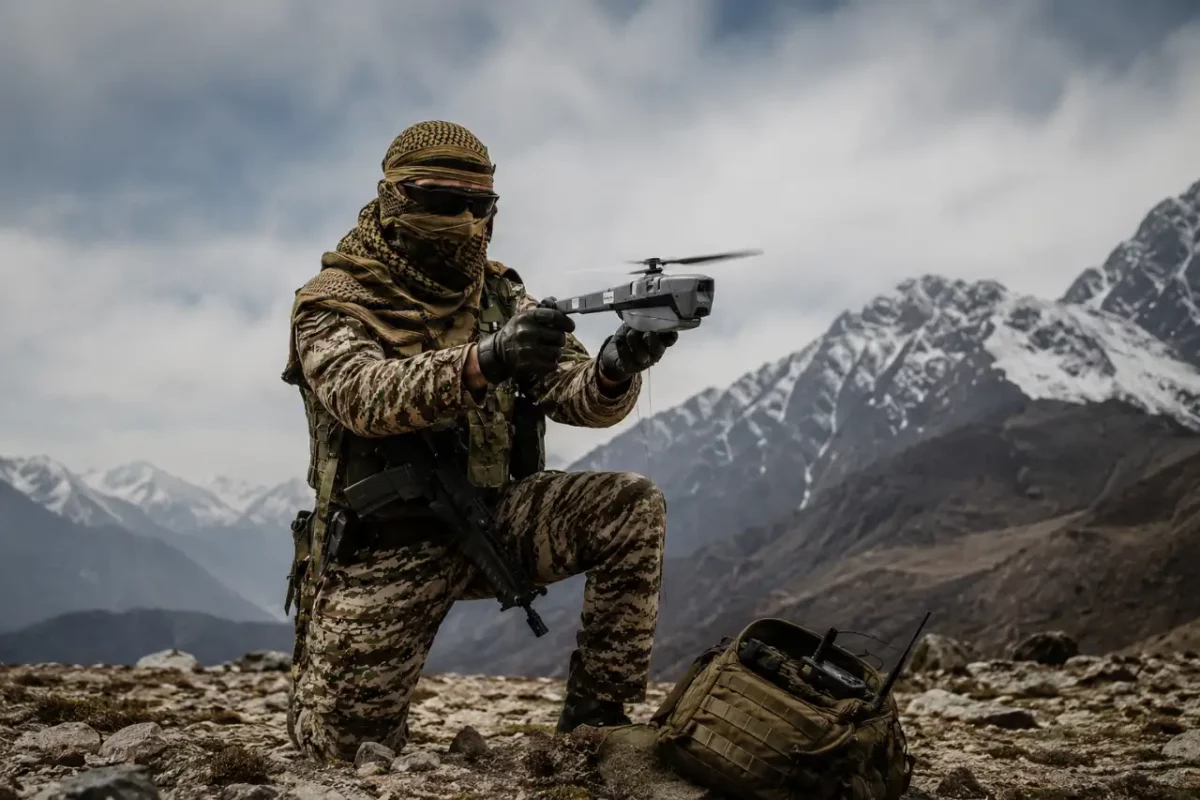
The Indian Air Force has initiated a significant capability upgrade for its elite Garud Commando Force by issuing a Request for Information (RFI) for indigenous man-portable loitering munitions. The move aims to provide these special forces operators with an organic, long-range precision strike and reconnaissance capability that can operate independently of conventional air or artillery support.





According to the RFI, issued under the Make in India initiative, the system must be lightweight and fully man-portable so that small special forces teams can carry and launch it without heavy platforms or extensive logistical support. Key technical requirements include a minimum operational range of 40 kilometres, flight endurance of more than two hours, and the ability to carry both high-explosive (HE) and high-explosive anti-tank (HEAT) warheads. This dual-warhead flexibility will allow Garud teams to engage a wide spectrum of targets — from enemy personnel and bunkers to armoured vehicles and command posts.
Understanding Loitering Munitions
Loitering munitions, often called “kamikaze drones” or suicide drones, combine the roles of a surveillance unmanned aerial vehicle and a precision-guided munition. Once launched, the system can fly to a designated area, loiter overhead while transmitting real-time video and sensor data to the operator, identify high-value targets, and then dive onto them with lethal effect. Crucially, the operator retains the ability to abort the strike if conditions change or if collateral damage risks become unacceptable. This “find, fix, finish” loop dramatically shortens the sensor-to-shooter timeline compared with traditional call-for-fire procedures.
The RFI also stresses survivability features. The munitions must function effectively in GPS-denied environments and resist electronic warfare measures — requirements shaped by lessons from recent high-intensity conflicts where electronic attack has become routine.
Why Garuds Need This Capability
Currently, the heaviest man-portable weapon typically available to Indian special forces teams is an anti-tank guided missile with an effective range of roughly 4–5 km. A 40 km-range loitering munition multiplies that engagement envelope nearly tenfold while simultaneously giving the team its own airborne reconnaissance asset. For Garud operators working deep in contested or denied areas — whether in high-altitude mountains, dense jungles, or complex urban terrain — this organic “eyes-and-strike” package is a genuine force multiplier.
It reduces dependence on external fire support that may be delayed, unavailable, or politically constrained. It also allows small teams to conduct stand-off attacks with far lower risk of collateral damage than larger munitions or artillery, an important consideration in populated areas or near critical infrastructure.
Background: The Garud Commando Force
Raised in 2004 in the aftermath of terrorist threats to Indian airbases, the Garud Commando Force is the Indian Air Force’s dedicated special operations unit. Its core mandates include protecting critical air force installations, combat search and rescue of downed aircrew, special reconnaissance, counter-terrorism and counter-insurgency operations, suppression of enemy air defences, and the establishment or securing of forward airbases in hostile territory.
Personnel undergo one of the longest and most rigorous training pipelines among Indian special forces — lasting up to three years for full qualification — that includes airborne operations, jungle and snow survival, demolition, diving, and attachments with Army special forces and Rashtriya Rifles units. The force currently comprises an estimated 1,600-plus personnel organised into multiple flights based at key air force stations, with headquarters at the Garud Regimental Training Centre in Hindon.
Garuds have seen operational employment in Jammu and Kashmir counter-insurgency operations (including high-profile actions such as Operation Rakh Hajin), United Nations peacekeeping in Congo, security of critical assets during the 2016 Pathankot attack, and deployments along the Line of Actual Control during the 2020 standoff with China.
Strategic and Industrial Context
The decision reflects broader lessons from contemporary battlefields, particularly the extensive use of loitering munitions by both sides in the Russia-Ukraine conflict. Systems such as the American Switchblade, Polish Warmate, Turkish Kargu, and Israeli Harop have repeatedly demonstrated the ability of relatively low-cost, expendable munitions to destroy tanks, artillery, command posts, and fortifications while providing persistent surveillance.
India has already inducted or tested several indigenous loitering munition systems for the Army and other users. The IAF’s RFI specifically seeks a man-portable variant optimised for special operations, reinforcing the push for domestic industry to deliver solutions that meet stringent size, weight, power, and electronic-warfare resilience requirements.
Once fielded, these munitions will give Garud teams artillery-like reach and precision in the hands of a small, highly mobile unit. They will expand the force’s ability to conduct independent deep-strike and reconnaissance missions, improve situational awareness behind enemy lines, and provide commanders with more flexible options across the spectrum of conflict — from counter-terrorism to high-intensity conventional operations.
The RFI marks another concrete step in the modernisation of India’s special forces, aligning the Garud Commando Force with the demands of technology-intensive, contested battlespaces of the coming decade.