
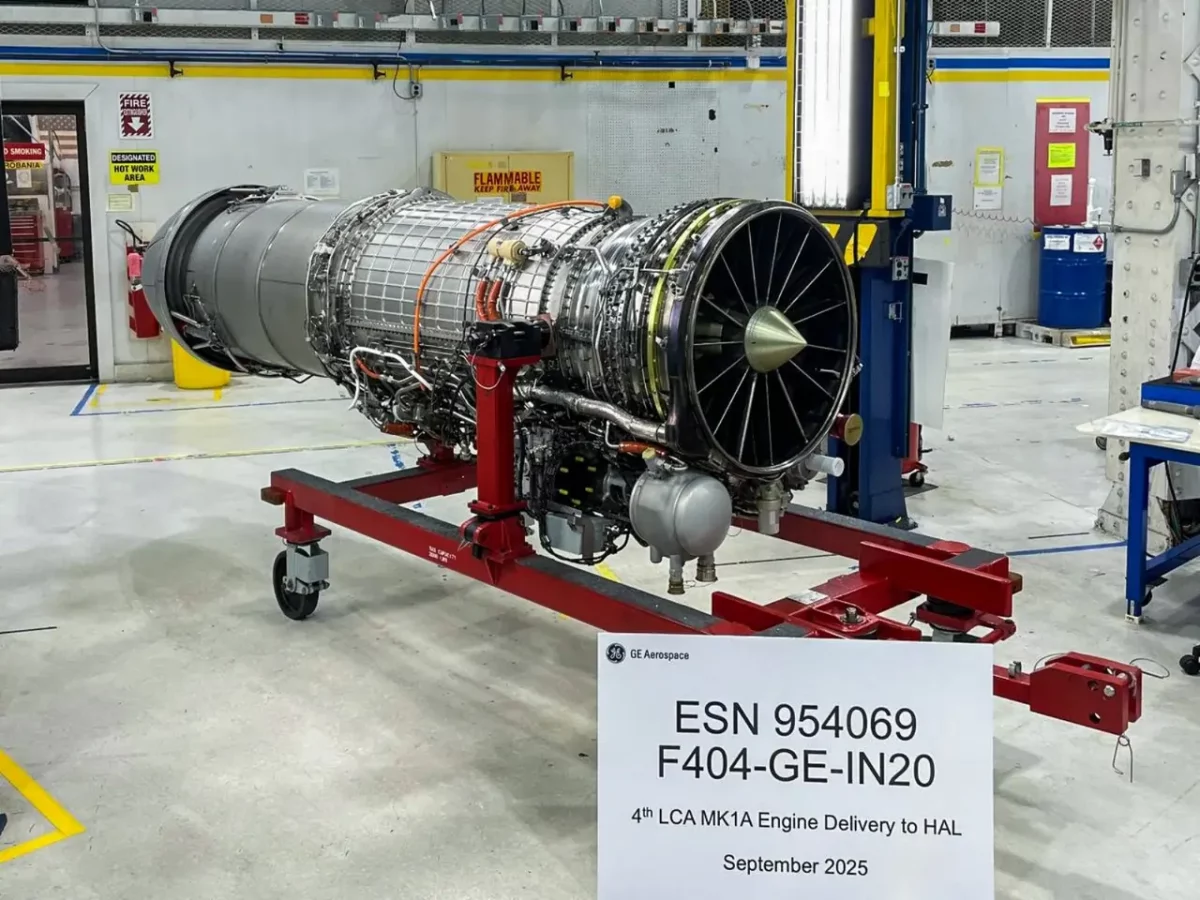
GE Aerospace has delivered the fifth F404-IN20 engine to Hindustan Aeronautics Limited (HAL), marking another significant step forward in the production of the TEJAS MK-1A fighter jets for the Indian Air Force (IAF). The handover is part of the 2021 contract for 99 engines and reflects steady progress in stabilising the supply chain after earlier delays.




The F404-IN20 engines are the powerplants for the enhanced Light Combat Aircraft (LCA) TEJAS MK-1A, which features advanced avionics, upgraded radar, electronic warfare systems, and improved reliability over the baseline TEJAS MK-1 variant.
HAL confirmed that earlier disruptions in supply have eased, enabling consistent deliveries. GE has committed to supplying 12 engines by the end of FY 2025. The first engine under the contract arrived in March 2025, followed by deliveries in September and October, paving the way for the latest milestone.
The IAF has already placed orders for 83 TEJAS MK-1A aircraft, and a proposal for an additional 97 jets is under advanced consideration. HAL aims to ramp up production to 30 aircraft per year by 2026–27, supported through expanded public-private partnerships.
In November 2025, HAL signed a landmark agreement with GE Aerospace worth over $1 billion for 113 additional F404-IN20 engines and support packages. These engines will power the next 97 TEJAS MK-1A fighters, with deliveries scheduled from 2027 to 2032. The deal underscores growing Indo-US defence cooperation and accelerates India’s goal of expanding its indigenous fighter fleet to 352 TEJAS variants.
The engines being supplied include performance enhancements tailored to Indian requirements, offering improved thrust, durability, and multirole mission capability. HAL Chairman DK Sunil stated that stabilised international supply chains have set the stage for timely MK-1A rollouts, with full-scale manufacturing underway.
The continued collaboration between HAL and GE Aerospace—spanning more than four decades—supports India’s push for self-reliance in aerospace manufacturing while strengthening operational readiness amid evolving regional security challenges.