

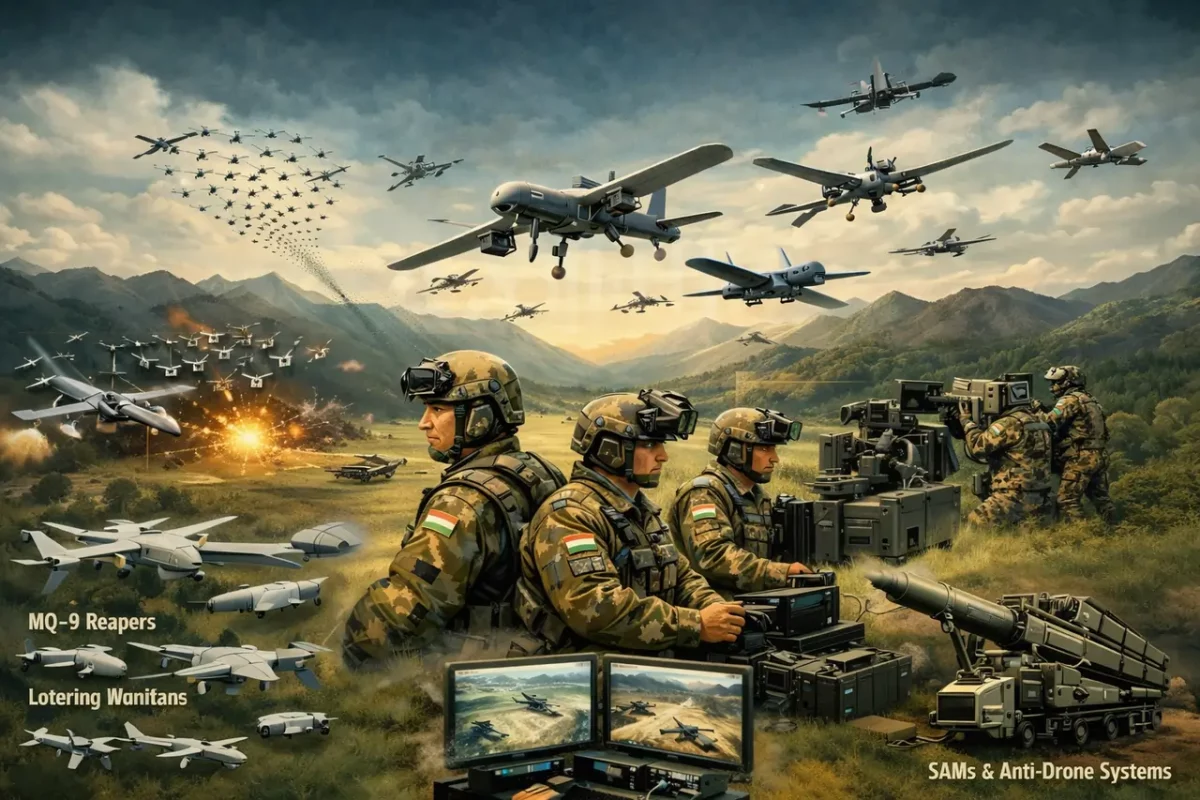
In a major shift towards future warfare, the Indian Army has announced plans to raise 15–20 specialised drone warfare units, known as Shaktibaan Drone Regiments. This initiative marks one of the most significant transformations in India’s land warfare doctrine, placing unmanned systems, autonomous platforms, and precision strikes at the core of combat operations.





The move is part of a broader force transformation vision under General Upendra Dwivedi, aimed at preparing India for battlefields increasingly dominated by drones, loitering munitions, and network-centric warfare.
What Are Shaktibaan Drone Regiments?
Shaktibaan Regiments are newly raised formations under the Regiment of Artillery of the Indian Army. Unlike conventional artillery units, these regiments are designed around unmanned aerial combat systems rather than guns or rockets.
They are expected to operate:
- Swarm drones
- Loitering munitions (kamikaze drones)
- Long-range unmanned aerial vehicles (UAVs)
Collectively, these systems will allow the Army to strike targets ranging from 5 km to nearly 500 km deep inside enemy territory—without risking pilots or large troop formations.
Defence officials have confirmed that initial Shaktibaan units are already being operationalised, with more to follow in phases.
Why Shaktibaan Regiments Matter
Recent global conflicts have demonstrated that drones can decisively alter battlefield outcomes—from intelligence gathering to deep precision strikes. The Indian Army sees Shaktibaan Regiments as a response to this reality.
These units will:
- Enhance precision strike capability across multiple fronts
- Reduce reliance on manned platforms for high-risk missions
- Enable rapid, scalable, and cost-effective combat power
- Support multi-domain operations by integrating air, land, cyber, and electronic warfare inputs
By embedding drones directly within artillery formations, the Army aims to achieve real-time surveillance-to-strike loops, dramatically shortening decision and response times.
Key Features of Shaktibaan Drone Regiments
1. Swarm Drone Technology
Swarm drones operate as coordinated groups, sharing data in real time. They can:
- Saturate enemy air defences
- Conduct simultaneous reconnaissance and attack missions
- Execute complex operations with minimal human intervention
This capability is particularly effective against high-value or well-defended targets.
2. Loitering Munitions
Also known as suicide or kamikaze drones, loitering munitions combine surveillance and strike roles.
They:
- Hover over target areas for extended periods
- Attack only after target confirmation
- Offer high precision with minimal collateral damage
India already fields indigenous loitering munitions, and their numbers will expand rapidly under the Shaktibaan framework.
3. Long-Range UAVs
Long-range drones will bridge the gap between traditional artillery systems like Pinaka and strategic missiles such as BrahMos.
These UAVs will provide:
- Persistent ISR (Intelligence, Surveillance, Reconnaissance)
- Deep-strike options without escalation to missile use
- Greater flexibility in deterrence and limited conflict scenarios
Fast-Track Procurement & Indian Industry Push
To equip the first Shaktibaan Regiments, the Indian Army is set to issue fast-track tenders for around 850 loitering munitions, along with launchers and support systems.
The programme—estimated at ₹2,000 crore—is expected to involve leading Indian defence firms such as:
- Solar Defence & Aerospace
- Adani Defence
- RapheM
Deliveries are anticipated within two years, reinforcing India’s Atmanirbhar Bharat push in defence manufacturing.
Part of a Larger Drone Warfare Ecosystem
Shaktibaan Regiments are not a standalone effort. They complement several parallel initiatives, including:
- Training of over 100,000 drone operators
- Creation of Ashmi drone platoons within infantry units
- Raising of Bhairav Special Forces with drone-centric roles
Together, these reforms signal a decisive shift from platform-heavy warfare to technology-driven, unmanned combat operations.
The Bigger Picture
With 15–20 Shaktibaan Drone Regiments, the Indian Army is laying the foundation for drone-led wars of the future—where speed, autonomy, precision, and information dominance will outweigh sheer numbers.
As India faces complex security challenges along both western and northern borders, the Shaktibaan initiative represents a doctrinal leap, ensuring that the Army remains agile, lethal, and technologically ahead in the evolving character of warfare.