
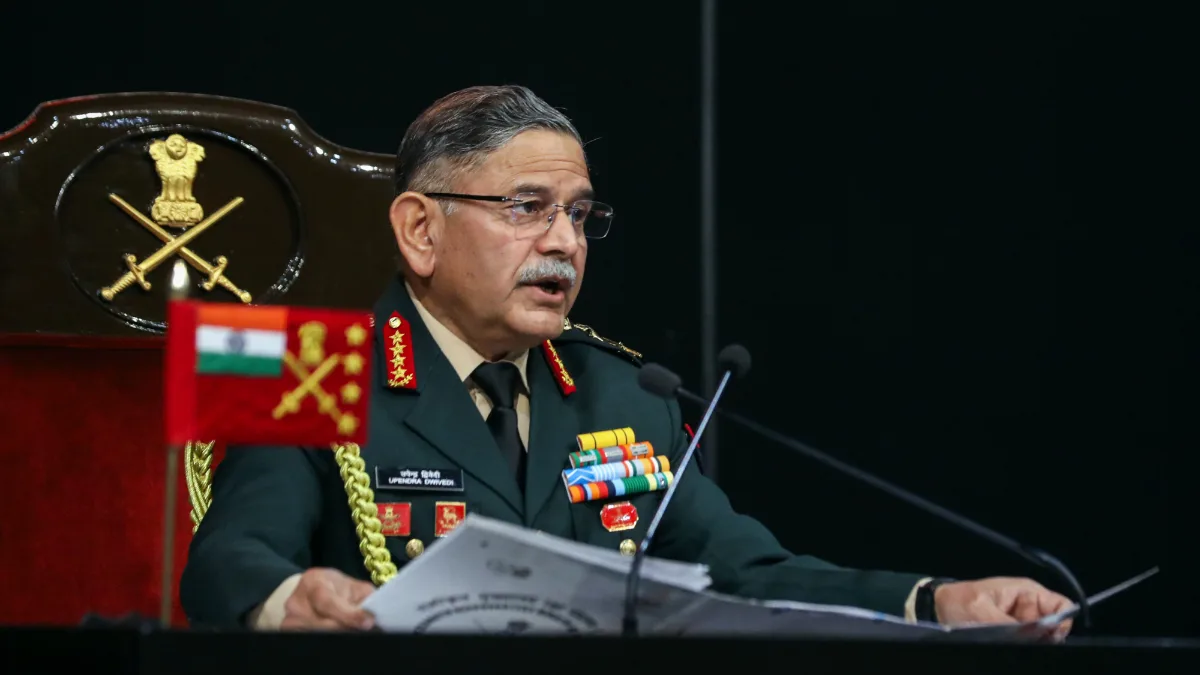
In a significant statement on the integration of women into the Indian Army, Chief of Army Staff General Upendra Dwivedi has underscored the force’s commitment to gender neutrality rather than mere equality, while indicating readiness to induct women into infantry roles contingent upon societal acceptance. This assertion was made during his annual press conference on January 13, 2026, where he addressed ongoing efforts to enhance women’s participation in various military capacities.


General Dwivedi emphasized that women should not be perceived as a “vulnerable commodity” but as capable contributors requiring robust standards. He stated, “If standards are same, if capabilities are same, and in India as a nation, society is ready to accept it, it (combat role) can be done tomorrow.” This highlights the Army’s pragmatic approach, balancing operational requirements with social evolution.
The Army Chief elaborated that achieving uniform standards remains challenging due to medical authorities and team composition constraints, which currently limit full gender neutrality. He noted, “Today, I am not able to ensure gender neutrality because there are medical authorities which do not allow me and the team of composition, where the females also say no, sir, it’s not possible.” Despite these hurdles, he expressed optimism about progressive changes, citing examples such as the Common Physical Test (CPT) 26, where efforts to align standards have been pursued but not fully realized.
Looking ahead, General Dwivedi outlined a data-driven strategy: over the next three to four years, performance metrics from women officers will guide the expansion of opportunities. This phased approach would begin with supporting arms not yet open to women, progress to combat arms, and eventually extend to special forces. He described this as “a sequential and welcome social change,” reflecting broader societal shifts from segregated educational institutions and laws to more inclusive norms.
In terms of current initiatives, the Indian Army is actively increasing women’s induction across ranks. At the National Defence Academy (NDA), 60 women cadets are enrolled, with an annual intake of 20 planned. The Officers’ Training Academy (OTA) in Chennai and Gaya aims to induct 120 women annually. For other ranks (ORs), amendments to Section 12 of the Army Act are under consideration to facilitate greater inclusion, targeting a 12-fold increase by 2032. Presently, approximately 8,000 women serve as officers, and the Territorial Army has recently opened vacancies for women, with 110 positions anticipated.
This stance aligns with prior developments, such as the Supreme Court’s 2020 ruling granting permanent commissions to women officers, marking a pivotal step toward gender parity in the armed forces. General Dwivedi’s comments also resonate with recent acknowledgments of women’s exemplary performance, as noted in a January 13, 2025, statement where he affirmed that women officers are “doing remarkably well” and that induction efforts would continue to expand.
The Army Chief’s remarks come amid global discussions on women’s roles in militaries, drawing parallels to conflicts worldwide where gender-inclusive forces have demonstrated effectiveness. As India advances its military modernization—including the establishment of drone regiments, rocket forces, and indigenization of ammunition—the integration of women remains a key pillar of reform, ensuring the force’s adaptability and inclusivity.