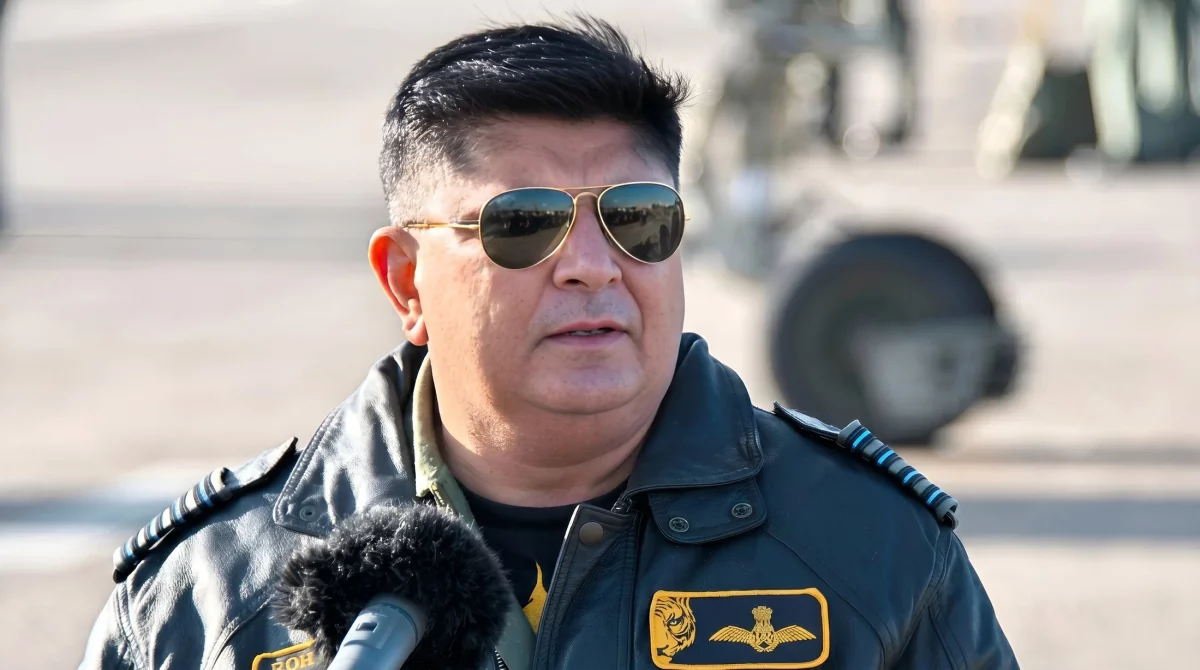
Air Commodore Rohit Kapil stands among the distinguished senior officers of the Indian Air Force, known for his operational expertise, leadership under pressure, and contributions to India’s evolving air defence architecture. As the Air Officer Commanding (AOC) of 45 Wing at Sirsa, Haryana, he played a crucial role during Operation Sindoor in May 2025—a high-intensity, short-duration conflict that tested India’s integrated air defence preparedness.





During this period of heightened hostilities, India’s western airspace remained under constant threat from aerial and missile-based attacks. Under Air Commodore Kapil’s command, air defence systems were maintained at peak operational readiness, ensuring rapid response capability against any incoming threat. His leadership contributed significantly to the successful neutralisation of a hostile missile threat, safeguarding critical regions and reinforcing the credibility of India’s multi-layered air defence network.
For his distinguished service in active operations and exceptional leadership, he was awarded the Yudh Seva Medal in 2025 by the President of India, Droupadi Murmu. This recognition reflects his vital contribution to national security during a period of operational stress.
A Career Defined by Flying Excellence and Leadership
Commissioned into the Flying Branch of the Indian Air Force on 20 June 1998, Air Commodore Kapil belongs to a generation of fighter pilots who have shaped India’s modern air combat capability. A specialist on the Sukhoi Su-30MKI, one of the IAF’s most advanced multirole fighter aircraft, he has accumulated over 3,500 hours of flying experience across multiple aircraft platforms.
His professional credentials include qualification as a Category ‘A’ Flying Instructor, a distinction that underscores his expertise not just as an operational pilot but also as a mentor responsible for training future generations of fighter pilots. Over the years, he has played a direct role in strengthening the IAF’s human resource and combat readiness.
In March 2016, he took command of a frontline Su-30MKI squadron that had been recently reactivated. Under his leadership, the squadron achieved rapid operational stabilisation, inducted new aircraft efficiently, and maintained high serviceability rates. His emphasis on rigorous training, discipline, and mission preparedness significantly enhanced the squadron’s operational effectiveness. In recognition of these contributions, he was awarded the Vayu Sena Medal (Devotion to Duty) on 26 January 2018 while serving as a Group Captain.
Strategic Exposure and International Engagements
Air Commodore Kapil’s career is also marked by important international exposure and strategic learning. He has attended the prestigious Advanced Command and Staff Course in the United Kingdom, gaining deeper insights into joint operations, strategic planning, and modern warfare doctrines.
He has represented India in joint military engagements, including exercises with the Republic of Singapore Air Force, where he contributed to enhancing interoperability, tactical coordination, and operational exchange between the two air forces. Such engagements play a crucial role in strengthening India’s defence diplomacy and operational preparedness in a global context.
In addition, he has been involved in key operational initiatives within India, including planning and executing air operations from forward and remote airfields in challenging environments. These initiatives highlight his adaptability and innovative approach to maximising operational reach under constrained conditions.
Role During Operation Sindoor
Operation Sindoor, launched in May 2025, was a calibrated military response by India following a major terrorist attack in Jammu and Kashmir. The operation involved coordinated air and missile strikes on identified targets, followed by a brief but intense period of escalation involving aerial engagements and missile threats.
As the Air Officer Commanding of a strategically located forward air base, Air Commodore Kapil was responsible for ensuring seamless coordination between fighter operations and ground-based air defence systems. His role required real-time decision-making, integration of radar and missile networks, and maintaining readiness across multiple operational domains.
During the conflict, India’s air defence systems successfully responded to incoming threats, demonstrating the effectiveness of indigenous and integrated technologies in safeguarding national airspace. Air Commodore Kapil’s leadership ensured that defensive measures remained robust while offensive operations continued without disruption, reflecting a balanced and coordinated operational approach.
Continuing Service and Strategic Importance
In his current role at 45 Wing, Sirsa, Air Commodore Kapil continues to oversee one of the Indian Air Force’s critical operational bases. His responsibilities include managing frontline squadrons, ensuring combat readiness, supervising air defence coordination, and maintaining high alertness in a sensitive sector near the western frontier.
His career trajectory—from a young fighter pilot to a senior operational commander—mirrors the evolution of the Indian Air Force into a technologically advanced and strategically agile force. Through decades of service, he has contributed to strengthening India’s air power, both in terms of operational capability and leadership development.
Air Commodore Rohit Kapil’s journey reflects the core ethos of the Indian Air Force—precision, professionalism, and unwavering commitment to national security. In an era defined by complex and rapidly evolving threats, officers of his calibre continue to play a decisive role in ensuring that India’s skies remain secure.