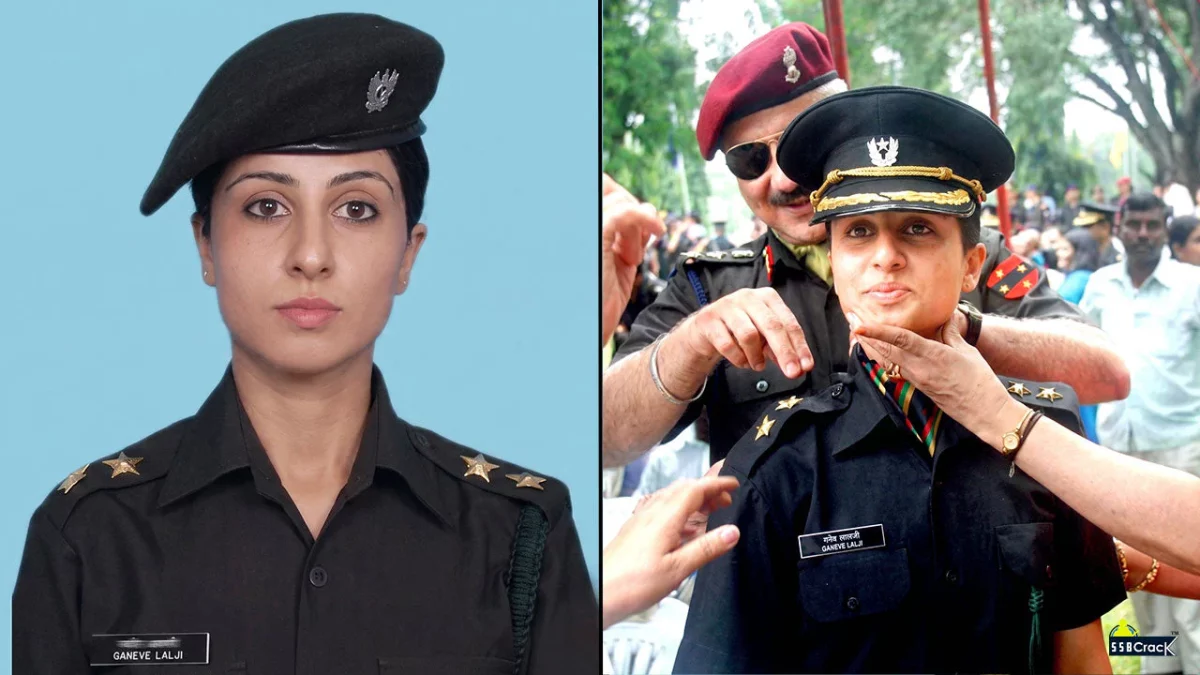
In the history of the Indian Army, some milestones are remembered not only for the appointment itself but also for the message they send to future generations. One such landmark moment came in July 2013, when Lieutenant Ganeve Lalji became the first woman officer in the Indian Army to be appointed as Aide-de-Camp to an Army Commander.





Her appointment as ADC to Lieutenant General Rajan Bakshi, then General Officer Commanding-in-Chief of Central Command, was a significant step in the gradual expansion of professional opportunities for women officers in the Army. It was not merely a ceremonial posting. It was a position of trust, discipline, coordination and close interaction with senior military leadership.
Ganeve Lalji’s achievement marked a new chapter in the journey of women officers in the Indian armed forces. At a time when women were still serving mainly in selected branches and roles, her selection showed that capability, merit and professionalism could open doors that had traditionally remained closed.
Ganeve Lalji came from a family deeply rooted in military service. She belonged to a third-generation Army family, where service to the nation was not just an idea but a lived tradition. Her grandfather, Major General Lalji D. Singh, served in the Corps of Engineers, particularly the Bombay Sappers, and retired in the 1980s after a distinguished career. Her father, Colonel S.S. Lalji, also served in the Army and was associated with 411 Para Regiment at the time of her commissioning.
Growing up in such an environment naturally shaped her outlook towards discipline, service and leadership. For Ganeve Lalji, joining the Army was not an accidental choice. A graduate in Physics, she described her decision to wear the uniform as a natural call from within. Her family background gave her inspiration, but her own determination helped her earn her place in the service.
She underwent pre-commission training at the Officers’ Training Academy in Chennai, one of India’s premier military training institutions for future officers. On 18 September 2011, she passed out as a Lieutenant during a ceremony that saw 352 young officers being commissioned into the Indian Army. Among them were 104 women officers, representing the growing presence of women in the officer cadre.
After commissioning, Ganeve Lalji joined the Intelligence Corps, a branch that demands sharp intellect, discretion, analytical ability and professional maturity. During her Young Officers’ course in Pune, she displayed impressive performance and proved her ability to handle demanding responsibilities at an early stage of her career.
Her rise to a historic appointment came within a short span of service. By 2013, with less than two years in uniform, Lieutenant Ganeve Lalji was chosen for the prestigious role of ADC to an Army Commander. The appointment was important because ADCs serve in close proximity to senior commanders and are entrusted with responsibilities that require reliability, alertness and confidence.
The selection was not casual or symbolic. It came after a serious evaluation process. Under the leadership of then Army Chief General Bikram Singh, the Army studied the aspirations, motivation and professional potential of women officers. Hundreds of women officers were reportedly assessed on qualities such as toughness, leadership, confidence and suitability for high-responsibility roles.
Out of this competitive process, Ganeve Lalji emerged as the standout officer. Her appointment was announced in June 2013, and she assumed the role on 1 July 2013, the same day Lieutenant General Rajan Bakshi took charge of the Central Army Command in Lucknow.
The role of an Aide-de-Camp is both demanding and prestigious. An ADC assists a senior commander in managing official schedules, protocol duties, engagements, communication and coordination. The officer must maintain composure, discipline and efficiency while operating in a high-pressure environment. The position requires not only smartness and military bearing but also complete trustworthiness.
Until then, such roles in the Army had largely been associated with male officers. Women officers in the Navy had served in comparable roles as flag lieutenants, but in the Indian Army, Ganeve Lalji’s appointment broke new ground. Her selection showed that women officers could be entrusted with assignments close to the highest levels of command.
Apart from her professional achievements, Ganeve Lalji was also known for her interest in adventure and outdoor activities. She completed specialised courses in mountaineering and skiing at the Western Himalayan Mountaineering Institute in Manali. These pursuits reflected her confidence, physical endurance and willingness to take on difficult challenges.

Such qualities were valuable not only in outdoor activities but also in military life. Her ability to combine academic strength, physical toughness and professional discipline helped her stand out as a promising young officer.
Her appointment came during a period when the Indian Army was slowly expanding the scope of women’s participation. At that time, women officers were serving in selected branches such as intelligence, signals, education and other support arms and services. Combat roles were still restricted, and opportunities in high-visibility command-linked appointments were limited.
Against this background, Ganeve Lalji’s appointment became a powerful symbol. It showed that the Army was willing to recognise talent and place women officers in roles requiring proximity to senior leadership and responsibility at the highest levels of formation command.
Her achievement also had a motivational impact beyond her own career. For young girls and defence aspirants, especially those dreaming of joining the armed forces, her journey proved that women could rise through merit and take up positions that were earlier considered beyond their reach. She became an example of quiet determination rather than loud symbolism.
What makes Ganeve Lalji’s story special is that it reflects both continuity and change. On one hand, she carried forward the proud legacy of a military family. On the other, she became part of a changing India where women officers were gradually being recognised for their abilities in more diverse roles.
Her story is also a reminder that progress in the armed forces often happens through individuals who perform their duties with sincerity and professionalism. Ganeve Lalji did not become a symbol because she sought attention. She became one because she earned a role that had historical importance.
Today, she is remembered as the first woman officer of the Indian Army to become ADC to an Army Commander. Her appointment remains an important milestone in the larger journey of women in uniform. It marked a shift in perception and opened the way for more women officers to be considered for responsible and visible appointments.
Ganeve Lalji’s journey continues to inspire defence aspirants, particularly young women who wish to serve the nation through the armed forces. Her life reflects courage, discipline, family legacy and professional excellence. More importantly, it shows that when opportunity meets preparation, history is created.
Her appointment was more than a personal achievement. It was a message that the uniform recognises merit, commitment and capability. In becoming the first woman officer to serve as ADC to an Army Commander, Ganeve Lalji did not just break a barrier; she became a pathfinder for many others who would follow.