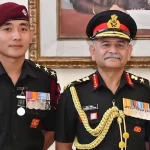

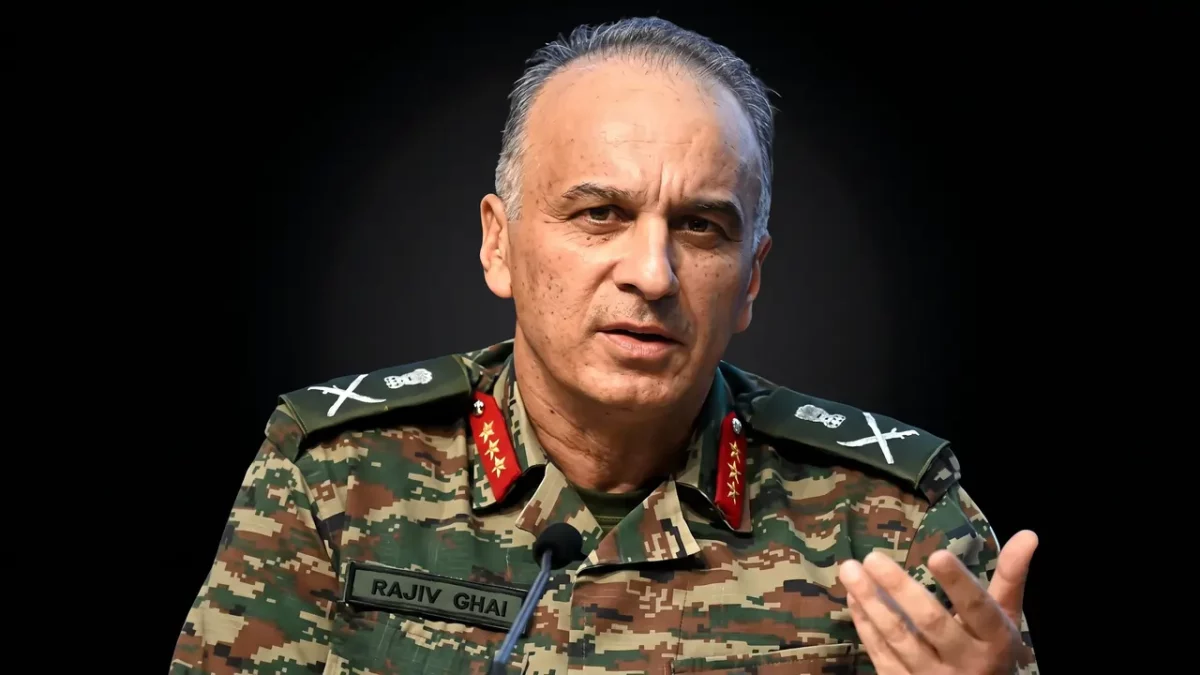
New Delhi: In a significant departure from established practice, Lieutenant General Rajiv Ghai, SYSM, UYSM, AVSM, SM***, has been appointed as the Military Adviser in the National Security Council Secretariat (NSCS), marking a major development in India’s apex national security advisory structure.


Lt Gen Ghai succeeds Lieutenant General N.S. Raja Subramani (Retd), who recently assumed charge as the Chief of Defence Staff on 31 May 2026. The appointment is notable because Lt Gen Ghai becomes the first serving three-star officer to take over as Military Adviser in the NSCS since the post was revived in 2018.
Until now, the position had largely been held by retired senior officers who brought post-service experience to the national security establishment. Previous holders, including Lieutenant Generals Khandare and Anil Chauhan, Lt Gen N.S. Raja Subramani, and Air Marshal Sandeep Singh, had all superannuated from active service before taking charge. Lt Gen Ghai, however, still has more than 15 months of service remaining, giving the NSCS access to a serving officer with recent operational, strategic, and institutional experience.
The move is being viewed as an important signal at a time when India is pushing forward with military integration, theatre command reforms, capability modernisation, and a more coordinated approach to national security decision-making.
Lt Gen Ghai is one of the Indian Army’s most decorated and operationally experienced officers. Commissioned into the Kumaon Regiment on 16 December 1989 from the Indian Military Academy, Dehradun, he has served for more than 36 years in a wide range of command, staff, instructional, and operational appointments. He is an alumnus of the National Defence Academy, Khadakwasla, Defence Services Staff College, Wellington, Army War College, Mhow, and National Defence College, New Delhi.
Over the course of his career, he has served in conventional operational environments, counter-insurgency and counter-terrorism areas in Jammu and Kashmir and the Northeast, high-altitude sectors, and United Nations peacekeeping duties in Lebanon. His field experience spans some of India’s most sensitive military theatres, including the Line of Control, the northern borders, and the eastern sector along the Line of Actual Control.
Among his key command appointments, Lt Gen Ghai commanded an infantry battalion in the western sector, an independent brigade group in the northern sector, and later the 56th Infantry Division. On 15 June 2023, he took over as General Officer Commanding of the XV Corps, popularly known as the Chinar Corps, based in Srinagar. The Corps plays a critical role in counter-terrorism operations, Line of Control security, and internal security management in the Kashmir Valley.
His tenure as Chinar Corps Commander came during a period when security forces were focused on maintaining pressure on terrorist networks, countering infiltration attempts, and improving coordination among the Army, Jammu and Kashmir Police, paramilitary forces, and intelligence agencies.
Apart from command responsibilities, Lt Gen Ghai has held several important staff appointments at Army Headquarters and Northern Command. These include roles in the Military Operations Directorate, including Brigadier Military Operations, and later Major General General Staff at Headquarters Northern Command. He has also served as an instructor at the Infantry School, Mhow, and the Defence Services Staff College, Wellington, contributing to the professional military education of future commanders.
Lt Gen Ghai came into national prominence after assuming the appointment of Director General of Military Operations on 25 October 2024. As DGMO, he became the public face of India’s military response during Operation Sindoor, one of the most significant cross-border counter-terror operations in recent years.
Operation Sindoor followed the 22 April 2025 terrorist attack in Pahalgam, Jammu and Kashmir, in which 26 civilians, mostly tourists, were killed. The attack triggered nationwide outrage and led to a calibrated military response by India. In the early hours of 7 May 2025, the Indian Armed Forces launched precision strikes on nine terrorist infrastructure sites in Pakistan and Pakistan-occupied Jammu and Kashmir. The operation was described as focused, measured, and non-escalatory, with India stating that no Pakistani military facilities were targeted.
As DGMO, Lt Gen Ghai played a central role in the planning, execution, and official communication of the operation. The strikes demonstrated India’s ability to conduct coordinated tri-service action while maintaining escalation control. During subsequent briefings, the armed forces highlighted the role of intelligence, precision targeting, air defence, cyber capabilities, and joint planning in the success of the operation.
Operation Sindoor also became a major example of India’s evolving military doctrine — one that combines conventional readiness, counter-terror precision, technological integration, and political-military coordination. Lt Gen Ghai’s role during this period placed him at the centre of India’s military-operational decision-making at a time of heightened regional tension.
On the first anniversary of the operation in May 2026, Lt Gen Ghai described Operation Sindoor as a defining moment in India’s strategic journey. He underlined that the operation proved India’s growing self-reliance in defence was not merely a slogan but a force multiplier. He also emphasised that the operation was not an end in itself but the beginning of a new phase in India’s response to terrorism and threats to sovereignty.
For his leadership during Operation Sindoor, Lt Gen Ghai was awarded the Sarvottam Yudh Seva Medal on Independence Day 2025. He had earlier been awarded the Uttam Yudh Seva Medal on Republic Day 2025, the Ati Vishisht Seva Medal in 2023, and the Sena Medal with two bars, making him one of the most decorated serving officers of his generation.
After his tenure as DGMO, Lt Gen Ghai assumed the appointment of Deputy Chief of Army Staff (Strategy) in June 2025. The DCOAS Strategy vertical is among the Indian Army’s most important strategic appointments, dealing with long-term operational planning, intelligence, capability development, emerging threats, and future warfare concepts.
In this role, Lt Gen Ghai was responsible for overseeing critical operational and intelligence functions while contributing to the Army’s strategic transformation. His tenure coincided with growing emphasis on drones, artificial intelligence, surveillance systems, integrated battle networks, cyber and electronic warfare, and technology-enabled operations.
In March 2026, Lt Gen Ghai also took over as Colonel of the Kumaon Regiment, Kumaon Scouts, and Naga Regiment at the Kumaon Regimental Centre in Ranikhet. As Colonel of the Regiment, he has focused on soldier welfare, regimental pride, operational readiness, and the adoption of modern technologies to meet contemporary battlefield requirements.
His appointment as Military Adviser in the NSCS now brings his operational and strategic experience into the national security decision-making framework. The Military Adviser functions as a key military voice within the National Security Council system, providing inputs on military strategy, operational assessments, tri-service coordination, force planning, and emerging security challenges.
The NSCS plays a crucial role in assisting the National Security Adviser and the government on matters related to national security, strategic policy, intelligence assessments, defence planning, and coordination between different arms of the security establishment. The Military Adviser acts as an important bridge between the armed forces and the highest levels of national security policy formulation.
Lt Gen Ghai’s appointment comes at a particularly important moment. General N.S. Raja Subramani, who previously held the Military Adviser post, has now assumed charge as the Chief of Defence Staff with the responsibility of driving military integration and theatreisation. With Lt Gen Ghai now entering the NSCS, the government will have access to a serving officer who has recently handled operational planning, cross-border response, Army strategy, and high-level military coordination.
This continuity is expected to help align military assessments with national security policy at a time when India faces complex challenges along both the northern and western borders. The evolving security environment includes continued threats of cross-border terrorism, instability in the region, increasing use of drones and unmanned systems, cyber threats, grey-zone operations, and the need for faster joint military responses.
Lt Gen Ghai’s career profile makes him particularly suited for such a role. He has commanded troops in sensitive operational areas, handled senior staff roles in military operations, led a Corps in Kashmir, served as DGMO during a major military response, and worked as Deputy Chief of Army Staff in charge of strategy. Few officers combine such recent field, operational, and institutional experience at the same level.
His appointment as a serving three-star officer also indicates a shift in how India may choose to structure military advice within the national security system. Instead of relying only on retired expertise, the government has now placed an active senior commander within the NSCS, potentially allowing more direct integration of current military realities into strategic decision-making.
For the armed forces, the development also reinforces the importance of jointness, operational readiness, and strategic communication. Operation Sindoor highlighted the value of coordination across services and agencies, while the ongoing theatre command process requires sustained civil-military and inter-service alignment. Lt Gen Ghai’s new role is expected to contribute to this process by strengthening the interface between military planning and national security policy.
Lieutenant General Rajiv Ghai’s appointment as Military Adviser in the NSCS is therefore more than a routine personnel change. It represents recognition of his distinguished service, operational leadership, and strategic depth. It also signals an effort to bring current military experience closer to the centre of national security decision-making.
From his commissioning into the Kumaon Regiment in 1989 to his leadership during Operation Sindoor and his strategic role at Army Headquarters, Lt Gen Ghai’s career reflects the evolution of the Indian Army itself — from conventional battlefield preparedness to counter-terror operations, high-altitude deployment, technological transformation, and integrated national security planning.
As he takes over this influential advisory role, Lt Gen Ghai brings with him the experience of a field commander, the perspective of a military planner, and the credibility of an officer who has handled some of India’s most sensitive operational responsibilities. His tenure as Military Adviser is expected to strengthen coordination between the armed forces and the national security establishment at a time when India’s defence posture is undergoing rapid transformation.