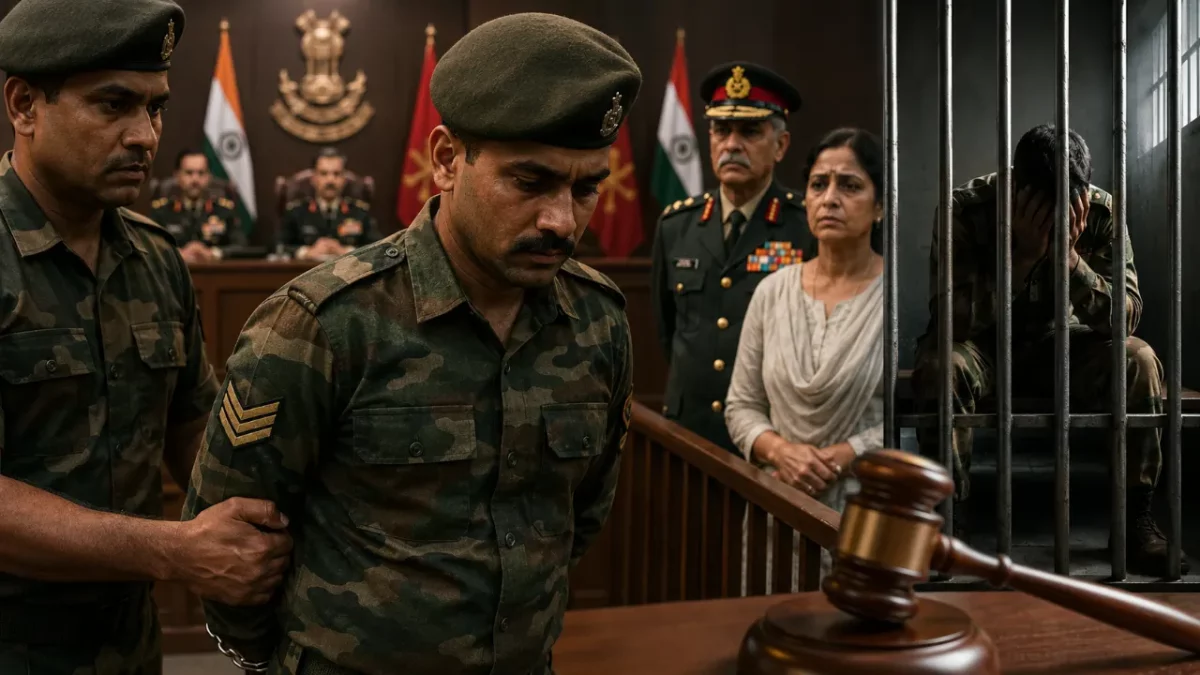
An Indian Army Havildar has been dismissed from service and sentenced to one year of rigorous imprisonment after being convicted of molesting the wife of a serving Major General at a military station. The soldier, who was employed as a washerman and belonged to an artillery regiment, was tried by a Summary Court Martial conducted by his Commanding Officer. He was charged under Section 69 of the Army Act for committing a civil offence punishable under Section 74 of the Bharatiya Nyaya Sanhita, 2023.





Section 74 of the BNS deals with assault or the use of criminal force against a woman with the intention of outraging her modesty. The alleged incident took place on May 19, 2026, within the premises of the Major General’s official residence.
Incident Allegedly Took Place Near Temple
According to the complaint submitted by the Major General’s wife to the Corps Commander, the Havildar had been attached to the officer’s official residence and was responsible for maintaining a temple located on the premises.
The woman stated that she went to the temple to offer prayers on the morning of May 19 and found the Havildar already present there.
She alleged that the soldier approached her from behind, grabbed her and attempted to grope her. When she tried to raise an alarm, he allegedly covered her mouth with his hands in an attempt to stop her from shouting.
The complainant said she managed to free herself from his grip and ran towards the residential building. The Havildar allegedly followed her before being stopped and apprehended by the guard commander and other Army personnel stationed nearby.
The charge framed against the soldier alleged that he had used criminal force against the woman by groping her from behind and attempting to cover her mouth, with the intention of outraging her modesty.
Soldier Allegedly Admitted the Accusation
During the military proceedings, the Havildar reportedly acknowledged that he had been deployed at the Major General’s residence and was performing duties at the temple on the morning of the incident.
In a statement recorded on May 24, he allegedly admitted to the accusation made by the complainant.
The Havildar also claimed that he was surrounded and assaulted by guards after the incident. According to his statement, he suffered a bleeding head injury and went into shock before being taken to a hospital.
He said he could not determine whether he had been struck with a stone or a wooden baton.
The Commanding Officer who conducted the Summary Court Martial noted that the Havildar had been regularly assigned responsibility for the maintenance and upkeep of the temple since April 2026.
Evidence Was Largely Uncontested, Says Commanding Officer
The Commanding Officer concluded that the allegations prima facie constituted an offence under Section 74 of the Bharatiya Nyaya Sanhita, read with Section 69 of the Army Act.
According to the court martial record, a significant portion of the evidence presented against the soldier was not disputed during the preliminary proceedings.
The Commanding Officer stated that the accused had provided a written and signed statement during the hearing conducted under Army Rule 22, in which he allegedly admitted to committing the act mentioned in the tentative charge sheet.
The Havildar also reportedly chose not to cross-examine the prosecution witnesses who appeared during the hearing of the charge.
Army Rule 22 broadly governs the hearing of charges against a person subject to the Army Act before further disciplinary or court martial proceedings are initiated.
Confession Recorded Before Independent Board
The soldier’s voluntary statement was subsequently recorded before a Board of Officers constituted by the Brigade Headquarters.
The Army authorities reportedly satisfied themselves that the statement had been made voluntarily and in accordance with the applicable Army Orders.
The process was also recorded through audio-visual means. The original memory card containing the recording was placed on the official record as part of the proceedings.
In the voluntary statement, the Havildar reportedly referred to his 24 years of previously unblemished military service. He allegedly accepted the accusation, expressed remorse and shame, offered an unconditional apology and sought forgiveness.
The Commanding Officer observed that the accused had confessed to the offence on three separate occasions.
The first alleged admission was made before the Commanding Officer during the Army Rule 22 proceedings. The second was recorded before the independent Board of Officers constituted under the relevant Army Order. The third was made during the Summary of Evidence under Army Rule 23(3).
The Commanding Officer stated that these admissions were supported by the testimony of three prosecution witnesses and that there was no significant conflict regarding the facts of the case.
Based on the available statements and evidence, the Summary Court Martial convicted the Havildar, dismissed him from Army service and awarded him one year of rigorous imprisonment.
Army Cited Need for Prompt Disposal
While explaining the decision to conduct a Summary Court Martial, the Commanding Officer reportedly said the incident involved a serious violation of the victim’s dignity and personal security within her own residential premises.
He observed that cases involving sexual offences must be handled promptly and discreetly to avoid causing further trauma to the victim.
According to the officer, unnecessary delays could prolong the woman’s distress and weaken confidence in the Army’s commitment to protecting the dignity and safety of women within the military community.
The Commanding Officer maintained that conducting a Summary Court Martial was the most expedient and effective way to dispose of the matter without subjecting the victim to prolonged proceedings.
Defence Lawyer Questions Fairness of Trial
The Havildar’s lawyer, Anand Kumar, has challenged the manner in which the proceedings were conducted.
Kumar argued that the soldier should not have been tried by a Summary Court Martial for an alleged civil offence under Section 69 of the Army Act.
He claimed that the case was handled hurriedly because the complainant was the wife of a senior Army officer. The lawyer also alleged that no appropriate reference order had been issued for conducting the proceedings.
According to the defence counsel, the case should have been placed before a District Court Martial, where the accused would have had access to a more elaborate trial process.
Kumar further alleged that the soldier’s plea of guilty was recorded to avoid requiring the complainant to face questioning by defence lawyers during a full court martial.
He maintained that a District Court Martial would have provided the accused with a fairer opportunity to contest the allegations, examine the prosecution evidence and cross-examine witnesses.
Summary Court Martial Versus District Court Martial
A Summary Court Martial is one of the forms of military trial authorised under the Army Act. It is generally conducted by the Commanding Officer of the accused and is designed to dispose of certain disciplinary cases relatively quickly.
A District Court Martial, by comparison, is conducted by a panel of officers and ordinarily involves more extensive procedural safeguards, including a broader opportunity for legal representation, examination of witnesses and presentation of a defence.
The defence’s objections are therefore centred not only on the conviction but also on whether a Summary Court Martial was the appropriate forum for trying an allegation involving a civil offence and a potential prison sentence.
The Army authorities, however, relied on the accused’s alleged repeated admissions, witness statements and the need to resolve the case without unnecessary delay.
The conviction, dismissal and imprisonment remain subject to the review, confirmation and post-trial remedies available under military law.