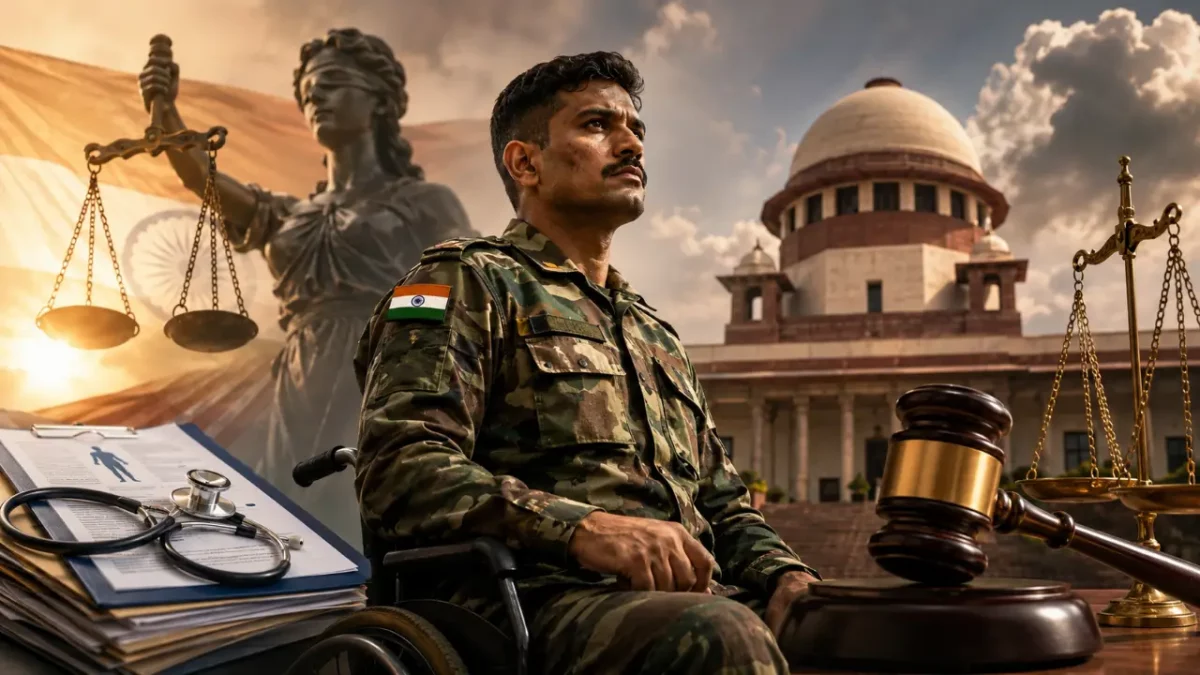
In a strongly worded judgment that prioritises the welfare and morale of armed forces personnel, the Kerala High Court has upheld an Armed Forces Tribunal order granting disability pension to a retired Subedar Major (Honorary Captain). The Court held that merely describing Type-II Diabetes Mellitus and Primary Hypertension as “lifestyle disorders” is not a valid ground to deny the disability element of pension.





A Division Bench of Justices K. Natarajan and Johnson John delivered the order on 16 July 2026 in Union of India & Ors. v. K Sub Maj (Hony Capt) Mohanraj T.K. (W.P.(C) No. 19501 of 2026; Neutral Citation: 2026:KER:52646). The Court dismissed the Union of India’s challenge to the Armed Forces Tribunal (Regional Bench, Kochi) order dated 12 January 2024.
The Bench observed:
“A soldier is a blank cheque written to the country for any amount up to and including his life.” It added that protecting the morale of soldiers is a core responsibility of the Government and society, as they are the ones who risk their lives for the nation.
Background of the Case
The respondent, Subedar Major (Honorary Captain) Mohanraj T.K., a Kerala-domiciled veteran of the Madras Engineer Group, was invalided out of service on medical grounds. At the time of the High Court proceedings he was 56 years old and resided in Chengannur, Kerala.
The Release Medical Board recorded multiple disabilities. The two relevant for the pension claim were:
- Type-II Diabetes Mellitus (assessed at 20%)
- Primary Hypertension (assessed at 30%)
The Board held that these conditions were neither attributable to nor aggravated by military service. It cited “lifestyle modification” with reference to paragraphs in the Guide to Medical Officers (Military Pensions), 2008. Other disabilities (including cerebrovascular issues and orthopaedic conditions) were separately negatived on the basis of injury reports and a Court of Inquiry.
Importantly, no note of any disease was recorded at the time of Mohanraj’s enrollment into military service. He was accepted as being in sound physical and mental condition.
His claim for disability pension was rejected. He approached the Armed Forces Tribunal, Regional Bench, Kochi, in O.A. No. 1 of 2023.
Armed Forces Tribunal’s Order
On 12 January 2024, the Tribunal directed the authorities to:
- Obtain the composite degree of disability for Type-II Diabetes Mellitus (20%) and Primary Hypertension (30%) from a competent Medical Board within three months;
- Issue a corrigendum Pension Payment Order granting the disability element of pension from the date of discharge; and
- Disburse arrears within six months, failing which interest at 9% per annum would apply.
The Union of India challenged this order before the Kerala High Court under Article 226 of the Constitution, contending that the Tribunal had wrongly interfered with the Medical Board’s opinion and that the diseases were lifestyle-related and not service-connected.
High Court’s Reasoning
The High Court rejected the Union’s challenge on multiple grounds rooted in established service jurisprudence and statutory regulations.
1. Statutory Presumption under Regulation 423
Regulation 423 of the Regulations for Medical Services for the Armed Forces, 1983, creates a clear presumption: a disease that leads to discharge is ordinarily deemed to have arisen in service if no note of it was made at the time of acceptance for service. The only exception is where medical opinion, for reasons that must be stated, holds that the disease could not have been detected on medical examination prior to acceptance.
Since no disease was noted at enrollment, Mohanraj was entitled to this presumption. The Medical Board’s bare assertion of “lifestyle modification” did not amount to the detailed, reasoned medical opinion required to rebut it.
2. Onus of Proof Lies on the Employer
Following the Supreme Court’s landmark decision in Dharamvir Singh v. Union of India (2013) and subsequent rulings including Sukhvinder Singh v. Union of India (2014) and Bijender Singh v. Union of India (2025), the Court reiterated that a member of the armed forces is presumed to be in sound health upon entry. Any subsequent deterioration leading to invalidation is presumed to be due to service. The onus of proving otherwise lies on the employer, not the soldier. The claimant is entitled to the benefit of reasonable doubt, and pensionary provisions must be interpreted liberally.
3. ‘Lifestyle Disorder’ Label is Insufficient
The Court relied heavily on the Supreme Court’s recent decision in Rajumon T.M. v. Union of India (2025). It held that a mere characterisation of diabetes or hypertension as a “lifestyle disease,” or a reference to service in a peace station, does not constitute sufficient reasoning to deny attributability or aggravation. Such an assertion is a conclusion masquerading as a reason. Military life inherently involves stress, irregular diet, sleep deprivation, frequent postings, and psychological burden — factors that cannot be casually inverted into “lifestyle choices” of the individual.
4. Limited Scope of Article 226
The High Court emphasised that its extraordinary jurisdiction under Article 226 is meant to prevent manifest injustice, jurisdictional errors, or errors apparent on the face of the record. It cannot be used to re-appreciate every finding of the Armed Forces Tribunal or to correct minor errors. Finding no such infirmity in the Tribunal’s order, the Bench declined to interfere.
The Court also invoked Article 33 of the Constitution, noting that while fundamental rights of armed forces personnel may be restricted in the interest of discipline and national security, this does not extend to denying legitimate pensionary benefits on slender or unreasoned grounds.
Outcome
The writ petition filed by the Union of India was dismissed. The High Court upheld the Armed Forces Tribunal’s direction. The authorities must now assess the composite disability for the two conditions through a competent Medical Board and grant the disability element of pension from the date of discharge, along with arrears as directed by the Tribunal.
Significance of the Judgment
This ruling is significant for several reasons. Conditions such as diabetes and hypertension are among the most frequently cited grounds for rejection of disability pension claims by Release Medical Boards, often with a mechanical “lifestyle disorder” stamp. The Kerala High Court’s decision reinforces that administrative shorthand cannot override statutory presumptions and Supreme Court precedents that favour a liberal, beneficial interpretation of welfare provisions for soldiers.
By describing a soldier as “a blank cheque written to the country for any amount up to and including his life,” the Court has elevated the discussion beyond technical medical and regulatory issues to the larger question of institutional responsibility towards those who serve. The judgment is likely to be cited frequently in pending and future disability pension cases before the Armed Forces Tribunals and High Courts across the country.
For defence personnel and veterans, it reaffirms that the benefit of doubt in borderline medical cases belongs to the soldier, and that the State’s obligation does not end when a person is invalided out of service.