
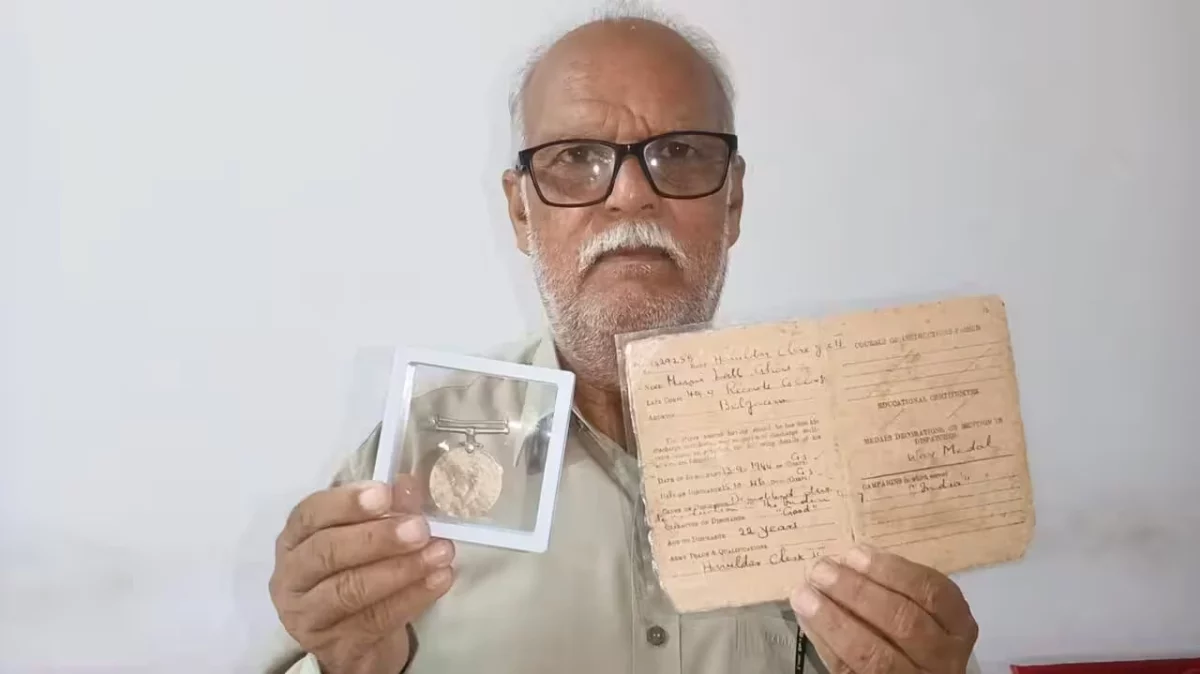
Daltonganj (Palamu), August 27, 2026: At the Special Intensive Revision (SIR) camp at Palamu Club, a Daltonganj family produced something officials do not see every day: a Second World War medal and a unit service record dated May 10, 1953, belonging to their late father, former Indian Army havildar clerk Munni Lall Ghai. They brought the documents to establish Indian lineage after six siblings were placed in the “no-mapping” category of the ongoing voter-list revision.
Ashwini Ghai, 67, said his brother Narender Kumar Ghai returned to the camp on Thursday after an earlier visit two days earlier, carrying the war medal and the 1953 unit record. The family originally comes from Amritsar and later settled in Palamu. All six siblings — three brothers and three sisters — are listed as unmapped, meaning their names could not be automatically linked to the 2003 SIR electoral roll that officials are using as a reference for progeny mapping.
Officials at the Palamu Club camp reacted with a mix of surprise, admiration and respect when they saw the medal and service papers of an Indian soldier, Ashwini said. They did not keep photocopies of the medal or the unit record. Narender instead submitted a copy of his passport as supporting documentation. The family said they hope the papers will speed up verification.
Why “no-mapping” matters in SIR 2026
Jharkhand’s SIR is the Election Commission’s intensive revision of electoral rolls. A large share of existing electors were mapped against the 2003 SIR roll so they would not have to produce extra documents. Those who could not be mapped — because parents or earlier entries were not found, records were incomplete, or families had migrated — fall into the no-mapping category and must appear at camps or hearings with proof of identity, residence and, in many cases, lineage.
Statewide, more than 14 lakh electors remained unmapped after the enumeration phase. Notices have gone out to about 14.03 lakh voters in the no-mapping category, besides others flagged for logical discrepancies or similar demographic entries. Hearings and document checks are underway through the claims-and-objections window. Draft rolls published on August 5 also dropped about 43.6 lakh names in the Absent, Shifted, Dead or Duplicate (ASDD) categories. Eligible people can still be added back.
Palamu’s five assembly seats together have 72,760 electors in the no-mapping list. Daltonganj has the highest number at 21,090, followed by Chhatarpur (18,086), Hussainabad (12,992), Bishrampur (11,073) and Panki (9,519). That concentration helps explain why a camp at Palamu Club has become a focal point for families carrying old papers, pension proofs and, in this case, a wartime medal.
Officials: migrants and labour households struggle most
Assistant electoral registration officer Amardeep Walhotra, posted at the Palamu Club camp, said progeny mapping is especially hard among migrant and labour-class electors because many lack documentary records. Some mention that their parents receive pension; in those cases, officials ask for pension-related papers. The Ghai family’s Army record is an unusually strong historical document in that setting.
Camp work at Palamu Club has been smoother than at some other centres, officials said, where queues and confusion have been longer. Women have been coming in larger numbers on behalf of men working away from home. On Thursday, a woman who had received news of a death in the family was allowed to finish verification out of turn and left within minutes.
A larger test of memory, migration and paperwork
The Ghai case sits at the intersection of three themes running through Jharkhand’s SIR. First, the Commission is trying to clean rolls after years of deaths, untraceable electors and permanent shifts; more than six lakh deceased voters were identified during enumeration alone. Second, it is trying to keep genuine citizens on the list — including families that moved decades ago from places such as Amritsar to Palamu. Third, it is asking people whose parents never appeared on the 2003 Jharkhand roll, or whose papers were never digitised, to reconstruct lineage with whatever they still have: passports, pensions, land records, or, rarely, a wartime medal.
For a family whose father served as a havildar clerk and fought in the Second World War, the medal is both proof and memory. Whether officials treat it as sufficient supporting evidence will be decided in the verification process now underway. The family says it is hopeful. Across Palamu, tens of thousands of other unmapped electors are making the same trip with far thinner files.