

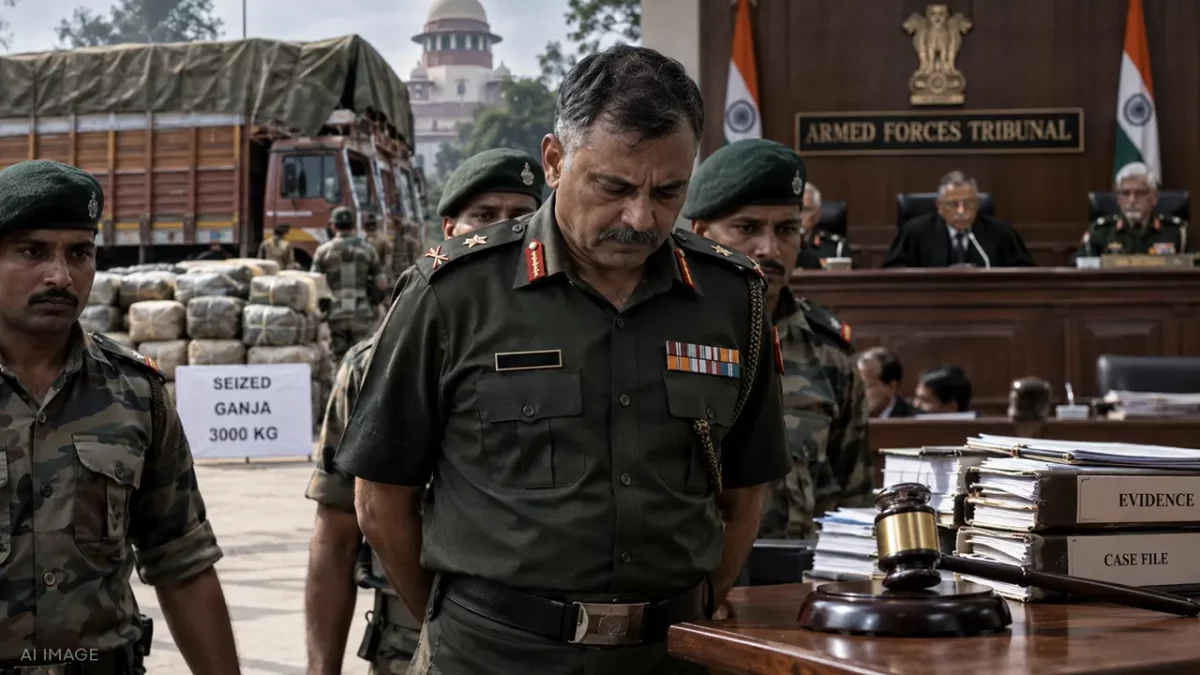
Chandigarh, September 19, 2026 — The Armed Forces Tribunal (AFT) has upheld the conviction and sentence awarded by a General Court Martial more than two decades ago to an ex-Colonel for abetting the transport of 3,000 kg of ganja, financial irregularities and professional misconduct while commanding an Assam Rifles battalion.



The Chandigarh Bench of the Tribunal, comprising Justice Sudhir Mittal and Lt Gen Ranbir Singh, delivered the order on September 17. The Bench held that it found no infraction in the findings or sentence of the General Court Martial. It further ruled that the application challenging the trial was hopelessly barred by limitation.
The ex-Colonel joined the Army in the ranks in January 1969 and was commissioned as an officer in December 1977. He was promoted to the rank of Colonel in June 1997 and subsequently appointed Commanding Officer of 21 Assam Rifles in Nagaland.
Four charges were framed against him in January 2000. The first, under Section 69 of the Army Act, related to abetting the transport of 3,000 kg of ganja. The second, under Section 63, accused him of improperly instructing a rifleman of his unit to escort a civilian truck along with the unit convoy.
He was also charged under Section 52(f) with drawing the pay of six casual porters amounting to Rs 59,676 despite allegedly knowing that the porters had not been employed. A fourth charge under Section 52(b) accused him of misappropriating Rs 20,472 contributed by unit personnel.
Following a Court of Inquiry and recording of Summary of Evidence, a General Court Martial was convened in January 2000. In March 2000, the court sentenced the officer to two years of rigorous imprisonment and ordered that he be cashiered from service.
Upon confirmation of the proceedings in September 2000, a portion of the imprisonment was remitted and the ex-Colonel was exonerated of the charge relating to the alleged misappropriation of Rs 20,472. A mercy petition filed in April 2003 was subsequently rejected in March 2004.
During the proceedings, the officer pleaded not guilty. He contended that he had been framed due to professional jealousy, that mandatory procedures had not been followed, that the General Court Martial had recorded perverse findings and that he had been medically unfit to face trial.
The Tribunal rejected these contentions in light of the evidence and other material on record.
The Bench also examined the delay in challenging the court-martial proceedings. It noted that the Chandigarh Bench became functional in 2009 and that the application was filed in 2010. Under the Armed Forces Tribunal Act, an order passed prior to November 2006 — three years before the Bench became functional — could not be entertained unless accompanied by an application seeking condonation of delay.
No such application had been filed in the case, leading the Tribunal to conclude that the challenge was barred by limitation.
The Tribunal further found no ground on merits to interfere with either the findings or the sentence imposed by the General Court Martial.
The order brings a long-pending legal challenge to a close. The original incident dates back to 1999, when the officer was commanding 21 Assam Rifles. Reports from that period had linked the case to the interception of a civilian truck carrying a large quantity of marijuana and allegations that an escort from the unit convoy had been provided. These allegations subsequently formed the basis of the first two charges tried by the court-martial.
The Tribunal’s decision leaves intact the disciplinary outcome of the 2000 General Court Martial while also reinforcing the statutory limitation applicable to belated challenges against older military justice orders where no plea for condonation of delay has been properly filed.