
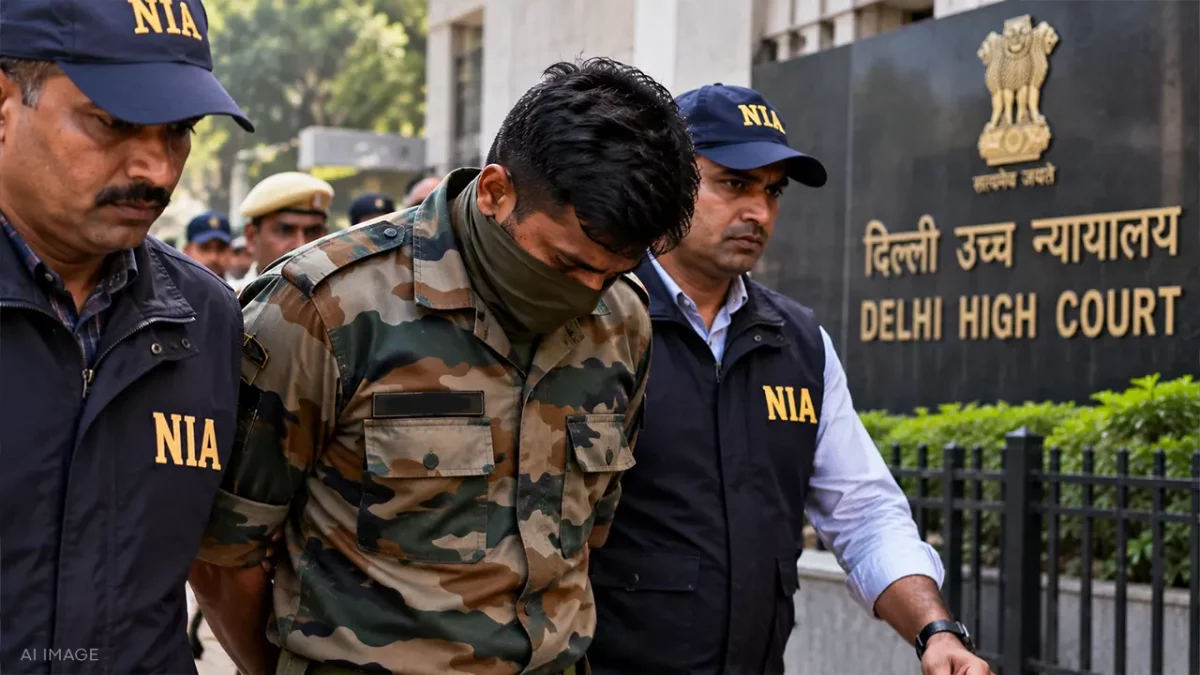
New Delhi, October 5, 2026: The Delhi High Court has refused regular bail to an Army man accused of acting as a conduit for classified military documents allegedly meant for an official of the Pakistan High Commission. Justice Sanjeev Narula, in an order dated September 25, held that the nature of the material, its asserted source, and its intended destination outweighed the period already spent in custody and the medical grounds raised by the accused. The Court directed that the trial be expedited.


The applicant was arrested in July 2021 by the Crime Branch of the Delhi Police. The prosecution has alleged that he received secret military documents from a co-accused and passed them on to an official at the Pakistan High Commission. Copies recovered from him are stated to relate to military training, the operationalisation of the Armed Forces Special Operations Division, and confidential military intelligence summaries. The Indian Army has verified the documents as authentic, classified, and sensitive.
The case is registered under the Official Secrets Act, 1923. The most serious provisions of the Act provide for imprisonment of up to 14 years. Public reporting of the order has not named the accused.
Defence and prosecution
Advocate V. Madhukar, appearing for the petitioner, argued that the seriousness of the charge cannot by itself displace the ordinary principles governing bail. He submitted that the Court must examine the role attributed to the accused, the material against him, the length of custody, and the progress of the trial. The petitioner has undergone more than three years and four months of actual custody. The investigation has concluded, and the evidence relied upon is largely documentary and already with the prosecution or the Court. Good conduct during an earlier period of interim bail was also cited.
Assistant Public Prosecutor Yudhvir Singh Chauhan opposed the plea. The State relied on the recovery of the classified documents and their authentication by the Army. The Court recorded that the case does not rest only on an uncorroborated allegation or a co-accused’s disclosure statement. It noted primary material linking the applicant to the alleged transmission chain, including phone records, SIM card details, financial transactions, and the statement of his employee.
Medical ground rejected
The petitioner also sought bail on medical grounds, citing wheelchair dependency and comorbidities. A nine-member Medical Board of the All India Institute of Medical Sciences examined him and recorded a significant discrepancy between the medical history he had provided and the objective findings. The Court acknowledged that he has real medical issues, but held that the report does not state that necessary treatment cannot be given in custody, or that continued detention is medically impossible.
Court’s reasoning
Justice Narula observed that merely invoking the Official Secrets Act, or the prospect of a 14-year sentence, does not automatically bar bail. “An allegation bearing upon national security calls for close scrutiny; it does not place the matter beyond the court’s bail jurisdiction,” the order said. At the same time, the Court declined to treat the case as an ordinary bail matter.
“The gravity of the present case lies not in the statutory label alone, but in the nature of the documents allegedly procured, their asserted source, and their intended destination. The documents recovered from the Applicant are stated to concern military training, a sensitive military unit, and intelligence material. The Army authorities have verified their classified character,” the Court held.
It clarified that a bail hearing is not a full trial, and that questions of admissibility are not to be decided at this stage. The period of custody and conduct on interim bail were held to count in the petitioner’s favour, but not enough, at this stage, to outweigh the seriousness of the allegations. Bail was refused, with a direction for an expedited trial.
The order is a refusal of bail. It is not a finding of guilt. The allegations remain to be tested at trial.