

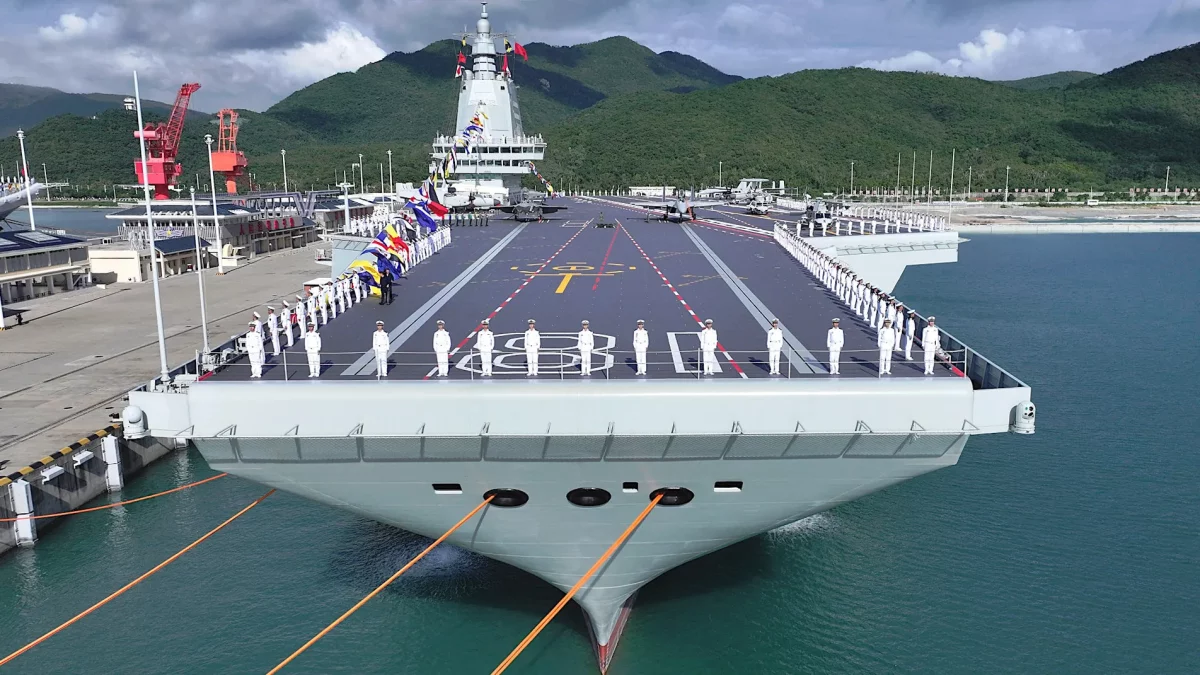
In a landmark moment for its maritime ambitions, China has officially commissioned its third and most advanced aircraft carrier, the Fujian, marking its entry into the elite league of nations operating electromagnetic catapult-equipped carriers — a technological feat previously mastered only by the United States.




The grand commissioning ceremony, held at a naval port in Sanya City, was attended by Chinese President Xi Jinping, who personally inspected the massive vessel. Named after Fujian Province, the carrier was launched in June 2022 and has since undergone extensive sea trials to validate its propulsion, catapult, and combat systems.
With the induction of the Fujian, China now operates a trio of aircraft carriers — Liaoning, Shandong, and Fujian — underscoring the People’s Liberation Army (PLA) Navy’s rapid transition from a coastal defence force to a formidable blue-water navy capable of power projection across oceans.
Technological Leap with Electromagnetic Catapults
The Fujian represents a major technological leap for China’s naval aviation. Its electromagnetic catapult launch system enables carrier-borne aircraft to take off with full fuel and weapon payloads, drastically extending their range and strike capability. The system also supports a higher sortie generation rate, enhancing operational efficiency during sustained combat operations.
In addition to catapults, the carrier is fitted with electromagnetic arresting gear for precision landings, further improving the safety and reliability of air operations. These features collectively elevate the Fujian to a technological standard comparable to the U.S. Navy’s Gerald R. Ford-class supercarriers.
Advanced Air Wing: J-35, J-15T, and KJ-600
The Fujian’s flight deck will host China’s latest generation of carrier-based aircraft, including the J-15T heavy fighter jet, the J-35 stealth fighter, and the KJ-600 airborne early warning and control (AEW&C) aircraft. Notably, the J-15DT electronic warfare variant made a public appearance at China’s V-Day military parade in Beijing, signalling its operational readiness.
These aircraft, when fully integrated, are expected to significantly enhance the PLA Navy’s surveillance, strike, and network-centric warfare capabilities — placing China’s carrier aviation force among the most sophisticated in the Indo-Pacific region.
A Behemoth of the Seas
Weighing over 80,000 tons at full load, the Fujian ranks among the largest aircraft carriers in the world. Since its maiden sea trials in May 2024, it has completed multiple test phases focusing on propulsion, electronics, and catapult performance. Officials claim all evaluations were completed “as per schedule,” confirming the vessel’s operational readiness for active deployment.
Strategic Implications for the Indo-Pacific
The commissioning of the Fujian is viewed as a clear message of China’s growing maritime confidence and strategic intent to project power far beyond its traditional sphere of influence. With the Fujian now joining active service, the PLA Navy gains the capability to sustain carrier battle groups in distant waters — a development closely monitored by the United States, India, and regional allies.
China’s latest naval expansion coincides with rising geopolitical friction. On November 4, Beijing publicly refuted U.S. President Donald Trump’s allegations of secret nuclear testing, reaffirming its adherence to a self-defensive nuclear doctrine. The timing of the Fujian’s commissioning is seen by analysts as symbolic of China’s resolve to counter U.S. narratives and assert technological parity in defence capability.
A Defining Moment in China’s Maritime Rise
The induction of the Fujian solidifies China’s position as a major maritime power and a central actor in the Indo-Pacific security equation. Equipped with next-generation aviation systems, electromagnetic launch technology, and a diverse combat-ready air wing, the carrier is poised to serve as a cornerstone of China’s future naval operations.
Defence experts believe that as the Fujian reaches full operational capability, it will not only redefine China’s naval warfare doctrines but also accelerate the regional arms race, with implications stretching from the South China Sea to the Indian Ocean.