

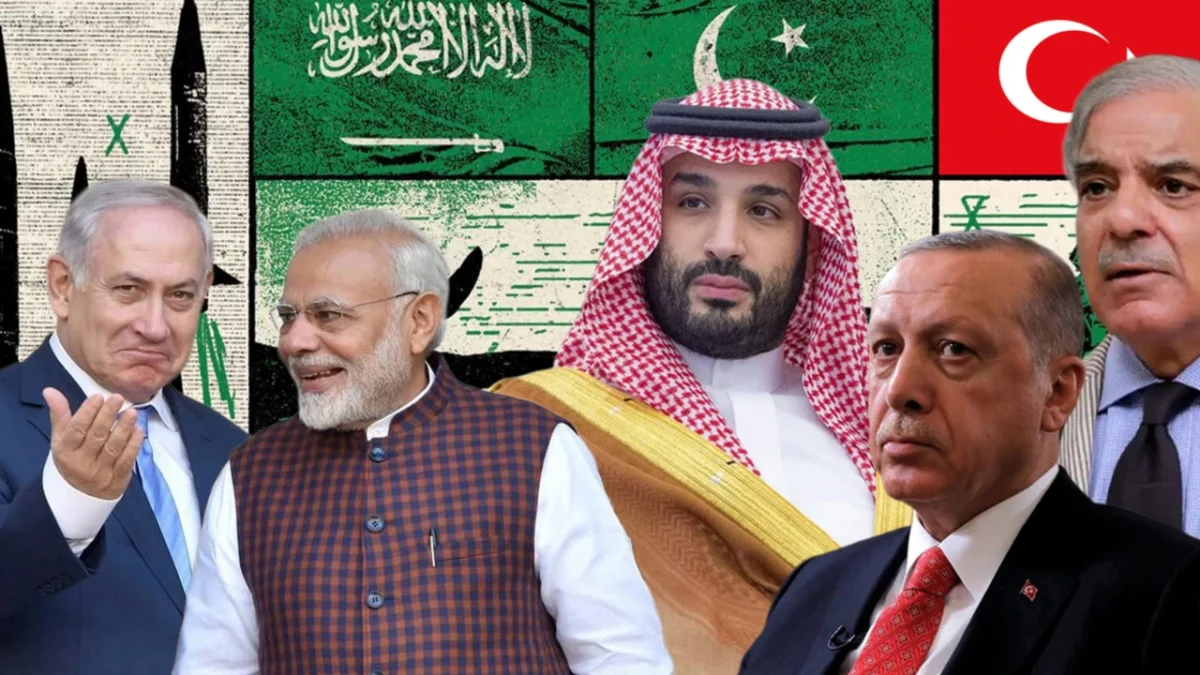
A potential new security alignment involving Turkey, Pakistan and Saudi Arabia is beginning to draw global and regional attention, with analysts warning that such a grouping—informally dubbed an “Islamic NATO”—could have serious strategic implications, particularly for India.




According to international media reports, Turkey is close to finalising a deal to join a defence alliance between Saudi Arabia and Pakistan. The existing Pak–Saudi agreement reportedly includes a collective security clause resembling Article 5 of NATO, under which an attack on one member is treated as an attack on all.
What Is Being Called ‘Islamic NATO’?
The term “Islamic NATO” is being used by analysts to describe a potential NATO-style collective defence arrangement among Islamic or Arab states. The idea gained momentum in September last year, when discussions on a joint security framework were held during an emergency summit of the Arab League and the Organisation of Islamic Cooperation.
Pakistan and Saudi Arabia subsequently announced a “strategic mutual defence agreement,” explicitly stating that aggression against one would be considered aggression against the other—language closely mirroring NATO’s collective defence principle.
Turkey’s reported entry into this framework would significantly expand its scope and capability.
Why Turkey Is Interested
Turkey already has one of the largest militaries in NATO and a rapidly expanding indigenous defence industry. Strategic experts note that Ankara sees value in aligning with Pakistan and Saudi Arabia due to overlapping interests across South Asia, West Asia and parts of Africa.
Analysts argue that Turkey brings military experience and advanced defence production, Pakistan contributes manpower, missile capability and nuclear deterrence, while Saudi Arabia adds immense financial strength—together forming a potent strategic triangle.
Turkey’s interest is also being linked to growing uncertainty over long-term US security guarantees and shifting geopolitical priorities in West Asia.
Implications for India
From India’s perspective, any such alliance is a cause for concern. India and Pakistan were engaged in a brief but intense military confrontation in May 2025 during Operation Sindoor, after which Indian authorities stated that Pakistan had employed Turkish-origin drones.
Turkey publicly criticised India’s actions during Operation Sindoor and expressed diplomatic support for Pakistan, further sharpening New Delhi’s concerns about a deepening Ankara–Islamabad nexus.
Indian defence analysts warn that a structured security alliance combining Turkish military technology, Pakistani nuclear capability and Saudi financial backing could alter the strategic balance in multiple theatres, not just South Asia but also West Asia and the Eastern Mediterranean.
How Realistic Is an ‘Islamic NATO’?
Despite the rhetoric, some experts remain sceptical about the feasibility of a NATO-style alliance among Islamic states. They argue that Gulf nations may be reluctant to commit to automatic military responses that could drag them into conflicts not directly linked to their national interests, particularly those involving Israel or regional rivalries.
However, recent regional conflicts and perceived vulnerabilities have begun to shift long-standing security assumptions in parts of the Arab world, prompting discussions on greater self-reliance and collective defence mechanisms.
Strategic Uncertainty Ahead
While it remains unclear whether a formal “Islamic NATO” will materialise, the growing military convergence between Turkey, Pakistan and Saudi Arabia is being closely monitored in New Delhi. Indian strategic planners view the developments as part of a broader trend of emerging security blocs that could complicate regional stability and demand calibrated diplomatic and military responses.
For India, the evolving alignment underscores the importance of strengthening its own strategic partnerships, enhancing indigenous defence capabilities, and remaining alert to new power configurations taking shape in its extended neighbourhood.