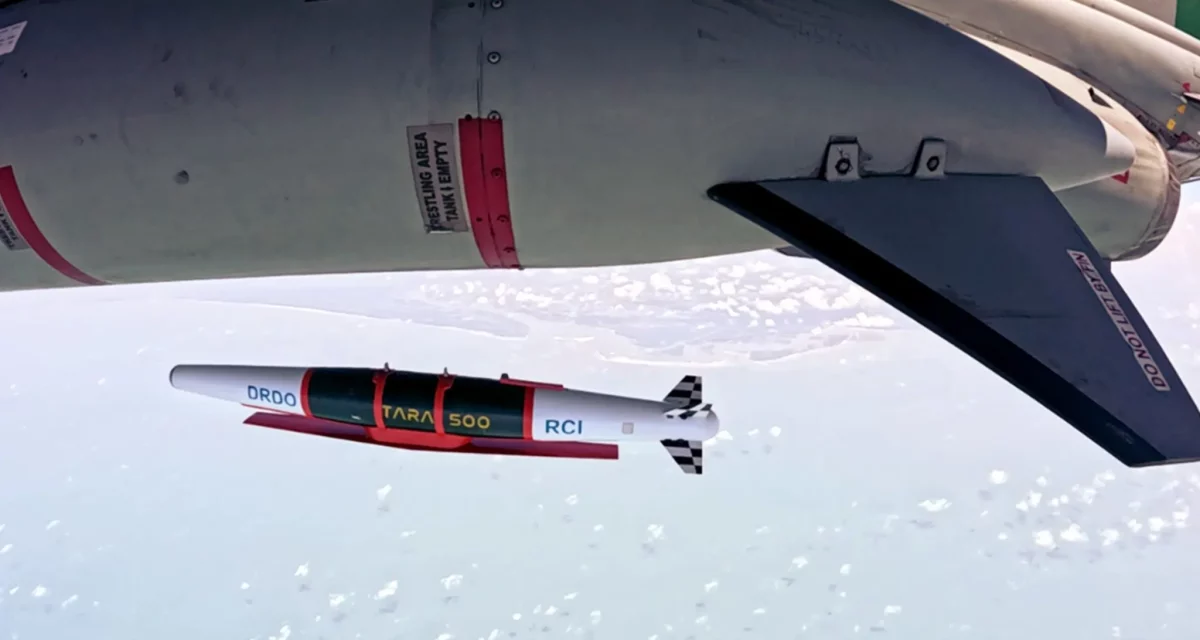
New Delhi, May 9, 2026 — In a significant advancement for India’s indigenous defence capabilities, the Defence Research and Development Organisation (DRDO) and the Indian Air Force (IAF) successfully conducted the maiden flight trial of the Tactical Advanced Range Augmentation (TARA) glide weapon system on May 7, 2026, off the coast of Odisha. The test, carried out from an IAF Sepecat Jaguar aircraft using a 500 kg bomb equipped with the TARA modular kit, marks India’s entry into domestically developed glide munitions technology.





The announcement, issued by the Ministry of Defence via the Press Information Bureau on May 8, 2026, has been accompanied by widespread public interest and speculation. Visible glowing contrails and high-altitude trails observed across eastern India, West Bengal, Odisha, and parts of Bangladesh — combined with a large Notice to Airmen (NOTAM) restricting a approximately 3,560 km corridor over the Bay of Bengal — have prompted intense discussion regarding a possible long-range strategic missile test, including unconfirmed rumours of an Agni-6 intercontinental ballistic missile (ICBM) launch.
TARA: India’s First Indigenous Glide Weapon System
TARA represents a modular range-extension kit designed to transform conventional unguided warheads into precision-guided, stand-off munitions. Developed primarily by DRDO’s Research Centre Imarat (RCI) in Hyderabad, in collaboration with other DRDO laboratories, Development-cum-Production Partners (DcPP), and Indian industry entities including Adani Defence and Aerospace, the system utilises state-of-the-art low-cost technologies to enhance accuracy, lethality, and operational range while minimising costs.
Key technical specifications include:
- Deployment parameters: Released from altitudes between 10,000 and 45,000 feet at speeds near Mach 0.8. When deployed from approximately 42,000 feet at Mach 0.9, the system achieves an effective range of 80–100 km.
- Guidance variants:
- SAT (Satellite Aided Terminal) configuration with a Circular Error Probable (CEP) of less than 20 metres.
- UC-IIR (Uncooled Imaging Infrared) seeker variant offering a CEP of less than 3 metres.
- Payload compatibility: Designed for 250 kg, 450 kg, and 500 kg class warheads.
- Operational advantages: Aerodynamic lift surfaces and guidance mechanisms enable extended glide flight, allowing aircraft to engage ground targets from beyond the reach of many enemy air-defence systems. The kit employs GPS/INS navigation with anti-jamming features in advanced configurations.
The successful trial validates the system’s design, flight stability, and terminal accuracy. Production activities have already commenced with industry partners, positioning TARA for rapid induction into IAF service. This development aligns with India’s broader Atmanirbhar Bharat initiative, reducing reliance on imported precision-guided munitions such as the American JDAM or Israeli Spice kits.
Mystery Trails and Strategic Speculation
Concurrently with the TARA test, observers across the eastern seaboard reported striking visual phenomena — bright, looping, or elongated glowing trails visible against twilight skies. These sightings, documented on social media from locations including coastal Odisha, West Bengal, and even Cox’s Bazar in Bangladesh, have generated significant speculation. Many analysts and enthusiasts initially interpreted the trails as signatures of a high-energy ballistic or hypersonic trajectory.
The Indian authorities had issued a NOTAM effective from approximately May 6 to May 9, 2026, designating a substantial safety corridor over the Bay of Bengal originating from the Dr. A.P.J. Abdul Kalam Island (formerly Wheeler Island) launch complex in Odisha. Such extensive range restrictions — spanning over 3,500 km — are characteristically associated with long-range ballistic missile trials, including those in the Agni series.
While no official confirmation of an Agni-6 test has been issued, the timing and visual evidence have fuelled conjecture that India may have conducted a parallel or follow-on strategic test. The Agni-6 programme remains officially unacknowledged in its full configuration, though it is widely understood to represent the next evolution beyond the Agni-5 ICBM, potentially incorporating multiple independently targetable re-entry vehicles (MIRVs), extended range exceeding 10,000 km, and possibly hypersonic glide vehicle elements for enhanced survivability against missile defences.
Defence analysts note that the visible trails could originate from either the TARA release profile under specific atmospheric conditions or from a separate high-altitude test activity conducted under the same NOTAM window. Official statements have focused exclusively on the TARA achievement, maintaining strategic ambiguity regarding additional activities.
Strategic Implications
The TARA system significantly bolsters the IAF’s stand-off precision strike doctrine, enabling low-cost conversion of existing bomb stockpiles into smart munitions. This capability is particularly relevant in scenarios requiring surgical strikes against high-value targets while minimising collateral damage and pilot exposure.
In the broader context of regional security dynamics, India’s continued progress in both tactical glide weapons and strategic missile systems underscores its commitment to maintaining a credible minimum deterrent and enhancing conventional precision options. Neighbouring nations and strategic observers are expected to monitor subsequent developments closely, particularly as production and integration of TARA accelerate.
The Ministry of Defence emphasised that TARA is the first fully indigenous glide weapon to employ advanced yet economical subsystems, setting a precedent for future indigenous munitions programmes. With successful validation complete, the system is poised to transition from development to operational deployment, further strengthening India’s layered defence posture.
As details continue to emerge, the interplay between publicly demonstrated tactical achievements and the enduring speculation surrounding strategic systems such as Agni-6 highlights the sophisticated and multifaceted nature of India’s evolving missile and munitions ecosystem. Further official clarifications are anticipated in the coming days.