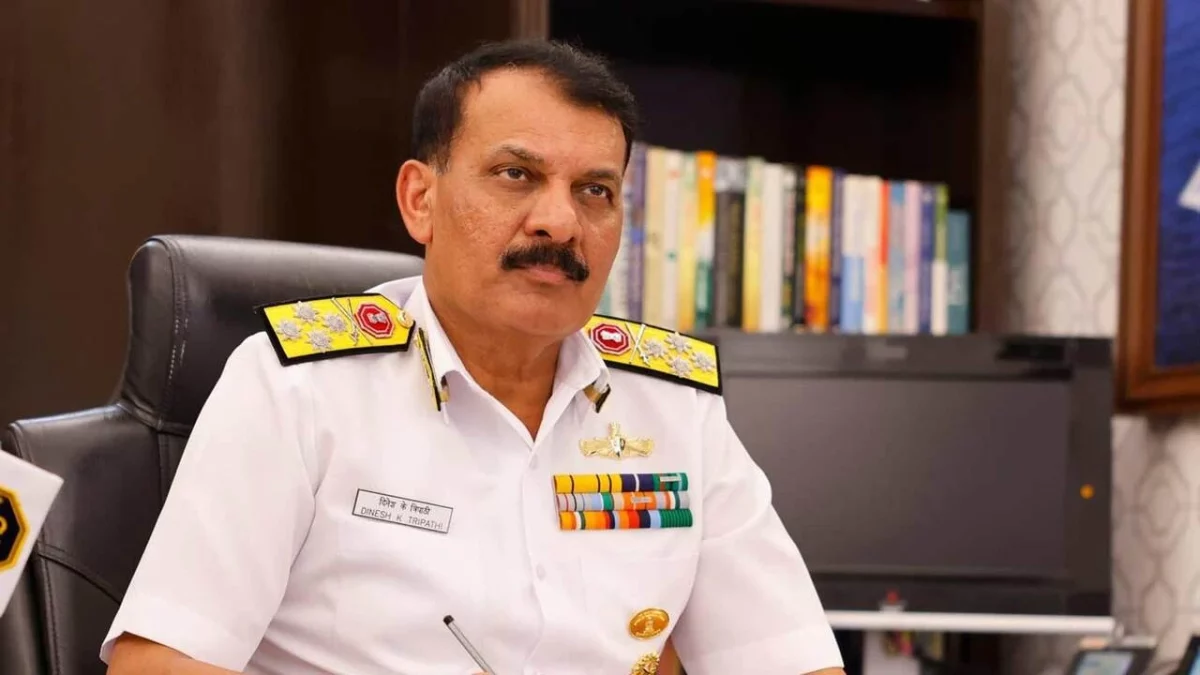
In a strong display of India’s maritime resurgence, Chief of Naval Staff Admiral Dinesh K Tripathi revealed that the Indian Navy is inducting an indigenous warship or submarine every 40 days, marking one of the fastest naval expansion rates globally. The pace underscores India’s determination to achieve complete “Atmanirbharta” (self-reliance) in defence and maritime capability.





Currently operating a fleet of around 145 ships and submarines, the Navy has set an ambitious target of crossing 200 vessels by 2035. Notably, all 52 warships currently under construction are being built in Indian shipyards — a clear sign of India’s evolving shipbuilding strength and industrial maturity.
Admiral Tripathi highlighted that self-reliance in the Navy extends beyond building ships and submarines — it involves nurturing an entire industrial, innovation, and digital ecosystem encompassing indigenous components, secure information networks, semiconductors, and advanced data links. He described self-reliance, synergy, and security as the three essential pillars of India’s maritime power.
The Navy Chief also reaffirmed the service’s commitment to strategic maritime partnerships based on principle and shared purpose, aligning with Prime Minister Narendra Modi’s MAHASAGAR vision — Mutual And Holistic Advancement for Security and Growth Across Regions. This vision aims to deepen India’s cooperation with the Global South through trust, transparency, and coordinated maritime operations such as patrols, surveillance, humanitarian assistance, and interoperability exercises.
Admiral Tripathi noted that India’s defence production has more than tripled in the past decade, surpassing ₹1.5 lakh crore, a reflection of the country’s growing domestic manufacturing and technological capacity. The focus, he said, is shifting from “Make in India” to “Trust in India” — signaling global confidence in India’s defence manufacturing capabilities.
As the Navy accelerates its modernisation drive, it is not only expanding fleet strength but also enhancing indigenous content at the component level, with the goal of becoming a fully self-reliant maritime force by 2047, coinciding with India’s centenary of independence.
Through rapid indigenous production, technological innovation, and principled global engagement, the Indian Navy is charting a course toward becoming a formidable, self-reliant maritime power by mid-century.