

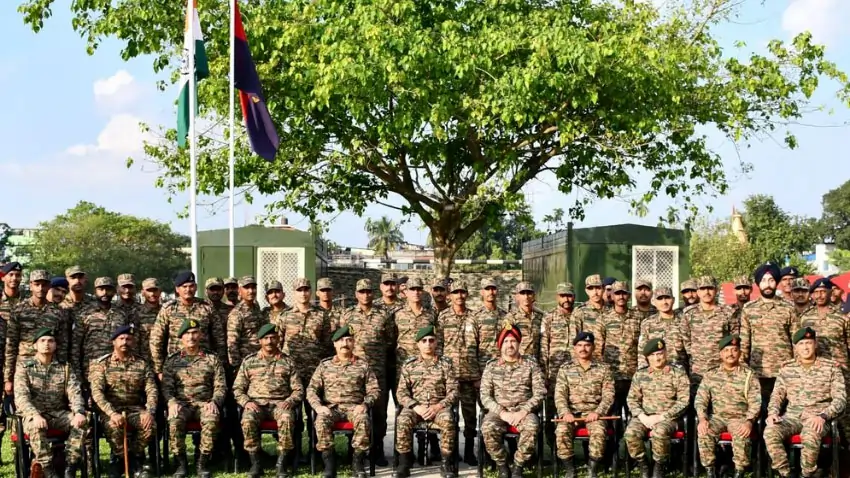
In a major strategic development, India has established three new military garrisons along the Bangladesh border to reinforce the defence of the Siliguri Corridor — the nation’s most vital yet vulnerable land link between mainland India and its northeastern states. The corridor, famously known as the Chicken’s Neck, is a narrow 22-kilometre-wide strip that serves as the lifeline for India’s northeast.





The newly established garrisons are located at Bamuni (near Dhubri, Assam), Kishanganj (Bihar), and Chopra (West Bengal). Together, these installations are designed to enhance operational readiness, improve surveillance, and ensure rapid troop deployment in case of any security contingencies in the sensitive border belt adjoining Bangladesh.
The Lachit Borphukan Military Station at Bamuni marks the first major Indian Army base in Assam near the Bangladesh frontier. Spread across 196 bighas of reclaimed government land, the base is named after the legendary Ahom General Lachit Borphukan, symbolizing Assam’s proud military heritage. The project was made possible through active coordination with state authorities and demonstrates Assam’s commitment to bolstering national security in the region.
Falling under the operational command of the Tezpur-based 4 Corps, the Dhubri station has been tasked with overseeing surveillance, area domination, and quick deployment along the border. The station will also serve as a strategic hub for counter-infiltration operations and technological integration to enhance situational awareness in the corridor.
Meanwhile, the garrisons at Kishanganj and Chopra, located within the Siliguri Corridor, were rapidly developed to function as forward bases enabling swift troop movement. The Chopra base lies less than a kilometre from Tetulia in Bangladesh’s Panchagarh district, placing it in an extremely sensitive tactical location. Both installations fall under the Brahmastra Corps, which oversees crucial defensive operations in the region.
These developments come amid India’s continuous efforts to secure the Siliguri Corridor — a region that remains a strategic chokepoint vulnerable to potential adversarial moves. The area falls under the overall command of the Trishakti Corps (33 Corps), headquartered near Siliguri, which has already deployed advanced defence assets such as Rafale fighter jets, BrahMos missile systems, S-400 air defence systems, and Akash SAM platforms.
Senior defence officials assert that contrary to popular perception, the Chicken’s Neck is not India’s weakness but rather one of its most fortified defence zones, capable of rapid reinforcement from adjoining states like West Bengal, Sikkim, and Assam.
The establishment of these three garrisons also coincides with India’s heightened vigilance over the shifting political landscape in Bangladesh. The recent emergence of an interim leadership in Dhaka and its increasing proximity to Pakistan and China have raised strategic concerns in New Delhi. The new bases, therefore, serve not just as defensive installations but as symbols of India’s proactive military posture and regional dominance.
By setting up the Lachit Borphukan Military Station in Dhubri along with forward deployment bases at Kishanganj and Chopra, India has significantly strengthened its eastern frontier. These developments mark a decisive shift from a purely deterrent stance to an assertive posture aimed at maintaining operational superiority, territorial integrity, and uninterrupted connectivity to the Northeast.
The establishment of these new garrisons underscores India’s commitment to ensuring that the Siliguri Corridor remains impregnable, responsive, and ready for any eventuality in the evolving geopolitical environment of South Asia.