
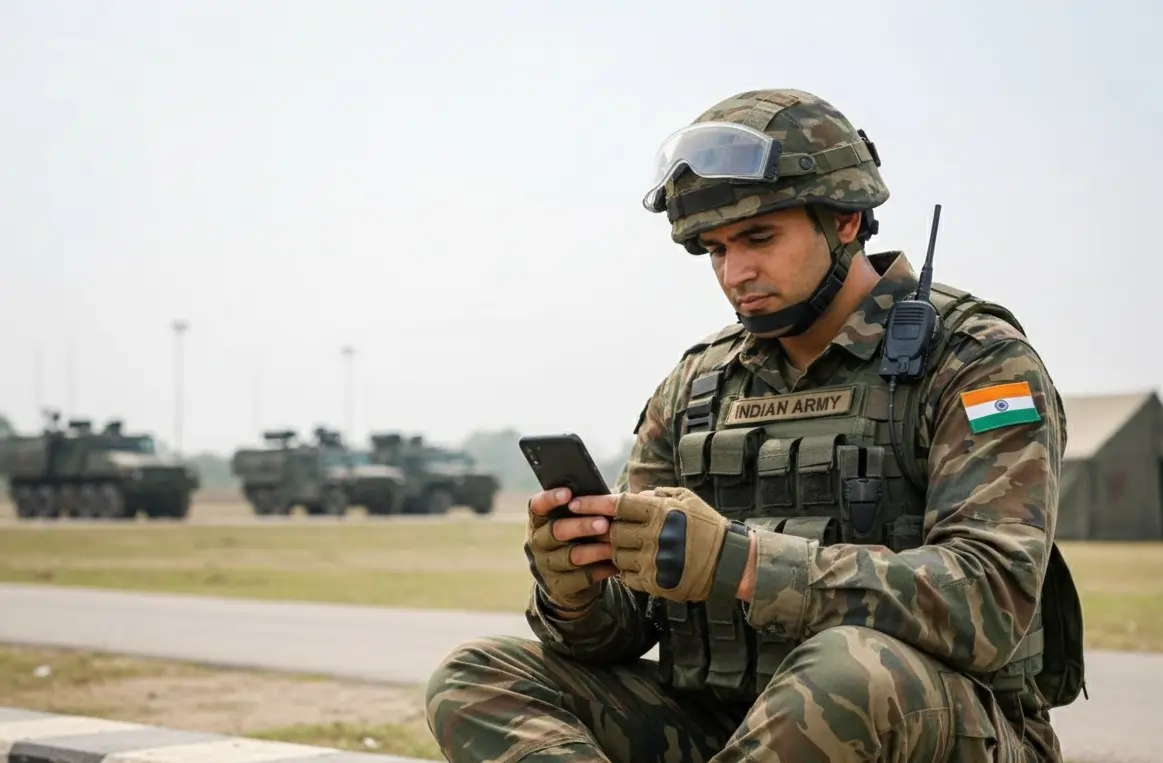
In a significant shift reflecting the realities of modern information warfare and the pervasive role of digital platforms in daily life, the Indian Army has amended its long-standing social media policy. Effective immediately as of December 25, 2025, the revised guidelines permit serving personnel to access Instagram and other select applications in a strictly “view-only” or passive mode. This development, issued by the Army Headquarters through the Directorate General of Military Intelligence (DGMI), marks a departure from earlier blanket prohibitions while underscoring the military’s unwavering commitment to operational security (OPSEC). The policy aims to empower soldiers with tools for information awareness and disinformation monitoring, all without exposing them to the risks associated with active online engagement.


Historical Context: From Bans to Measured Access
The Indian Army’s relationship with social media has been cautious, shaped by a series of security incidents and geopolitical tensions. In July 2020, amid escalating border conflicts with China and concerns over data privacy, the Army mandated the deletion of accounts on platforms like Facebook and Instagram for all officers and soldiers. This directive also banned 89 mobile applications, 59 of which had links to China— including popular ones like TikTok, WeChat, and PUBG Mobile—citing risks of espionage, data leakage, and malware infiltration. Non-compliance was met with warnings of strict disciplinary action, reflecting the era’s heightened vigilance against “honey traps”—scenarios where foreign agents use fake profiles to extract sensitive information from unsuspecting personnel.
Over the years, these restrictions were periodically reviewed and tightened in response to emerging threats. Multiple cases emerged where soldiers inadvertently shared operational details, locations, or personal data, leading to potential compromises. For instance, platforms like Instagram, with their visual and interactive nature, were seen as particularly vulnerable to exploitation. The 2020 ban was part of a broader national effort, aligning with the Indian government’s prohibition on Chinese apps amid the Galwan Valley clash. However, as digital literacy has grown and the need for real-time information awareness has become evident—especially in countering disinformation campaigns—the Army has recognized the value in controlled access.
This latest amendment builds on existing guidelines, formally incorporating Instagram into the list of restricted-use platforms. It represents a pragmatic evolution, acknowledging that complete isolation from social media could hinder personnel’s ability to stay informed about global events, trends, and potential threats. Defence analysts suggest this move is influenced by similar policies in other militaries, such as the U.S. Army, which allows monitored social media use for recruitment and morale while enforcing strict protocols.
Core Details of the Revised Policy
The new directive emphasizes “passive participation,” a term that encapsulates the Army’s cautious approach. Here’s a breakdown of the key provisions:
- Instagram Access: Personnel are now allowed to use Instagram exclusively for viewing and monitoring content. This is intended solely for “information awareness,” such as tracking news, educational material, or disinformation. However, the policy explicitly states: “No comments or views will be communicated on Instagram.” Any form of interaction—posting, commenting, liking, sharing, reacting, or direct messaging—is strictly prohibited. This “view-only” mode ensures soldiers can observe without leaving a digital footprint that could be exploited.
- Other Social Media Platforms: Similar rules apply to YouTube, X (formerly Twitter), and Quora, where access is limited to passive consumption for gaining knowledge. Uploading user-generated content or engaging actively remains banned. These platforms were previously under scrutiny but are now conditionally permitted to foster better situational awareness.
- Messaging and Communication Apps: Apps like WhatsApp, Telegram, Signal, and Skype can be used for exchanging unclassified, general information—but only with known and verified contacts. The onus of recipient verification lies entirely with the user, highlighting the policy’s emphasis on individual responsibility.
- Professional Networks: LinkedIn is authorized for professional purposes only, such as uploading resumes or researching prospective employers/employees. This aligns with career development needs, particularly for personnel transitioning to civilian roles.
- Prohibited Activities and Tools: The ban on the original 89 apps persists, including high-risk ones like Facebook and TikTok. Additionally, personnel are advised to avoid VPNs, torrent websites, cracked or pirated software, anonymous web proxies, chat rooms, file-sharing platforms, and generic free movie sites. Cloud storage services should be used with “extreme care” to prevent data vulnerabilities.
To illustrate the scope of changes, the following table compares the pre-2025 policy with the current revisions:
| Aspect | Pre-2025 Policy (e.g., 2020 Directive) | Current Revised Policy (December 2025) |
|---|---|---|
| Instagram Access | Complete ban; accounts to be deleted | View-only mode for monitoring; no interactions |
| Other Platforms (X, YouTube, Quora) | Restricted or banned | Passive viewing allowed for information |
| Messaging Apps (WhatsApp, etc.) | Limited or banned | Allowed for unclassified info with known contacts |
| Banned Apps | 89 apps, including Chinese-linked ones | Ban continues unchanged |
| VPNs/Torrents | Prohibited | Explicitly warned against |
| Enforcement | Strict action for non-compliance | Individual responsibility emphasized |
This structured approach ensures clarity for over 1.3 million active personnel, with the DGMI overseeing implementation.
Reasons Behind the Amendment
The primary rationale is to strike a balance between connectivity and security. In an era where social media drives narratives and disinformation spreads rapidly—particularly in conflict zones like Jammu and Kashmir or along the Line of Actual Control—the Army views passive access as a tool for vigilance. Soldiers can now monitor trends, flag false information, and enhance their understanding of global affairs without active involvement.
Defence officials have highlighted past honey-trap incidents as a key driver, where adversaries used attractive profiles to befriend personnel and extract details. By limiting interactions, the policy reduces such risks. A quote from the official order underscores this: “Indian Army issued policy on use of social media applications like Instagram and others, allowing personnel to access Instagram for ‘purposes of viewing and monitoring only. No comments/views will be communicated on Instagram.'” This measured relaxation also addresses morale concerns, as complete bans could isolate younger recruits accustomed to digital lifestyles.
However, the policy isn’t without controversy. Some security experts argue that even view-only access could expose devices to malware or tracking, while others praise it as a forward-thinking step. Social media reactions on platforms like X indicate mixed responses, with users noting the “smart move” for digital discipline but questioning enforcement feasibility.
Implications for Personnel and National Security
For the troops, this policy offers a glimpse into the outside world, potentially boosting morale and awareness. It could aid in countering propaganda, especially from adversarial nations. Yet, the emphasis on personal accountability means violations could lead to severe repercussions, including court-martial proceedings.
On a broader scale, the amendment signals the Indian military’s adaptation to hybrid warfare, where information is as critical as ammunition. It may influence similar policies in the Navy and Air Force, which have their own guidelines. Internationally, this aligns with trends in militaries like Israel’s IDF, which allows monitored social media for recruitment while prohibiting sensitive posts.
Challenges remain in monitoring compliance, particularly in remote postings. Training programs on digital hygiene will likely be ramped up, and periodic audits could become standard. As one X user aptly put it, this is “watch-only mode for soldiers,” encapsulating the policy’s essence.
In conclusion, the Indian Army’s policy revision is a nuanced response to the digital era’s demands. By permitting passive access to Instagram and akin platforms, it fosters informed personnel while safeguarding the nation’s defences. As the policy rolls out, its success will hinge on disciplined adherence and ongoing threat assessments.