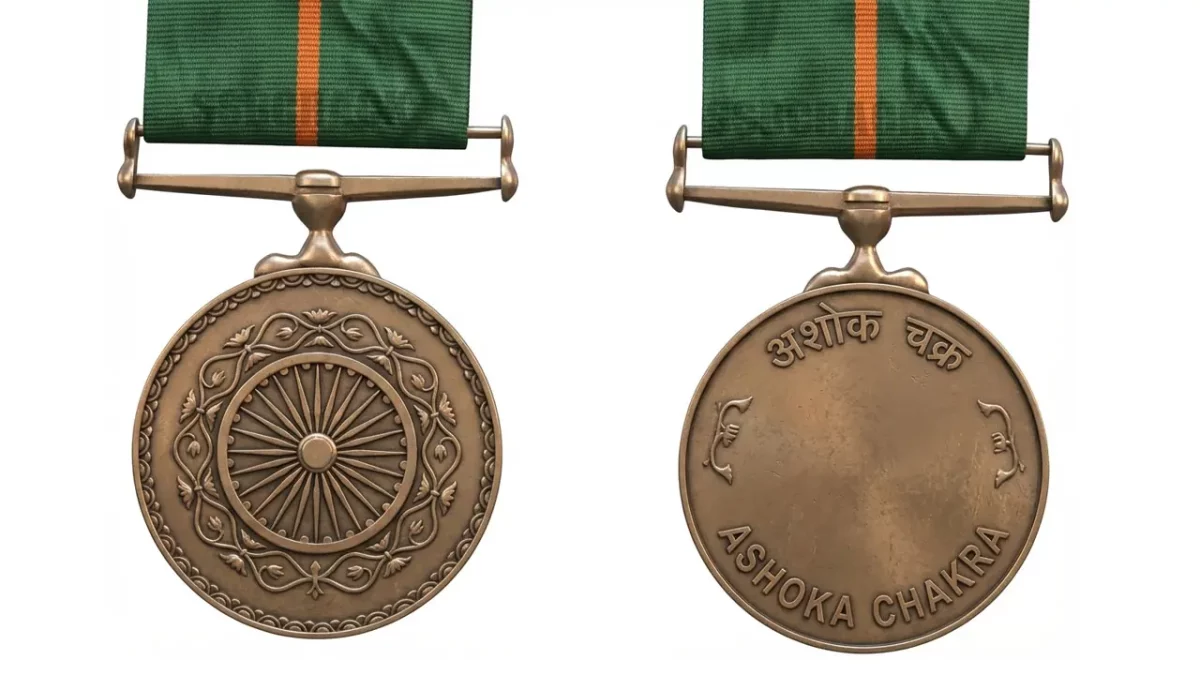
The Ashoka Chakra stands as a beacon of unparalleled courage in India’s honors system, representing the nation’s highest recognition for gallantry during peacetime. Instituted on January 4, 1952, by the Government of India, this prestigious award was designed to honor acts of the “most conspicuous bravery or some daring or pre-eminent valour or self-sacrifice” other than in the face of the enemy. Originally part of a three-tier system—Ashoka Chakra Class-I, Class-II, and Class-III—it was renamed on January 27, 1967, to simplify the nomenclature while retaining its essence: the Ashoka Chakra as the top honor, followed by the Kirti Chakra and Shaurya Chakra. The medal itself is a circular gold gilt design, 1-3/8 inches in diameter, featuring the Ashoka Chakra (a 24-spoke wheel) in the center, encircled by a lotus wreath and edged with lotus blooms. The reverse bears the words “Ashoka Chakra” in Hindi and English, separated by lotus flowers. It is suspended from a green ribbon with an orange vertical stripe, symbolizing peace and valor.





Over the decades, the Ashoka Chakra has been bestowed upon 87 individuals as of January 2026, encompassing military personnel from the Indian Army, Air Force, Navy, police forces, and civilians, including a handful of foreigners. Of these, 68 were posthumous, underscoring the ultimate sacrifice often involved. Seventeen civilians have received it, highlighting its inclusivity beyond the armed forces. The selection process involves recommendations from the Ministry of Defence, vetted by committees, and final approval by the President of India. Awards are typically announced on Republic Day (January 26) or Independence Day (August 15), accompanied by a cash prize of ₹6 lakh and lifelong benefits for recipients or their families.
The award’s history reflects India’s post-independence challenges, from integrating princely states to combating insurgencies, terrorism, and natural or man-made disasters. The first awards in 1952 went to Havildar Bachittar Singh† and Naik Narbahadur Thapa for their valor during Operation Polo, which integrated Hyderabad into India. In the 1950s and 1960s, many awards addressed insurgencies in Nagaland and Mizoram, as well as dacoit attacks in Madhya Pradesh. The 1980s saw recognition for Operation Blue Star and the Siachen Glacier operations, alongside unique honors for space exploration, such as Wing Commander Rakesh Sharma’s 1984 Soyuz T-11 mission. The 1990s and 2000s were dominated by Kashmir insurgency awards, with a peak in 2009 following the 2008 Mumbai attacks, where 11 recipients, including police officers like Hemant Karkare† and Sandeep Unnikrishnan†, were honored for their heroism.
Notable among recipients are the only two women: Neerja Bhanot†, a flight attendant who saved hundreds during the 1986 Pan Am Flight 73 hijacking, and Kamlesh Kumari Yadav†, a CRPF constable who thwarted the 2001 Parliament attack. Foreign recipients include Soviet cosmonauts Yury Malyshev and Gennadi Strekalov in 1984 for their role in the Soyuz T-11 mission with Rakesh Sharma. The award has occasionally sparked discussions on its application, particularly in counter-insurgency contexts that some view as quasi-wartime, but official guidelines maintain its peacetime distinction.
In recent years, awards have been sparse, with the last before 2026 being Assistant Sub-Inspector Babu Ram† in 2021 for counter-insurgency in Kashmir. The 2026 award to Group Captain Shubhanshu Shukla revives the space exploration category. Shukla, a seasoned IAF test pilot with over 2,000 flying hours on aircraft like Sukhoi-30MKI and MiG-21, became the first Indian to visit the ISS in June 2025 via the Axiom-4 mission, marking India’s advancing space ambitions 41 years after Sharma’s flight. His award, approved by President Droupadi Murmu, highlights innovation and international collaboration in peacetime heroism.
The Ashoka Chakra not only commemorates individual bravery but also inspires national pride, with recipients’ stories integrated into military training, school curricula, and public memorials. For instance, memorials for 2008 Mumbai attack heroes stand as tributes, and annual ceremonies at the National War Memorial honor all gallantry awardees. As India faces new challenges like cybersecurity threats and climate disasters, the award’s scope may evolve, but its core remains a testament to selfless courage.
Complete Chronological List of Ashoka Chakra Recipients (1952-2026)
Below is a comprehensive table of all 87 recipients, including ranks, units, years, and notes. Posthumous awards are marked with †, non-Indian with ^.
| Year | Name | Rank/Position | Unit/Service | Notes/Context |
|---|---|---|---|---|
| 1952 | Bachittar Singh† | Havildar | Indian Army | Operation Polo |
| 1952 | Narbahadur Thapa | Naik | Indian Army | Operation Polo |
| 1953 | Suhas Biswas | Flight Lieutenant | Indian Air Force | Stricken flight landing |
| 1955 | D. K. Jatar† | Flight Captain | Air India (Civilian) | Kashmir Princess bombing |
| 1956 | Sundar Singh | Lance Naik | Indian Army | Kashmir conflict |
| 1957 | Jagannath Raoji Chitnis† | Lieutenant Colonel | Indian Army | Nagaland insurgency |
| 1957 | Joginder Singh† | Havildar | Indian Army | Nagaland insurgency |
| 1957 | Pollur Mutthuswamy Raman† | Second Lieutenant | Indian Army | Nagaland insurgency |
| 1958 | Eric James Tucker† | Captain | Indian Army | Nagaland insurgency |
| 1962 | Khadka Bahadur Limbu† | Subedar Major | Indian Army | Nagaland insurgency |
| 1962 | Man Bahadur Rai | Captain | Indian Army | Nagaland insurgency |
| 1965 | Chaman Lal† | Firefighter | Civilian | Train fire |
| 1965 | Lajja Ram† | – | Civilian | Dacoit attack |
| 1965 | Purshottam† | – | Civilian | Dacoit attack |
| 1965 | Tej Singh† | – | Civilian | Dacoit attack |
| 1967 | Shankar Lal Shrivastava† | Head Constable | Madhya Pradesh Police | Dacoit attack |
| 1968 | Takhat Singh† | – | Civilian | Dacoit attack |
| 1968 | Dhanpat Singh | – | Civilian | Dacoit attack |
| 1968 | Govind Singh | – | Civilian | Dacoit attack |
| 1968 | Hukum Singh | – | Civilian | Dacoit attack |
| 1968 | Lakhan Singh | – | Civilian | Dacoit attack |
| 1969 | Jas Ram Singh | Captain | Indian Army | Mizo insurgency |
| 1971 | Baij Nath Singh† | – | Civilian | Dacoit attack |
| 1972 | Bhure Lal | Constable | Madhya Pradesh Police | Dacoit attack |
| 1972 | Ummed Singh Mahra† | Captain | Indian Army | Nagaland insurgency |
| 1974 | Gurnam Singh† | Naib Subedar | Indian Army | Mine explosion |
| 1974 | Munni Lal† | – | Civilian | Dacoit attack |
| 1981 | Cyrus Addie Pithawalla | Second Lieutenant | Indian Army | Manipur insurgency |
| 1984 | Gennadi Strekalov^ | Flight Engineer | Roscosmos | Soyuz T-11 mission |
| 1984 | Yury Malyshev^ | Colonel | Soviet Air Forces | Soyuz T-11 mission |
| 1985 | Bhawani Datt Joshi† | Naik | Indian Army | Operation Blue Star |
| 1985 | Bhukant Mishra† | Major | Indian Army | Operation Blue Star |
| 1985 | Chhering Mutup | Lance Havildar | Indian Army | Siachen conflict |
| 1985 | Jasbir Singh Raina | Captain | Indian Army | Operation Blue Star |
| 1985 | Nirbhay Singh Sisodiya† | Naik | Indian Army | Operation Blue Star |
| 1985 | Ram Prakash Roperia† | Lieutenant | Indian Army | Operation Blue Star |
| 1985 | Rakesh Sharma | Wing Commander | Indian Air Force | Soyuz T-11 mission |
| 1986 | Vijay Jagirdar† | – | Civilian | 1984 anti-Sikh riots |
| 1987 | Neerja Bhanot† | Flight Attendant | Pan Am (Civilian) | Pan Am Flight 73 hijacking |
| 1991 | Randhir Prasad Verma† | Superintendent of Police | Bihar Police | Bank robbery |
| 1992 | Sandeep Sankhla† | Major | Indian Army | Kashmir insurgency |
| 1993 | Rakesh Singh Malhan† | Second Lieutenant | Indian Army | Kashmir insurgency |
| 1994 | Neelakantan Jayachandran Nair† | Colonel | Indian Army | Kashmir insurgency |
| 1995 | Harsh Uday Singh Gaur† | Lieutenant Colonel | Indian Army | Kashmir insurgency |
| 1995 | Rajiv Kumar Joon† | Major | Indian Army | Kashmir insurgency |
| 1995 | Sujjan Singh Yadav† | Subedar | Indian Army | Kashmir insurgency |
| 1996 | Arun Singh Jasrotia† | Captain | Indian Army | Kashmir insurgency |
| 1997 | Puneet Nath Datt† | Second Lieutenant | Indian Army | Kashmir insurgency |
| 1997 | Shanti Swaroop Rana† | Lieutenant Colonel | Indian Army | Kashmir insurgency |
| 2000 | Sudhir Kumar Walia† | Major | Indian Army | Kashmir insurgency |
| 2001 | Jagdish Prasad Yadav† | – | Rajya Sabha Secretariat (Civilian) | 2001 Indian Parliament attack |
| 2001 | Matbar Singh Negi† | – | Rajya Sabha Secretariat (Civilian) | 2001 Indian Parliament attack |
| 2001 | Kamlesh Kumari Yadav† | Constable | Central Reserve Police Force | 2001 Indian Parliament attack |
| 2002 | Surinder Singh† | Subedar | Indian Army | Kashmir insurgency |
| 2002 | Rambeer Singh Tomar† | Naik | Indian Army | Kashmir insurgency |
| 2002 | Suresh Chand Yadav† | Subedar Major | National Security Guard | Akshardham Temple attack |
| 2004 | Sanjog Chhetri† | Paratrooper | Indian Army | Kashmir insurgency |
| 2004 | Triveni Singh† | Lieutenant | Indian Army | Kashmir insurgency |
| 2007 | Chuni Lal† | Naib Subedar | Indian Army | Kashmir insurgency |
| 2007 | Radhakrishnan Nair Harshan† | Captain | Indian Army | Kashmir insurgency |
| 2007 | Vasanth Venugopal† | Colonel | Indian Army | Kashmir insurgency |
| 2008 | Dinesh Raghu Raman† | Major | Indian Army | Kashmir insurgency |
| 2009 | Ashok Kamte† | Additional Commissioner | Maharashtra Police | 2008 Mumbai attacks |
| 2009 | Bahadur Singh Bohra† | Havildar | Indian Army | Kashmir insurgency |
| 2009 | Gajender Singh Bisht† | Havildar | National Security Guard | 2008 Mumbai attacks |
| 2009 | Hemant Karkare† | Joint Commissioner | Maharashtra Police | 2008 Mumbai attacks |
| 2009 | Jojan Thomas† | Colonel | Indian Army | Kashmir insurgency |
| 2009 | Mohan Chand Sharma† | Inspector | Delhi Police | Batla House encounter |
| 2009 | Pramod Kumar Satapathy† | Assistant Commandant | Odisha Police | Naxalite–Maoist insurgency |
| 2009 | R. P. Diengdoh† | Deputy Superintendent | Meghalaya Police | Meghalaya insurgency |
| 2009 | Sandeep Unnikrishnan† | Major | National Security Guard | 2008 Mumbai attacks |
| 2009 | Tukaram Omble† | Assistant Sub-Inspector | Maharashtra Police | 2008 Mumbai attacks |
| 2009 | Vijay Salaskar† | Inspector | Maharashtra Police | 2008 Mumbai attacks |
| 2010 | D. Sreeram Kumar | Major | Indian Army | Manipur insurgency |
| 2010 | Mohit Sharma† | Major | Indian Army | Kashmir insurgency |
| 2010 | Rajesh Kumar† | Havildar | Indian Army | Kashmir insurgency |
| 2011 | Laishram Jyotin Singh† | Major | Indian Army | 2010 Kabul attack |
| 2012 | Navdeep Singh† | Lieutenant | Indian Army | Kashmir insurgency |
| 2014 | Mukund Varadarajan† | Major | Indian Army | Kashmir insurgency |
| 2014 | Neeraj Kumar Singh† | Naik | Indian Army | Kashmir insurgency |
| 2014 | K. Prasad Babu† | Sub-Inspector | Andhra Pradesh Police | Naxalite–Maoist insurgency |
| 2016 | Mohan Nath Goswami† | Lance Naik | Indian Army | Kashmir insurgency |
| 2017 | Hangpan Dada† | Havildar | Indian Army | Kashmir insurgency |
| 2018 | Jyoti Prakash Nirala† | Corporal | Indian Air Force | Kashmir insurgency |
| 2019 | Nazir Ahmad Wani† | Lance Naik | Territorial Army | Kashmir insurgency |
| 2021 | Babu Ram† | Assistant Sub-Inspector | Jammu and Kashmir Police | Kashmir insurgency |
| 2026 | Shubhanshu Shukla | Group Captain | Indian Air Force | Axiom-4 mission to ISS |
This table compiles data from official and verified sources, providing a self-contained reference. For deeper insights, the Ministry of Defence’s gallantry awards portal offers profiles and citations.
Notable Recipients and Their Stories
- Early Pioneers (1950s): Flight Lieutenant Suhas Biswas (1953) safely landed a stricken aircraft, saving lives. His award set a precedent for aviation heroism.
- Insurgency Heroes (1960s-1990s): Colonel Neelakantan Jayachandran Nair† (1994) led operations in Kashmir, exemplifying leadership under fire.
- Space Explorers: Wing Commander Rakesh Sharma (1985) became India’s first astronaut. Similarly, Group Captain Shubhanshu Shukla (2026), a test pilot with extensive experience, spent 18 days on the ISS in 2025, advancing India’s space program.
- Terrorism Fighters (2000s): Major Sandeep Unnikrishnan† (2009) led a commando team during the Mumbai attacks, sacrificing himself to save hostages. Lance Naik Nazir Ahmad Wani† (2019), a former militant who joined the army, symbolized redemption and bravery in Kashmir.
In conclusion, the Ashoka Chakra encapsulates India’s resilient spirit, honoring those who go beyond duty’s call. As the nation progresses, these stories continue to motivate future generations.