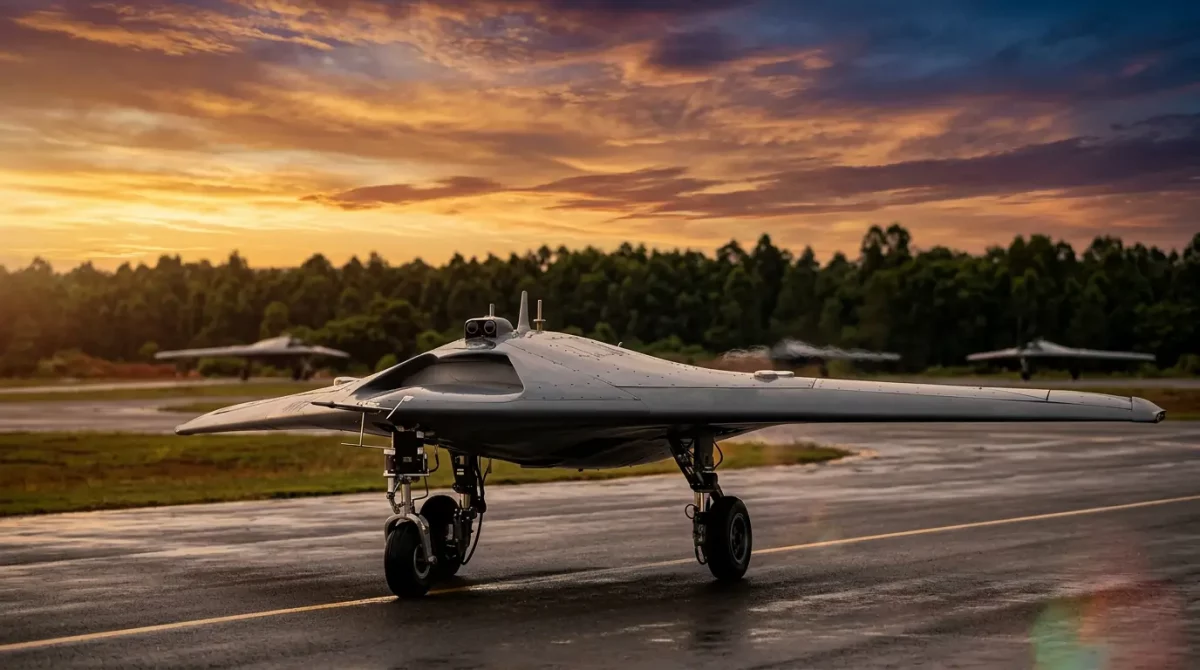
New Delhi, 27 March 2026 — In a significant boost to India’s indigenous defence capabilities and self-reliance in unmanned combat aviation, the Defence Acquisition Council (DAC), chaired by Defence Minister Rajnath Singh, today granted Acceptance of Necessity (AoN) for the procurement of Remotely Piloted Strike Aircraft (RPSA) for the Indian Air Force. This clearance encompasses four squadrons comprising 20 aircraft each, directly advancing the DRDO-developed Ghatak stealth unmanned combat aerial vehicle (UCAV) programme.





The decision forms part of a broader package of defence proposals valued at approximately ₹2.38 lakh crore, which also includes the S-400 long-range surface-to-air missile system, medium transport aircraft, and Su-30 aero-engine overhauls. Official statements from the Ministry of Defence emphasise that the RPSA will enable the Indian Air Force to conduct offensive counter-air operations, coordinated air strikes, and stealth intelligence, surveillance, and reconnaissance (ISR) missions in contested environments, thereby minimising risks to manned aircraft.
The Ghatak, also known as the Indian Unmanned Strike Air Vehicle, is an autonomous, jet-powered stealth UCAV designed primarily for deep-strike missions and suppression of enemy air defences (SEAD/DEAD). Developed by the Aeronautical Development Establishment (ADE) under the Defence Research and Development Organisation (DRDO), with design support from the Aeronautical Development Agency (ADA), the programme traces its origins to a 2009 feasibility study under the Autonomous Unmanned Research Aircraft initiative. Initial funding for critical technologies and lead-in design was sanctioned at ₹2.31 billion, followed by approval in 2016 for a scaled-down technology demonstrator, the Stealth Wing Flying Testbed (SWiFT), at a cost of ₹700 million.
The SWiFT demonstrator, featuring a flying-wing configuration, successfully conducted its maiden flight on 1 July 2022 at the Aeronautical Test Range in Chitradurga, Karnataka. Subsequent test flights in 2023 validated high-subsonic performance, autonomous takeoff and landing, stealth characteristics, and advanced avionics integration. Two prototypes were built, progressing from a tailed variant to a tailless flying-wing design, confirming the platform’s low radar cross-section and internal weapon carriage capabilities.
Key Specifications and Design Features
The Ghatak is engineered as a 13–15 tonne class platform with a carbon-composite airframe optimised for stealth. It adopts a flying-wing layout to minimise radar detectability and will be powered by a variant of the indigenous Kaveri afterburning turbofan engine (with the SWiFT using a Russian TRDD-50MT for early testing). Expected performance parameters include:
- Operational ceiling: Up to 9,100 metres (30,000 feet).
- Combat radius: Approximately 500 nautical miles (930 km), as per earlier Indian Air Force requirements.
- Payload: Internal weapons bay capable of carrying precision-guided munitions, missiles, and bombs.
- Autonomy features: Onboard mission computers, fire-control radar, identification friend-or-foe systems, and collision-avoidance technology for fully autonomous operations.
The platform is intended to operate as a “loyal wingman” alongside manned fighters such as the Tejas Mk II and the future Advanced Medium Combat Aircraft (AMCA), penetrating heavily defended airspace without exposing pilots to risk. It aligns with the Indian Air Force’s Vision 2047 roadmap, which envisions substantial acquisition of such UCAVs for both the Air Force and Army.
This DAC approval follows the Defence Procurement Board’s recommendation on 3 March 2026 to advance the acquisition of 60 Ghatak units, marking a rapid progression from development to series procurement. The move underscores India’s commitment to Atmanirbhar Bharat by prioritising home-grown platforms over foreign alternatives. Industry observers note that the four-squadron force will provide the Indian Air Force with a dedicated stealth strike capability to counter advanced threats, including those from regional adversaries.
Production is expected to involve public-private partnerships, with high indigenous content in airframe, avionics, and propulsion systems. While exact timelines for induction remain classified, the programme’s momentum—bolstered by successful demonstrator flights and engine certification targets—positions the Ghatak as a cornerstone of India’s future autonomous deep-strike force.
This landmark decision not only strengthens operational readiness but also signals India’s emergence as a key player in advanced unmanned combat systems on the global stage. Further details on contract awards and industrial participation are anticipated in the coming months.