

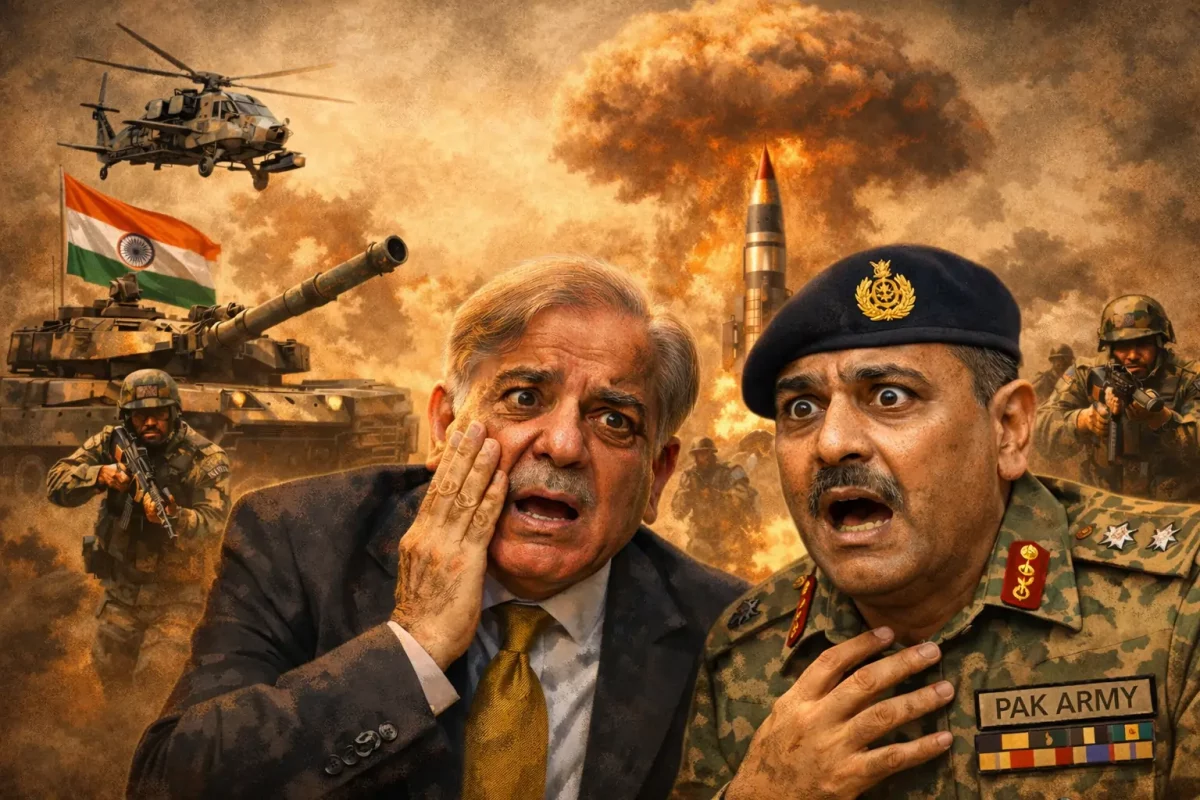
India has fundamentally reshaped the strategic balance with Pakistan through Operation Sindoor, a calibrated military action that directly challenged the long-standing assumptions underpinning Islamabad’s nuclear doctrine.





For more than two decades, Pakistan’s nuclear weapons functioned less as battlefield tools and more as psychological leverage, offsetting India’s conventional military superiority. Islamabad’s strategy of full-spectrum deterrence relied on deliberate ambiguity, keeping nuclear red lines undefined to deter not just major invasions, but even limited punitive strikes. This ambiguity enabled Pakistan to pursue sub-conventional tactics, including proxy terrorism, under the shadow of nuclear escalation.
Operation Sindoor: Breaking the Nuclear Inhibition
Operation Sindoor marked a decisive break from this paradigm. India conducted sustained, precise conventional strikes deep inside Pakistani territory without triggering nuclear signalling or escalation. The operation demonstrated that conventional air and ground actions can be executed below the nuclear threshold, significantly diluting the coercive value of Pakistan’s nuclear ambiguity.
Historically, Pakistan’s development of tactical nuclear weapons was intended to signal that even small-scale conventional conflict could invite nuclear response—thereby constraining Indian options. Operation Sindoor shattered this inhibition, proving that calibrated, well-signalled conventional operations do not automatically provoke nuclear retaliation.
Rationality Over Brinkmanship
Notably, Pakistan refrained from extraordinary escalation during the operation. Decision-makers in Islamabad adhered to a rational cost–benefit calculus, even under pressure. This response effectively clarified the boundary between conventional punishment and nuclear use, expanding the manoeuvre space for non-nuclear warfare in South Asia.
Air power—once perceived as a psychological red line in a nuclear dyad—emerged as a normalised instrument when applied with precision and restraint. India paired deep strikes with clear political messaging, framing actions as measured responses, not precursors to total war.
India’s Strategic Signalling
India’s senior military leadership reinforced this shift after the operation. General Anil Chauhan, Chief of Defence Staff, underscored the rationality displayed by both sides, emphasising that there is ample space below the nuclear threshold for conventional operations.
“There’s a lot of space for conventional operations which has been created, and this will be the new norm,” General Chauhan stated, rejecting the notion that nuclear weapons render conventional conflict uncontrollable.
This articulation addressed both domestic and international audiences, reinforcing India’s view that credible conventional force, backed by restraint and clarity, can manage escalation even in nuclearised environments.
Eroding the Shield of Ambiguity
By acting decisively without nuclear repercussions, India eroded the credibility of Pakistan’s ambiguous nuclear threats. While nuclear weapons retain relevance for existential deterrence, they no longer provide a blanket shield against conventional retaliation. Sub-conventional aggression can no longer be pursued with impunity.
In effect, Operation Sindoor rewrote Pakistan’s nuclear doctrine in practice. The demonstration showed that ambiguity fails when confronted with precise, limited conventional force. The strategic grammar of South Asia has shifted—from brinkmanship to rationality.
Implications for South Asia and Beyond
Pakistan’s nuclear arsenal remains potent, but its perceived omnipotence has diminished. India has carved out a broader domain for conventional responses, reshaping deterrence stability in the region. Future crises are likely to unfold within this expanded conventional envelope, with nuclear options pushed further up the escalation ladder.
Beyond the subcontinent, Operation Sindoor offers a case study in managing escalation under nuclear shadows—showing how technological precision, disciplined force application, and strategic messaging can reduce nuclear overhangs on conventional action.
In essence, India has redefined the rules of engagement. Pakistan is now compelled to adapt to a reality where conventional superiority, wielded judiciously, has reasserted itself as a viable and credible strategic instrument.