
China has strongly rejected a recent US defence report that assessed Beijing’s approach towards India, accusing Washington of distorting China’s defence policy to undermine improving ties between New Delhi and Beijing.




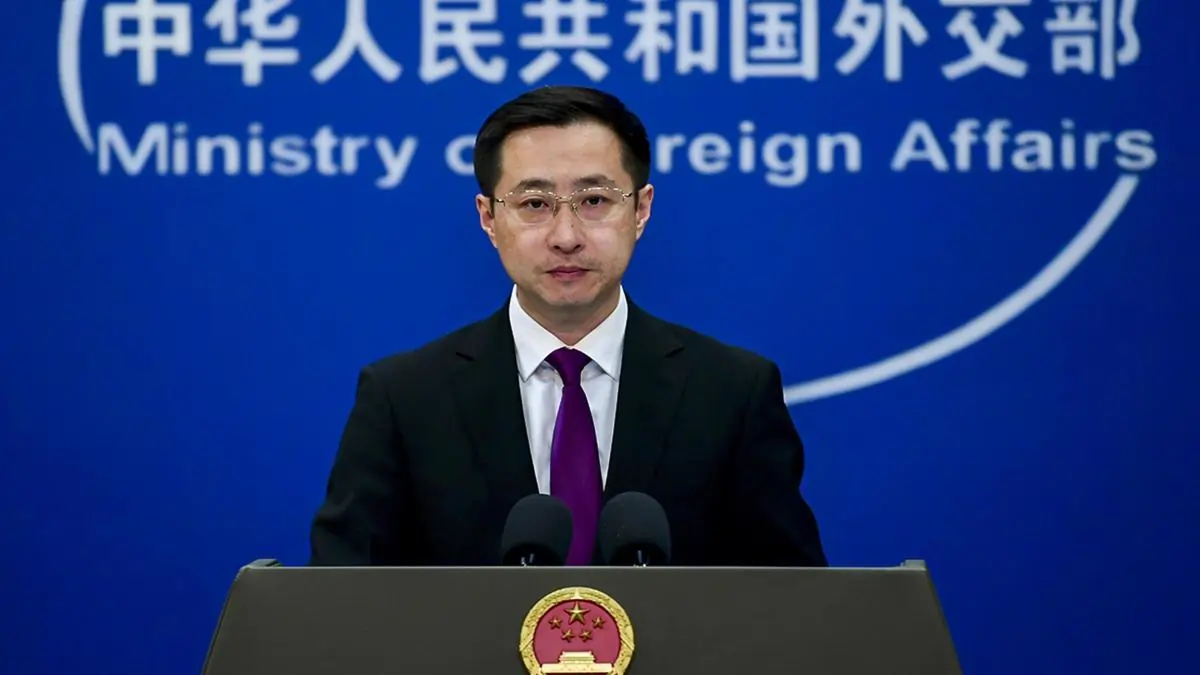
Responding during a routine press briefing, Chinese Foreign Ministry spokesperson Lin Jian said China handles its relations with India from a “strategic height and long-term perspective”, and firmly objected to external interference in what it described as a purely bilateral border issue.
Reaction to US Defence Report
Lin Jian’s remarks were in response to the United States Department of Defense report titled Military and Security Developments Involving the People’s Republic of China 2025, which suggested that China may be leveraging recent de-escalation along the Line of Actual Control (LAC) to stabilise ties with India and limit growing US–India strategic convergence.
“China opposes any third party making irresponsible remarks or judgments on China–India relations,” Lin said, adding that Washington should stop sowing discord in the region.
India–China Engagement Context
The US report pointed to an October 2024 disengagement agreement between India and China on remaining friction points along the LAC, announced shortly before a sidelines meeting between Xi Jinping and Narendra Modi at the BRICS Summit.
That meeting led to the resumption of monthly high-level dialogues, focusing on border management and confidence-building steps such as direct flights, visa facilitation, and exchanges between academics and journalists.
While US analysts view these moves as tactical, Lin Jian insisted that China seeks stable and constructive relations with India, handled independently without external pressure.
Shadow of the LAC Standoff
The episode unfolds against the backdrop of the 2020 Galwan Valley clash, which severely strained ties and resulted in prolonged military standoffs. Although multiple rounds of talks have produced partial disengagements, full normalisation remains contingent on sustained border peace.
India has repeatedly stated—most recently through External Affairs Minister S. Jaishankar—that relations with China cannot return to normal unless peace and tranquillity are restored along the LAC.
Strategic Undercurrents
China’s pushback also reflects its broader concerns over US-led groupings like the Quad, involving India, the US, Japan, and Australia. Beijing accuses Washington of exaggerating the “China threat” to justify alliances aimed at containing China.
India, meanwhile, continues to balance its deepening defence cooperation with the US—through initiatives like iCET and Quad exercises—with strategic autonomy, maintaining ties with Russia and platforms such as BRICS.
A Fragile Calm
Despite ongoing dialogue and record bilateral trade, mutual distrust persists, fuelled by Chinese infrastructure build-up near the LAC and unresolved diplomatic irritants. As 2025 unfolds, analysts note that the fragile calm along the border will test whether strategic restraint can prevail over great-power rivalry.
China’s dismissal of the US report underscores one message clearly: Beijing wants India ties managed bilaterally, without Washington in the picture—even as geopolitical competition in Asia continues to intensify.