Friday, Dec 26, 2025
SSBCrack
Search
  • Home
  • Indian Defence News
  • Notification
  • SSB Interview
    • SSB Interview Date
    • Screening
    • Psychology
    • GTO
    • Personal Interview
    • Conference
    • Medical
    • Merit List
  • Books
    • OIR Test & PPDT
    • SSB Interview
    • Psych Tests Workbook
    • SSB Psychology
    • NDA Exam
    • CDS Exam
    • AFCAT
    • EKT
  • eBooks
    • SSB eBook
    • OIR Test eBook
    • TAT eBook
    • SRT eBook
    • WAT eBook
    • Current Affairs
    • General Knowledge
  • Online Courses
    • NDA Exam
    • CDS Exam
    • CDS OTA Exam
    • AFCAT Exam
    • MNS Exam
    • TA Exam
    • ACC Exam
  • Download APP
  • Success Stories
  • Join Us
Reading: How India Reshaped Pakistan’s Nuclear Strategy Through Operation Sindoor?
Share
Font ResizerAa
SSBCrackSSBCrack
  • Home
  • Notification
  • SSB Interview
  • Books
  • eBooks
  • Courses
Search
  • Home
  • Notification
  • SSB Interview
  • Books
  • eBooks
  • Courses
Follow US
© 2010 - 2025 SSBCrack . All Rights Reserved.

Home » How India Reshaped Pakistan’s Nuclear Strategy Through Operation Sindoor?

Indian Defence News

How India Reshaped Pakistan’s Nuclear Strategy Through Operation Sindoor?

Operation Sindoor redefined escalation thresholds, weakening Pakistan’s nuclear ambiguity and expanding India’s conventional response space.

By Adhidev Jasrotia
Last updated: December 26, 2025
Share
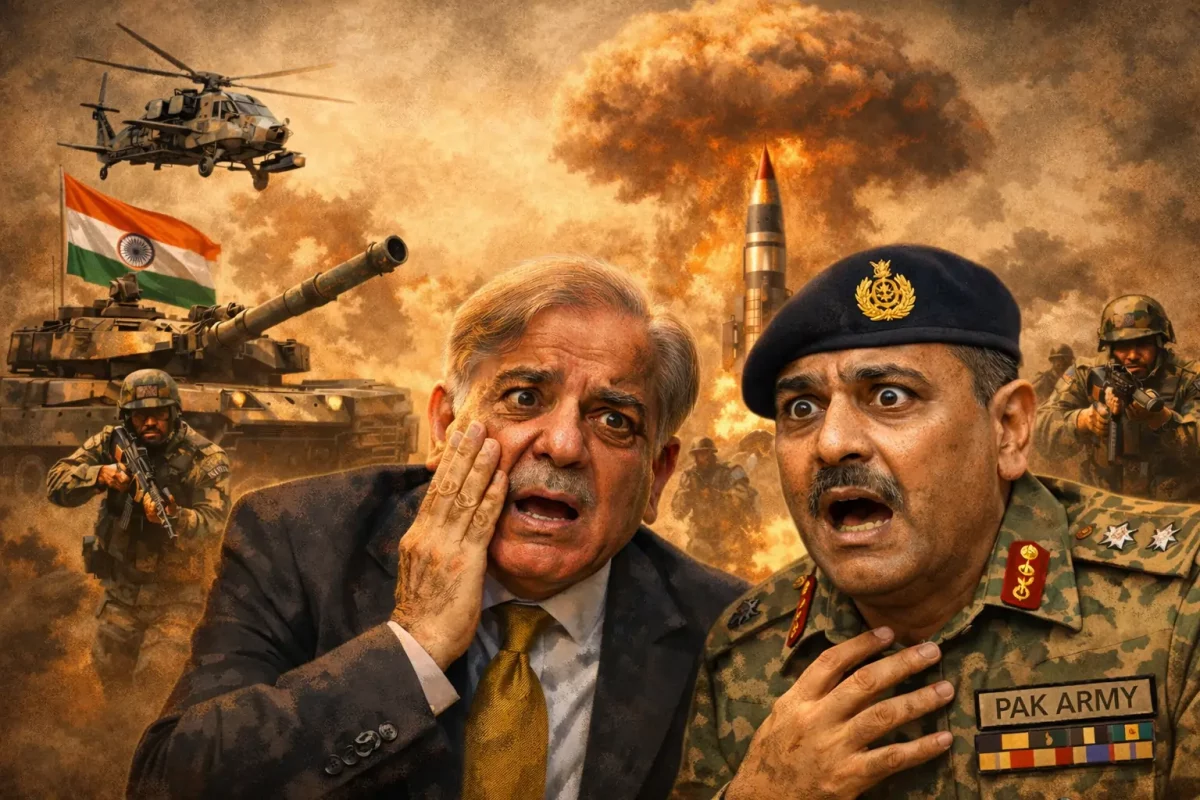
Pakistan Afraid of India

India has fundamentally reshaped the strategic balance with Pakistan through Operation Sindoor, a calibrated military action that directly challenged the long-standing assumptions underpinning Islamabad’s nuclear doctrine.


Olive Squad Coffee Mugs

For more than two decades, Pakistan’s nuclear weapons functioned less as battlefield tools and more as psychological leverage, offsetting India’s conventional military superiority. Islamabad’s strategy of full-spectrum deterrence relied on deliberate ambiguity, keeping nuclear red lines undefined to deter not just major invasions, but even limited punitive strikes. This ambiguity enabled Pakistan to pursue sub-conventional tactics, including proxy terrorism, under the shadow of nuclear escalation.

Operation Sindoor: Breaking the Nuclear Inhibition

Operation Sindoor marked a decisive break from this paradigm. India conducted sustained, precise conventional strikes deep inside Pakistani territory without triggering nuclear signalling or escalation. The operation demonstrated that conventional air and ground actions can be executed below the nuclear threshold, significantly diluting the coercive value of Pakistan’s nuclear ambiguity.

More Read

Indian Army to Acquire 20 Tactical RPAs to Boost Surveillance and ISR Capability
US Defence Report Warns: China Eyes Arunachal Pradesh Like Taiwan
Colonel Assault Case: CBI Files Chargesheet Against Four Punjab Police Officers

Historically, Pakistan’s development of tactical nuclear weapons was intended to signal that even small-scale conventional conflict could invite nuclear response—thereby constraining Indian options. Operation Sindoor shattered this inhibition, proving that calibrated, well-signalled conventional operations do not automatically provoke nuclear retaliation.

Rationality Over Brinkmanship

Notably, Pakistan refrained from extraordinary escalation during the operation. Decision-makers in Islamabad adhered to a rational cost–benefit calculus, even under pressure. This response effectively clarified the boundary between conventional punishment and nuclear use, expanding the manoeuvre space for non-nuclear warfare in South Asia.

Air power—once perceived as a psychological red line in a nuclear dyad—emerged as a normalised instrument when applied with precision and restraint. India paired deep strikes with clear political messaging, framing actions as measured responses, not precursors to total war.

India’s Strategic Signalling

India’s senior military leadership reinforced this shift after the operation. General Anil Chauhan, Chief of Defence Staff, underscored the rationality displayed by both sides, emphasising that there is ample space below the nuclear threshold for conventional operations.

“There’s a lot of space for conventional operations which has been created, and this will be the new norm,” General Chauhan stated, rejecting the notion that nuclear weapons render conventional conflict uncontrollable.

This articulation addressed both domestic and international audiences, reinforcing India’s view that credible conventional force, backed by restraint and clarity, can manage escalation even in nuclearised environments.

Eroding the Shield of Ambiguity

By acting decisively without nuclear repercussions, India eroded the credibility of Pakistan’s ambiguous nuclear threats. While nuclear weapons retain relevance for existential deterrence, they no longer provide a blanket shield against conventional retaliation. Sub-conventional aggression can no longer be pursued with impunity.

In effect, Operation Sindoor rewrote Pakistan’s nuclear doctrine in practice. The demonstration showed that ambiguity fails when confronted with precise, limited conventional force. The strategic grammar of South Asia has shifted—from brinkmanship to rationality.

Implications for South Asia and Beyond

Pakistan’s nuclear arsenal remains potent, but its perceived omnipotence has diminished. India has carved out a broader domain for conventional responses, reshaping deterrence stability in the region. Future crises are likely to unfold within this expanded conventional envelope, with nuclear options pushed further up the escalation ladder.

Beyond the subcontinent, Operation Sindoor offers a case study in managing escalation under nuclear shadows—showing how technological precision, disciplined force application, and strategic messaging can reduce nuclear overhangs on conventional action.

In essence, India has redefined the rules of engagement. Pakistan is now compelled to adapt to a reality where conventional superiority, wielded judiciously, has reasserted itself as a viable and credible strategic instrument.

IMA Mug

IMA Mug

₹499
Shop Now
IAF Mug

IAF Mug

₹499
Shop Now
NDA Mug

NDA Mug

₹499
Shop Now
Navy Mug

Navy Mug

₹299
Shop Now
NSG Mug

NSG Coffee Mug

₹499
Shop Now
Share This Article
Facebook Whatsapp Whatsapp Telegram
Share
ByAdhidev Jasrotia
An expert in Indian defence affairs, military recruitment, and geopolitical strategy, brings a strong foundation in national security journalism. Recommended for the Indian Army with All India Rank 138.
Previous Article Indian and Chinese Soldiers 1 US Defence Report Warns: China Eyes Arunachal Pradesh Like Taiwan
Next Article Chinese Minister China Rejects US Report on India Ties, Says Beijing Views Relations From ‘Strategic, Long-Term Height’

TRENDING NEWS

Rejected, Tested, Never Broken: Soldier Commissioned as Officer After 20 Years in Uniform

Rejected, Tested, Never Broken: Soldier Commissioned as Officer After 20 Years in Uniform

December 21, 2025
Lt Ravneet Kumar

One Brother Becomes Indian Army Lieutenant, Other Prepares for Defence Exams; Younger Sibling’s Success Inspires Elder

December 23, 2025
Sepoy Sonaram Hessa

Sepoy (Chef) Sonaram Hessa Wins 145 km All India Marathon in Lucknow

December 23, 2025
Lt Gyaneshwor Singh

24-Year-Old Gyaneshwor Singh from Manipur Becomes First Army Officer from His Village, Passes Out from IMA

December 20, 2025

YOU MAY ALSO LIKE

Indian Army to Acquire 20 Tactical RPAs to Boost Surveillance and ISR Capability
December 26, 2025
China Rejects US Report on India Ties, Says Beijing Views Relations From ‘Strategic, Long-Term Height’
December 26, 2025
How India Reshaped Pakistan’s Nuclear Strategy Through Operation Sindoor?
December 26, 2025
US Defence Report Warns: China Eyes Arunachal Pradesh Like Taiwan
December 26, 2025
US Conducts Precision Strike on Islamic State Militants in Northwest Nigeria
December 26, 2025
SSBCrack-Logo (2)

SSBCrack.com is a leading online platform dedicated to helping Indian defence aspirants prepare for the various armed forces examinations.

  • About Us
  • Cookie Policy
  • We Are Hiring
  • Write for SSBCrack
  • Share Your Story
  • Contact Us
  • SSBCrackExams
  • SSBCrack Hindi
  • SSBCrack News
  • SSB Interview Coaching
  • SSB Interview eBooks
  • Cookie Policy
  • Copyright Policy
  • Disclaimer
  • Terms and Conditions
  • PPDT Pictures
  • 15 OLQs for SSB
  • SSB Dress Code
  • SSB Rapid Fire Questions
  • SSB Interview Questions
  • SSB Interview Screening Test
  • SSB Interview Conference Questions
  • SSB Interview Process
  • Preparation Books
  • Online Courses
  • NDA Exam
  • CDS Exam
  • AFCAT
  • Success Stories
  • SSB Date
  • Screening
  • Psychology
  • Personal Interview
  • GTO
  • Conference
  • SSB Medical
  • Merit List

Follow US: 

© 2010-2025 SSBCrack. All Rights Reserved.

 
Welcome Back!

Sign in to your account

Username or Email Address
Password

Lost your password?