

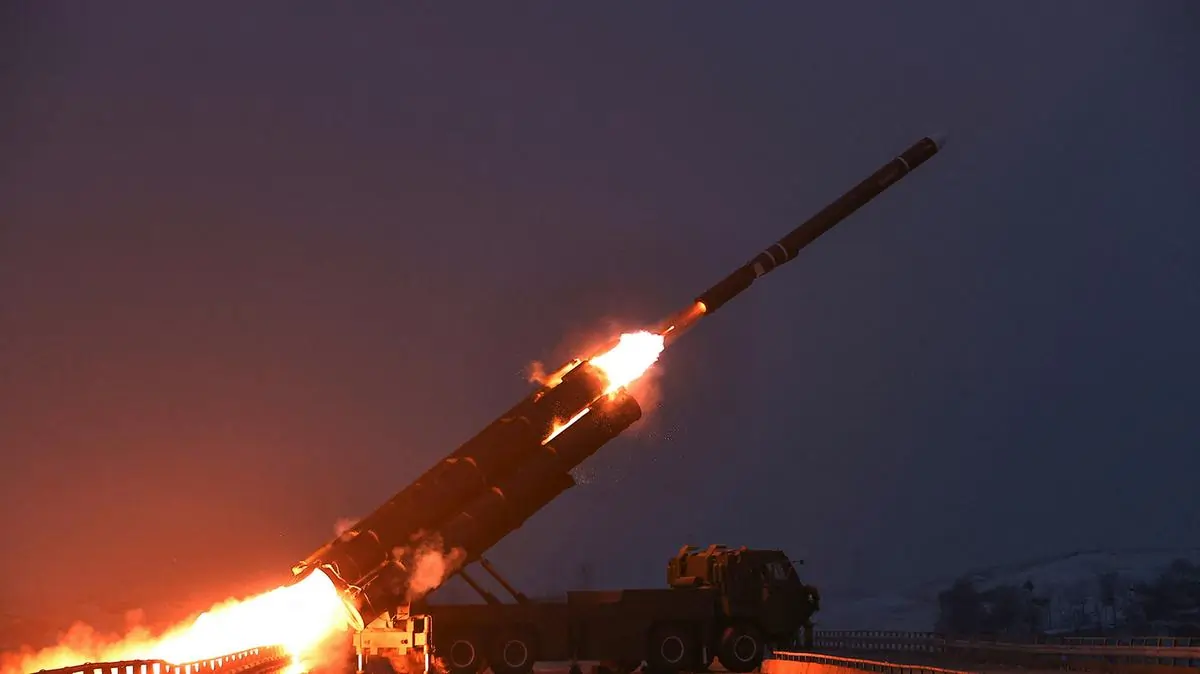
North Korea launched multiple ballistic missiles into the sea on Sunday morning, according to South Korea Joint Chiefs of Staff, in a move that has sharply heightened tensions on the Korean Peninsula just hours before Lee Jae Myung was scheduled to depart for China.





South Korea’s military said it detected several missile launches from the North Korean capital region at around 7:50 am local time. The missiles reportedly flew approximately 900 km, with authorities in Seoul, Washington, and Tokyo analysing their specifications and flight characteristics.
Japan Confirms Missile Activity
Japan Ministry of Defense also confirmed detecting a suspected ballistic missile launch. Japanese officials stated that two missiles reached altitudes of around 50 km and travelled distances of 900–950 km. No damage or casualties were reported.
Japan’s Defence Minister Shinjiro Koizumi condemned the launches, stating that North Korea’s nuclear and missile programmes pose a serious threat to regional and international peace and are “absolutely intolerable”.
Emergency Response in Seoul
Following the launches, South Korea’s National Security Council convened an emergency meeting. The South Korean presidential office described the missile tests as a provocative act in violation of United Nations Security Council resolutions, reaffirming Seoul’s readiness posture and close coordination with the United States and Japan.
The Joint Chiefs of Staff stressed that South Korea remains fully prepared to respond to any provocation and continues to maintain enhanced surveillance and deterrence measures.
Strategic Timing and Political Context
The missile launch came just hours before President Lee Jae Myung was due to leave for China for talks with Xi Jinping, where North Korea’s nuclear and missile programmes were expected to feature prominently on the agenda. Seoul hopes Beijing, Pyongyang’s key economic backer, can play a constructive role in easing tensions.
This was North Korea’s first ballistic missile launch since November, when Pyongyang conducted a test following approval by former US President Donald Trump for South Korea’s nuclear-powered submarine programme.
Push to Expand Missile Production
The launch also follows recent statements and actions by Kim Jong Un, who has ordered a major expansion of missile production. State media reported that Kim recently visited a facility producing tactical guided weapons and directed officials to increase production capacity by 250%, alongside building new factories to meet growing military demand.
North Korea is also preparing for a major Workers’ Party congress, its first in five years, where defence, military planning, and economic policy are expected to dominate discussions.
Regional Implications
Analysts believe the timing of the launch is intended to send a strong strategic signal amid shifting geopolitical dynamics and ongoing US–South Korea military cooperation. The latest missile tests further underscore persistent security challenges on the peninsula, keeping the region on high alert.