
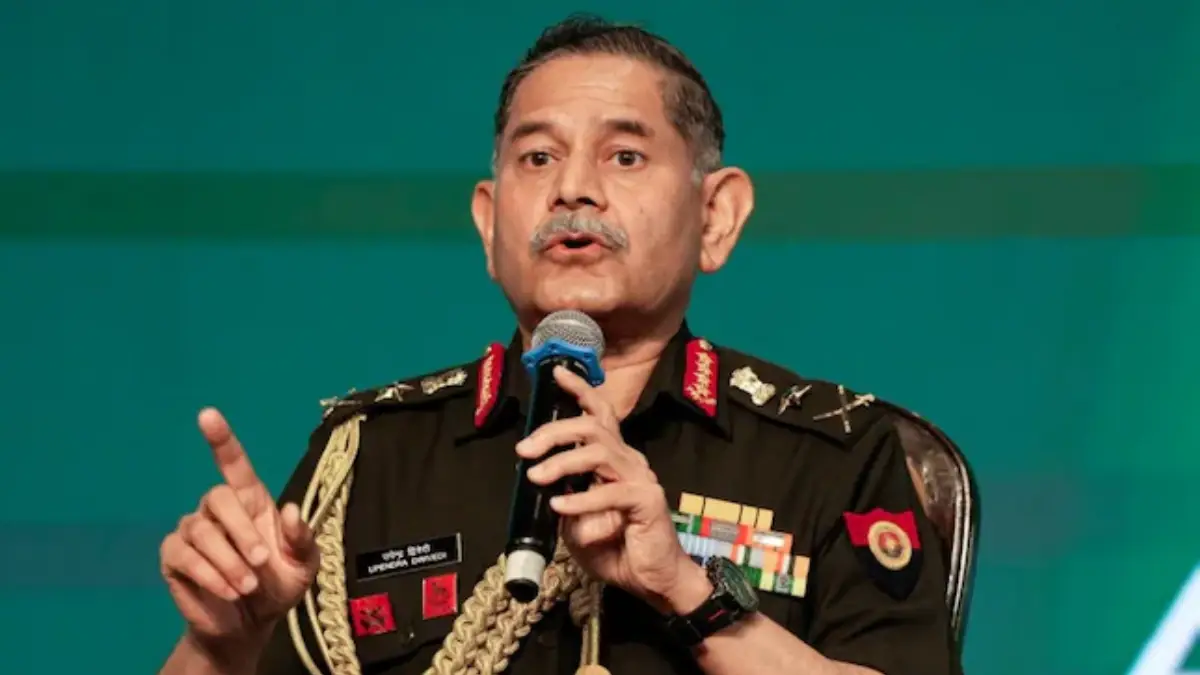
The Indian Army is fully prepared to induct women into infantry combat roles, provided there is broader societal acceptance and uniform standards are met, Chief of the Army Staff General Upendra Dwivedi said on Tuesday.


Addressing a media briefing, Gen Dwivedi underlined that the Army’s approach is rooted in gender neutrality, not special treatment. “Women should not be seen as a vulnerable commodity. If standards are the same, if capabilities are the same, and if society as a nation is ready to accept it, then combat roles can be opened tomorrow,” he said.
Phased, Data-Driven Approach
The Army Chief explained that expanding women’s roles would be a sequential process, guided by performance data and operational outcomes. The progression would begin with supporting arms, move to combat arms, and potentially extend to special forces in the long term—describing it as a “welcome social change.”
He acknowledged that while uniform standards are essential, medical and operational constraints remain challenges that must be addressed through rigorous evaluation and evidence-based decision-making.
Current Induction and Future Plans
Providing an update on women’s induction, Gen Dwivedi noted:
- Around 60 women Army cadets are currently training at the National Defence Academy (NDA), with about 20 inducted annually.
- The Officers’ Training Academy (OTA) at Chennai and Gaya inducts around 120 women officers per year.
- The Army has approximately 8,000 women officers at present.
- The Territorial Army has opened opportunities for women, with 110 vacancies planned.
On induction of women in Other Ranks (ORs), he said this would require amendments to Section 12 of the Army Act, adding that the Army is aiming for a 12-fold increase in women’s induction in ORs by 2032.
Modernisation for Future Warfare
Gen Dwivedi also highlighted the Army’s ongoing modernisation drive, shaped by lessons from contemporary conflicts. Key initiatives include:
- Raising dedicated drone regiments and expanding loitering munitions.
- Establishing a rocket-cum-missile force and enhancing counter-UAS capabilities.
- Inducting Bhairav battalions—13 raised so far—to bridge gaps between infantry platoons and special forces.
- Creating a Divyastra battery within artillery regiments to support divisional commanders.
- Achieving over 90% indigenisation in ammunition.
“After Operation Sindoor, drones received a major thrust,” he said, noting that each command can currently manufacture up to 5,000 drones, scalable to 20,000 or even one lakh depending on threat perception.
The Road Ahead
The Army Chief’s remarks signal a clear intent: women’s entry into infantry combat is a question of readiness, standards, and acceptance, not capability. As the Army modernises and society evolves, the pathway for women in frontline roles is being deliberately—and decisively—prepared.