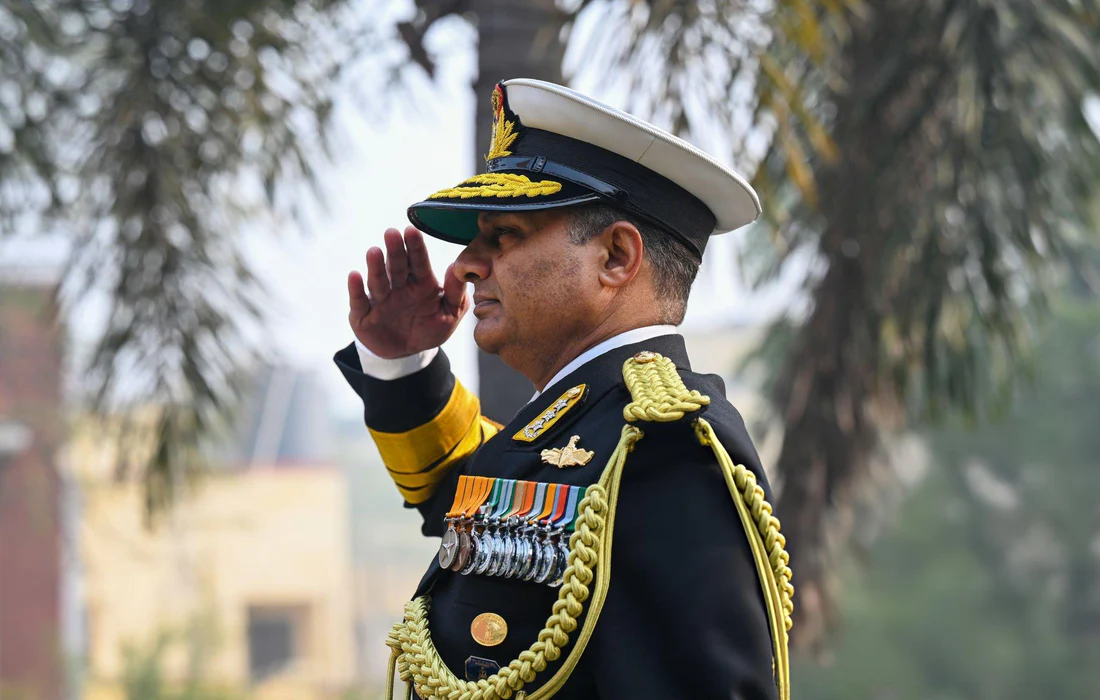
On 9 May 2026, the Government of India announced the appointment of Vice Admiral Krishna Swaminathan, PVSM, AVSM, VSM, as the next Chief of the Naval Staff. He will assume charge on 1 June 2026, succeeding Admiral Dinesh Kumar Tripathi, PVSM, AVSM, NM, who retires on 31 May 2026. Currently serving as the Flag Officer Commanding-in-Chief of the Western Naval Command—a role he assumed on 31 July 2025—Vice Admiral Swaminathan’s journey exemplifies disciplined service, intellectual rigour, and unwavering commitment to the Indian Navy. Here are five inspiring facts that illuminate his remarkable career and the values he embodies.





1. From a Teacher’s Home in Bangalore to the Pinnacle of Naval Leadership: The Transformative Power of Education
Born in Bangalore, Karnataka, to D. Swaminathan, a science teacher, and Shanta Swaminathan, also an educator, Vice Admiral Krishna Swaminathan grew up in modest circumstances in NR Colony, Basavanagudi. His early schooling at Bishop Cotton Boys’ School and Sainik School, Bijapur, instilled discipline and a passion for learning. He graduated from the National Defence Academy, Khadakvasla, and was commissioned into the Indian Navy on 1 July 1987.
What sets him apart is his relentless pursuit of knowledge alongside operational duties. He holds a BSc from Jawaharlal Nehru University, an MSc in Telecommunications from Cochin University of Science and Technology, an MA in Defence Studies from King’s College London, an MPhil in Strategic Studies, and a PhD in International Studies from Mumbai University. He further honed his strategic acumen at the Joint Services Command and Staff College in Shrivenham, United Kingdom, the College of Naval Warfare at Karanja, and the United States Naval War College in Newport, Rhode Island.
This blend of academic excellence and military training demonstrates that true leadership stems from continuous self-improvement—an inspiring reminder that intellectual depth strengthens operational effectiveness.
2. Mastering Communication and Electronic Warfare While Commanding India’s Most Powerful Warships
Specialising in Communication and Electronic Warfare—a domain critical to modern naval operations—Vice Admiral Swaminathan has commanded some of the Indian Navy’s most formidable platforms. His early commands included the missile vessels INS Vidyut and INS Vinash, followed by the missile corvette INS Kulish. He later took charge of the guided-missile destroyer INS Mysore, participating in the President’s Fleet Review in 2011 and the INDRA exercise with Russia in 2012.
The pinnacle of his seagoing command came on 2 November 2015, when he assumed command of the aircraft carrier INS Vikramaditya as its second Commanding Officer. Under his leadership, the carrier excelled during the International Fleet Review 2016 and was adjudged the Best Ship of the Western Fleet. These experiences forged a leader who understands both the technical intricacies of warfare and the human elements of command at sea.
His career illustrates that mastery of specialised skills, combined with hands-on leadership of capital ships, prepares officers for the highest responsibilities.
3. Pioneering Safety and Training Reforms That Strengthened the Entire Navy
As a flag officer, Vice Admiral Swaminathan made lasting contributions beyond operational commands. Promoted to Rear Admiral, he served as Chief Staff Officer (Training) at Headquarters, Southern Naval Command, Kochi, where he oversaw Navy-wide training programmes. He was instrumental in establishing the Indian Navy Safety Team (INST), which continues to enhance operational safety across all commands and platforms.
Later, as Flag Officer Sea Training (FOST) from 18 March 2019, he led the work-up organisation responsible for preparing ships and crews for high-intensity operations. These initiatives reflect a deep commitment to the welfare and readiness of personnel—a core value that has earned him widespread respect within the service.
His focus on safety and training underscores a leadership philosophy that prioritises people and preparedness over mere operational tempo.
4. A Merit-Based Ascent Through Every Tier of Naval Hierarchy
Vice Admiral Swaminathan’s rise through the ranks has been steady, merit-driven, and marked by increasing responsibility. After commanding INS Vikramaditya, he served as Principal Director Naval Signals and Naval Assistant to two successive Chiefs of the Naval Staff. Promoted to Vice Admiral on 4 November 2021, he served as Chief of Staff of the Western Naval Command, then assumed charge as Controller of Personnel Services on 17 April 2023 and Chief of Personnel on 6 October 2023.
On 1 May 2024, he became the 46th Vice Chief of the Naval Staff. Just over a year later, on 31 July 2025, he took command of the Western Naval Command. His appointment as Chief of the Naval Staff in May 2026 completes a remarkable trajectory achieved through consistent excellence rather than shortcuts.
This progression serves as powerful inspiration for young officers: sustained dedication, integrity, and performance lead to the highest offices in the nation’s defence forces.
5. Decorated Service and a Visionary Outlook on India’s Maritime Future
Vice Admiral Swaminathan’s distinguished service has been recognised with the nation’s highest peacetime awards: the Param Vishisht Seva Medal (26 January 2026), the Ati Vishisht Seva Medal (26 January 2021, for his command of the Western Fleet), and the Vishisht Seva Medal (2017). These honours reflect not only operational success but also exemplary leadership during critical periods, including fleet exercises and responses to natural calamities such as Cyclone Tauktae while serving as Flag Officer Defence Advisory Group.
Beyond medals, he has publicly articulated a forward-looking maritime vision. He advocates shifting India’s strategic mindset from a land-centric to a maritime-first perspective, emphasising the seas’ role in national security, trade, energy security, and global influence. His engagement with the Indian diaspora during deployments and his emphasis on naval diplomacy further highlight a holistic understanding of sea power in the 21st century.
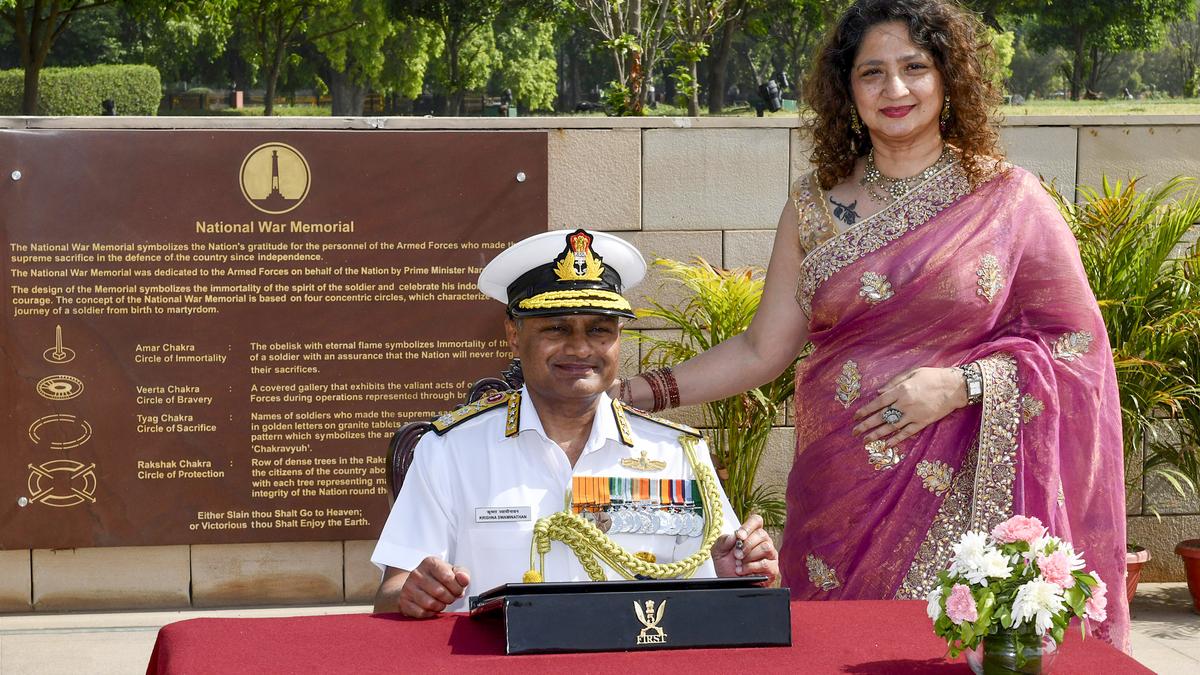
As he prepares to lead the Indian Navy, Vice Admiral Krishna Swaminathan stands as a living example of how humility, intellectual rigour, operational brilliance, and visionary thinking converge in one individual. His journey from a teacher’s son in Bangalore to India’s next Navy Chief inspires not only naval personnel but every Indian who believes in the power of disciplined service and lifelong learning. Under his stewardship, the Indian Navy is poised to strengthen its role as a net security provider in the Indo-Pacific and beyond.